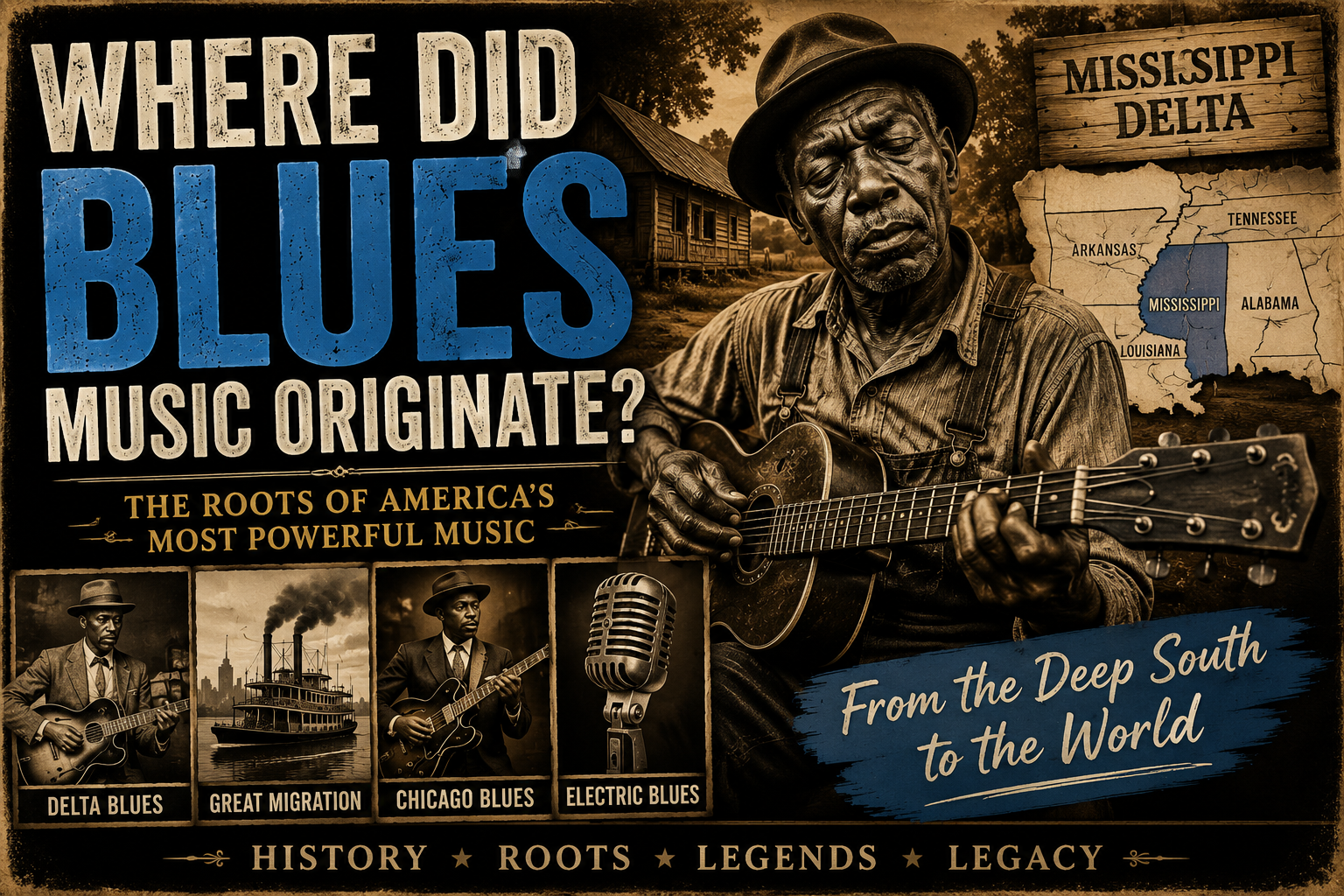

BluesMusica.com: Where did blues music originate? The answer is more complicated than naming a single city, plantation, or musician. The blues emerged from African American communities in the Southern United States during the late nineteenth and early twentieth centuries, developing from several musical traditions rather than being invented by one person.
Its roots can be traced through African musical traditions, spirituals, work songs, field hollers, ballads, and other forms of African American musical expression. Over time, these traditions evolved into a recognizable musical form that became known as the blues.
The story of the blues is therefore not simply the story of one place. It is the story of communities, migration, hardship, creativity, and musical traditions coming together in the American South.
Where Did the Blues Originate?
The blues originated primarily in the Southern United States, particularly among African American communities during the late nineteenth century and early twentieth century.
The Library of Congress describes the blues as a secular African American musical genre created and sung in the rural American South toward the end of the nineteenth century. Although there are no known recordings of blues songs from before the 1910s, historians generally recognize that a form identifiable as blues was already being performed by African American musicians in the South by the 1890s.
The exact birthplace cannot be identified with certainty because the early blues was largely an oral tradition. Musicians learned songs by hearing them, adapting them, changing verses, and developing their own styles.
The African Roots of the Blues
To understand the origins of blues music, we have to go back before the blues itself.
African musical traditions played an important role in the development of African American music in the United States. Musical characteristics such as call and response, expressive singing, rhythmic patterns, and certain approaches to improvisation have connections to African musical traditions.
Enslaved Africans and their descendants maintained elements of their musical heritage while also encountering European and American musical traditions.
Over generations, these different influences blended and produced new forms of African American music.
The Smithsonian Institution notes that African American musical traditions cannot be separated from the transatlantic slave trade and the forced movement of millions of Africans to the Americas. Music became one of the ways cultural traditions survived and evolved under extraordinary circumstances.
Spirituals, Work Songs and Field Hollers
Long before the blues became a recognizable commercial genre, African American communities were creating and performing many forms of music.
Among the important precursors were:
- Spirituals
- Work songs
- Field hollers
- Ring shouts
- Ballads
- Dance songs
- Country string-band traditions
Field hollers were especially important because they allowed individuals to express emotions, communicate, and sing in a highly personal style.
The Smithsonian Folkways educational materials identify field hollers and ring shouts among the early musical forms that help explain the roots of the blues.
These traditions did not suddenly become blues overnight. Instead, they contributed musical ideas that eventually became part of a developing blues language.
The Deep South and the Birth of the Blues
The American South became the environment in which the blues developed.
After the Civil War, African American communities in the South faced enormous economic and social challenges. The end of slavery did not bring equality. Reconstruction was followed by the expansion of Jim Crow laws, racial violence, and exploitative agricultural systems.
In this environment, music remained an important form of personal expression and community life.
The blues could communicate love, loneliness, work, travel, poverty, humor, desire, disappointment, and everyday experiences.
It was not simply music about sadness.
The Library of Congress specifically notes that blues songs address a wide range of topics and emotions, despite the common misconception that blues is exclusively about sorrow and protest.
Was the Mississippi Delta the Birthplace of the Blues?
The Mississippi Delta is one of the most important regions in blues history, but saying that the entire blues genre was invented there would be too simple.
The blues developed across several parts of the Southern United States, while the Mississippi Delta became one of its most famous centers.
The region became particularly important to the development of what we now call Delta Blues.
Smithsonian Folkways describes the Mississippi Delta as one of the regions where country blues developed, shaped by African American musical traditions including work songs, hollers, spirituals, ballads, and other forms.
So when people ask where the blues was born, the Mississippi Delta is certainly one of the most important answers—but it is not the only one.
Why Is the Mississippi Delta So Important?
The Mississippi Delta became an extraordinary environment for blues musicians.
Agricultural communities, juke joints, local gatherings, traveling musicians, and plantation communities created opportunities for music to circulate.
Musicians traveled between towns and communities, learning from one another and adapting songs as they went.
One famous location associated with this musical development is Dockery Farms in Mississippi.
Dockery became associated with several important blues musicians, including Charley Patton, Tommy Johnson, Willie Brown, Son House, and Robert Johnson. Smithsonian Magazine describes the plantation as an important base where blues musicians interacted and developed the country blues tradition.
Who Created the Blues?
There was no single person who created the blues.
This is one of the most important facts to understand about blues history.
The earliest blues musicians were part of communities in which music was passed from one performer to another. Many of those musicians were never recorded or documented.
That means the history of blues contains countless unknown musicians whose names have disappeared from the historical record.
Later musicians became famous because their performances were recorded, published, or promoted commercially.
That does not mean they invented the blues.
They helped develop, popularize, document, and transform a musical tradition that already existed.
When Did the Word “Blues” Appear?
The musical tradition developed before the modern blues recording industry existed.
The word “blues” gradually became associated with the musical form around the turn of the twentieth century.
Smithsonian educational material notes that African Americans were using the word “blues” to describe a state of mind as early as the 1860s, before it became firmly associated with a musical form.
By the early twentieth century, the term was increasingly being used for a recognizable type of song.
When Was Blues Music First Recorded?
The blues existed before recording technology documented it.
The first commercial blues recordings appeared in the early twentieth century.
One of the landmark moments came in 1920, when Mamie Smith recorded “Crazy Blues,” which became a major commercial success.
Recordings suddenly allowed blues music to reach audiences far beyond the communities where it had originally developed.
Recording technology therefore changed the history of the blues.
W. C. Handy and the Popularization of Blues
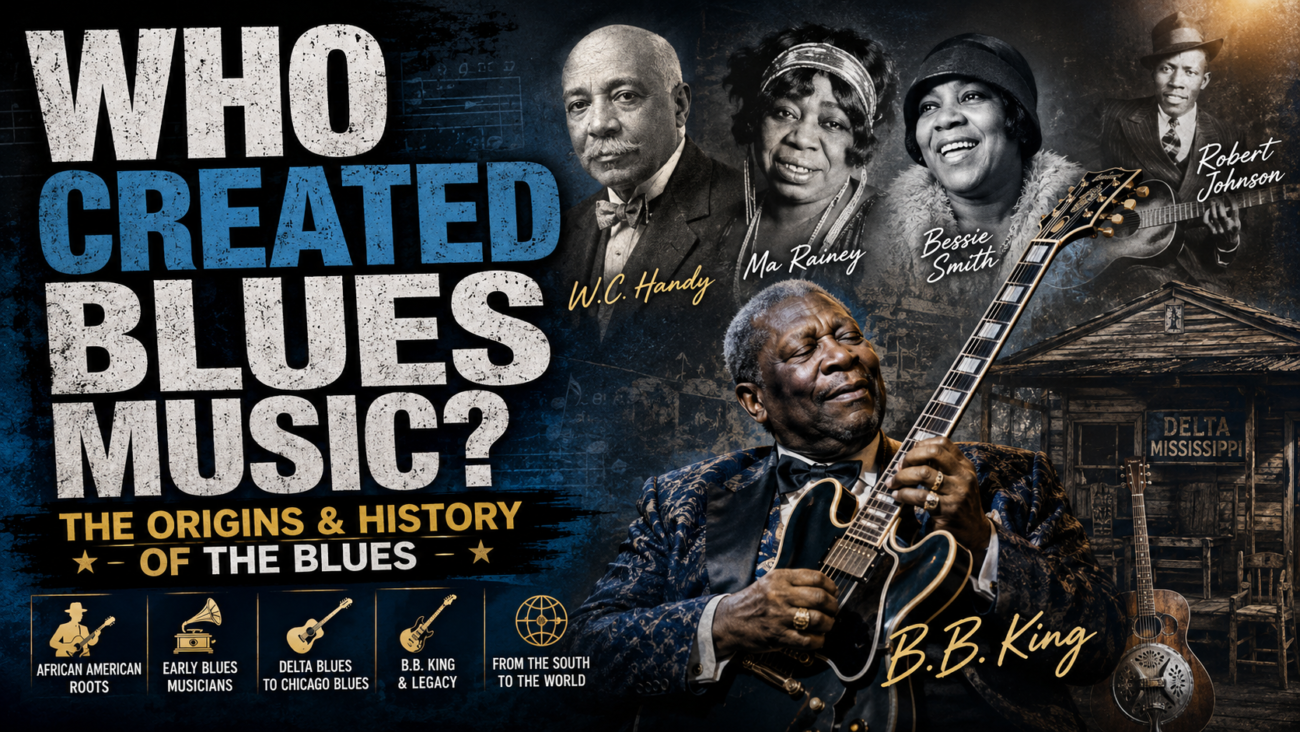
Although W. C. Handy did not invent the blues, he played an important role in bringing blues ideas into published music and mainstream American popular culture.
In 1912, Handy published “Memphis Blues”, helping introduce a blues-based composition to a much wider audience.
This is one reason Handy later became known as the “Father of the Blues.”
However, the title should not be interpreted literally.
The blues already existed among African American musicians before Handy’s compositions became popular.
His importance lies largely in documenting, arranging, publishing, and popularizing elements of a musical tradition that he encountered.
From Country Blues to Delta Blues
As blues musicians developed individual styles, different regional forms began to emerge.
Country Blues became a broad description for rural blues traditions, including Delta Blues and Piedmont Blues.
Delta Blues became particularly associated with Mississippi and the surrounding Southern region.
Its sound was often centered around acoustic guitar and voice, with slide guitar and distinctive rhythmic techniques playing important roles.
Read our full guide:
The Great Migration Changes the Blues
The history of blues music changed dramatically when African Americans migrated from the rural South to cities in the North and Midwest.
This movement became known as the Great Migration.
Musicians carried Southern musical traditions with them.
When they arrived in cities such as Chicago, the musical environment changed.
Musicians began using electric instruments and larger bands. Acoustic Southern blues traditions were transformed into powerful urban blues.
This development eventually helped create the sound we know as Chicago Blues.
Read our full guide:
From Chicago Blues to Rock Music
The development did not stop in Chicago.
Electric blues became an important influence on rhythm and blues, blues rock, and rock and roll.
Musicians in Britain and the United States studied recordings by American blues artists and incorporated blues guitar techniques, rhythms, structures, and vocal approaches into new forms of music.
String bending, blues scales, guitar riffs, call-and-response, and expressive improvisation became fundamental elements of modern guitar music.
The influence of the blues can therefore be heard far beyond the genre itself.
Why Is It Difficult to Name One Birthplace?
The biggest reason is simple: the early blues was not created in a recording studio.
It developed organically inside communities.
Musicians borrowed ideas from other musicians. Songs changed from one performer to another. Verses were rewritten. Melodies were adapted. Guitar techniques evolved.
There was no official moment when somebody could say:
“Today, I have invented the blues.”
Instead, the blues emerged gradually from African American musical traditions in the American South.
Mississippi, Louisiana, Texas and the Wider South
Although Mississippi is strongly associated with blues history, the development of blues music was not limited to Mississippi.
Early blues traditions emerged across different areas of the Southern United States, including regions of Texas, Louisiana, Georgia, and Mississippi.
Musicians traveled, migrated, and exchanged musical ideas.
This movement makes it difficult to draw a single geographic boundary around the birth of blues music.
The blues was a regional American musical development with many local variations.
The Blues Was Built by Communities
Perhaps the most important lesson in blues history is that the genre was built by communities rather than a single celebrity.
Thousands of African American musicians contributed to its development.
Some became famous.
Many did not.
The recordings that survived give us only a small window into a much larger musical world.
Behind famous names such as Robert Johnson, Son House, Charley Patton, Muddy Waters, and B.B. King were generations of musicians whose contributions helped create the musical vocabulary that later artists inherited.
Where Did Delta Blues and Chicago Blues Fit?
Think of blues history as an evolving musical journey.
African musical traditions
↓
African American spirituals, work songs, hollers and other traditions
↓
Early Southern blues
↓
Country Blues and Delta Blues
↓
Great Migration
↓
Chicago Blues and other urban blues styles
↓
Rhythm & Blues and Blues Rock
↓
Rock and modern popular music
This is not a perfectly linear timeline, because many styles developed simultaneously and influenced one another. But it helps illustrate how the blues continually evolved as musicians and communities moved and exchanged ideas.
Frequently Asked Questions
Where did blues music originate?
Blues music originated primarily in African American communities in the Southern United States during the late nineteenth and early twentieth centuries.
Was the blues invented in Mississippi?
Mississippi played an enormous role in blues history, particularly in the development of Delta Blues, but the broader blues tradition developed across multiple parts of the American South.
Who invented blues music?
No single person invented blues music. It developed gradually through African American musical traditions and the creativity of many musicians and communities.
Did the blues come from Africa?
The blues developed in the United States, but important characteristics of African American musical traditions have roots in African musical cultures. These traditions blended with musical forms encountered in North America over generations.
Did blues come from slavery?
The blues itself developed after slavery, but many musical traditions that contributed to its development—including spirituals, work songs, and other African American forms—have roots in the experiences and cultural traditions of enslaved Africans and their descendants.
Did Delta Blues come before Chicago Blues?
Traditional Southern and Delta Blues developed before the mature electric Chicago Blues style. Southern musicians later carried blues traditions north, where they evolved into urban electric forms.
Who is considered the Father of the Blues?
W. C. Handy is commonly called the “Father of the Blues” because of his role in publishing and popularizing blues-based music. However, he did not literally create the blues.
Conclusion
So, where did blues music originate?
The most accurate answer is the Southern United States, within African American communities during the late nineteenth and early twentieth centuries.
But the deeper story is much richer.
The blues emerged from generations of musical creativity, combining African musical traditions with spirituals, work songs, field hollers, ballads, and other forms of African American expression.
Mississippi became one of the most important centers of the tradition, particularly for Delta Blues. Later, the Great Migration carried Southern blues into cities such as Chicago, where musicians transformed it into powerful electric blues.
From there, the blues influenced rhythm and blues, rock and roll, blues rock, and generations of guitarists around the world.
The blues therefore does not belong to one musician or one city.
It belongs to a history of people, communities, movement, struggle, creativity, and musical expression.
BluesMusica.com: Explore the history of blues music, its legendary artists, regional styles, and the sounds that changed American music forever.
Next in our Blues History Roadmap: How Did Blues Music Develop?
where-did-blues-music-originate