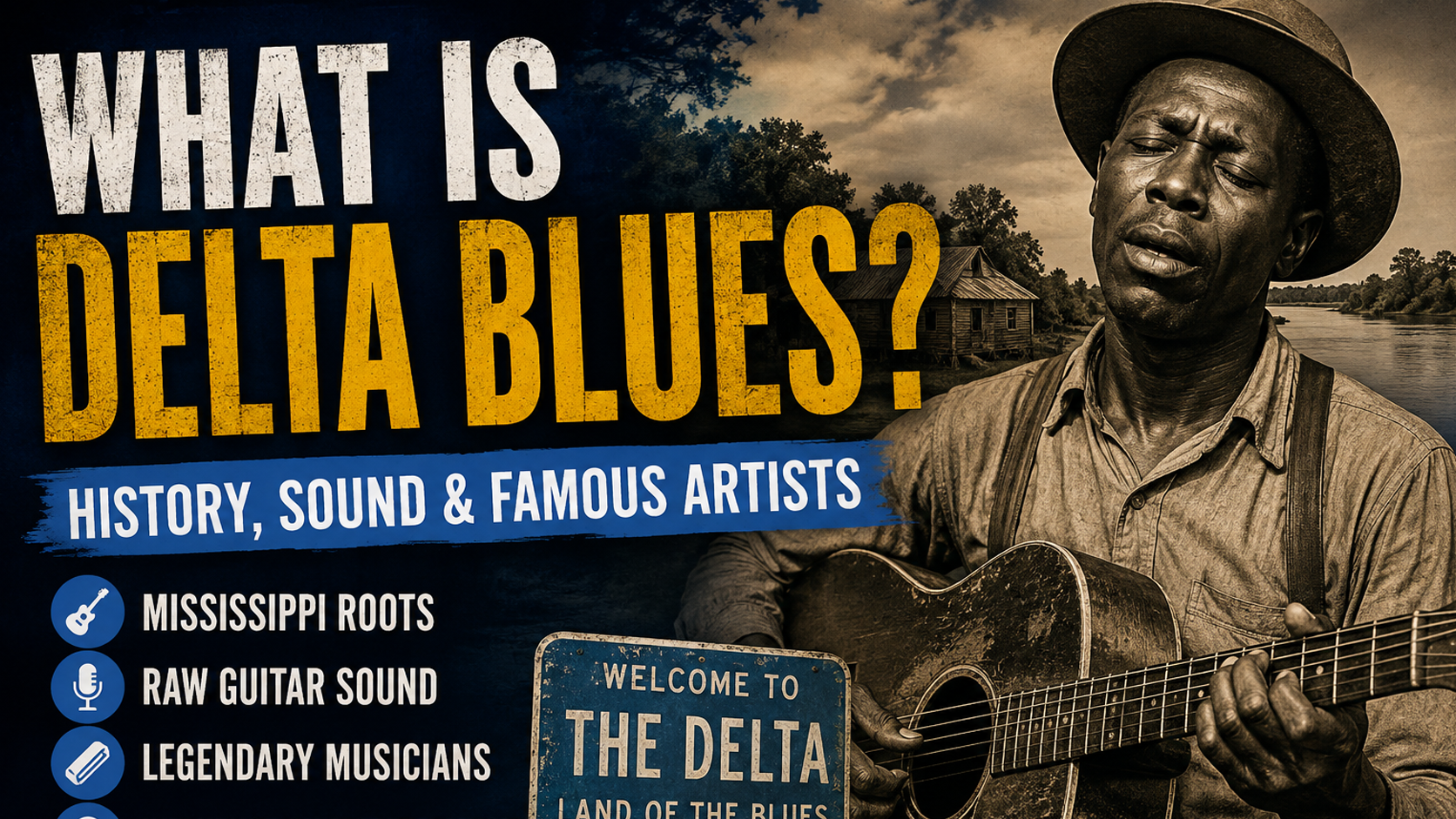

BluesMusica.com: What is Delta Blues? Delta Blues is one of the most influential forms of American blues music, developed in and around the Mississippi Delta. Known for its expressive vocals, powerful guitar playing, raw emotion, and strong connection to African American musical traditions, Delta Blues became a foundation for many later styles of blues, rock and roll, and popular music.
Unlike modern blues rock with large bands and amplified stages, early Delta Blues was often performed by a singer accompanying himself on acoustic guitar. Harmonica could also be part of the sound. The music was intimate, flexible, and deeply connected to everyday life in the American South.
The Library of Congress describes Delta Blues as a regional style of country blues originating in the Mississippi Delta, with acoustic guitar and solo vocals among its defining characteristics. :contentReference[oaicite:2]{index=2}
What Is Delta Blues?
Delta Blues is a style of country blues that developed in the Mississippi Delta region of the Southern United States.
The style is recognized for its raw guitar sound, expressive singing, improvisation, repeated blues phrases, and emotional storytelling.
Early Delta Blues musicians generally performed with relatively simple instrumentation. A singer might accompany himself with an acoustic guitar, while some musicians also used harmonica.
The result was a direct and personal musical style in which the voice and guitar often seemed to communicate with each other.
Where Did Delta Blues Originate?
Delta Blues originated in the Mississippi Delta, a historically important region of western Mississippi associated with cotton agriculture, African American communities, and the development of several important American musical traditions.
The term “Delta” can sometimes cause confusion because the Mississippi Delta is not simply the large river delta at the mouth of the Mississippi River. In blues history, the Mississippi Delta generally refers to the fertile region of western Mississippi between the Mississippi and Yazoo rivers.
The area became one of the most important cultural environments in the history of American blues.
Smithsonian Folkways describes the Mississippi Delta as a region where blues developed within a difficult social and economic environment following the Civil War and during the era of Reconstruction and Jim Crow. :contentReference[oaicite:3]{index=3}
When Did Delta Blues Begin?
There is no single year when Delta Blues was invented.
Like the broader blues tradition, Delta Blues developed gradually from African American musical traditions that included work songs, spirituals, field hollers, chants, folk music, and other forms of musical expression.
The broader blues tradition emerged during the late 19th and early 20th centuries. Delta Blues became recognizable as a regional style as musicians in Mississippi developed their own approaches to singing, guitar playing, rhythm, and storytelling.
The early recording industry later helped preserve and distribute the music beyond the Mississippi Delta.
The African American Roots of Delta Blues
Delta Blues cannot be separated from African American history in the American South.
After slavery ended, Black communities in the South continued developing musical traditions under difficult economic and social conditions.
Music provided a way to express work, faith, loneliness, relationships, hardship, travel, humor, anger, hope, and everyday experiences.
These experiences became part of the emotional vocabulary of the blues.
The Library of Congress notes that American blues developed from African American work songs, spirituals, and folk music. :contentReference[oaicite:4]{index=4}
How Work Songs Influenced Delta Blues
Work songs were an important part of African American musical life in the South.
Workers could use rhythm and repetition to accompany physical labor, communicate with one another, or simply make difficult work more bearable.
Call-and-response patterns and repeated vocal phrases later became important characteristics of blues music.
Although work songs were not Delta Blues themselves, they formed part of the musical environment from which the blues developed.
Field Hollers and the Delta Blues Voice
Field hollers were another important influence on the vocal style of early blues.
A field holler could be a highly individual vocal expression performed by a worker in the field or another isolated environment.
The singer could stretch notes, change pitch, repeat phrases, and use a highly emotional vocal delivery.
Many characteristics of this vocal tradition can still be heard in Delta Blues recordings.
What Does Delta Blues Sound Like?
So, what does Delta Blues sound like?
The classic Delta Blues sound is often raw, intimate, rhythmic, and highly expressive.
A typical performance might feature:
- Acoustic guitar
- Solo male or female vocals
- Harmonica
- Blues guitar riffs
- Slide guitar
- Repeated lyrical phrases
- Improvisation
- Call-and-response between voice and guitar
- Strong emotional expression
- Flexible rhythm and phrasing
Unlike highly arranged modern music, early Delta Blues could feel spontaneous and conversational.
The guitarist might answer a vocal line with a short guitar phrase, creating a musical conversation between the singer and instrument.
Delta Blues Guitar
The guitar is arguably the most recognizable instrument associated with traditional Delta Blues.
Players developed highly expressive techniques using bends, slides, hammer-ons, pull-offs, rhythmic patterns, and alternate tunings.
Some musicians played the guitar with a bottleneck or metal slide, creating a vocal-like sound that became strongly associated with Southern blues.
Delta Blues guitar does not always rely on complicated arrangements. Instead, the power often comes from timing, tone, rhythm, dynamics, and emotional expression.
Delta Blues Slide Guitar
Slide guitar became one of the defining sounds associated with many Delta Blues musicians.
A player places a smooth object such as a metal or glass slide against the guitar strings and moves it along the fretboard.
This creates smooth transitions between pitches and allows the guitar to imitate some characteristics of the human voice.
Slide guitar became an important part of the vocabulary of Southern blues and later influenced electric blues and rock guitar.
Open Tunings in Delta Blues
Many Delta Blues guitarists experimented with alternative and open tunings.
Open tunings allowed musicians to create strong chordal sounds and made certain slide guitar techniques easier to perform.
Different musicians developed different approaches, so there was never one single Delta Blues tuning.
The use of alternate tunings demonstrates how innovative early blues guitarists were despite often working with relatively simple instruments.
Who Were the First Delta Blues Musicians?
Because the early blues was primarily an oral tradition, it is impossible to create a complete list of the first Delta Blues musicians.
Many performers played before commercial recording technology documented their music.
However, several musicians became especially important during the early recording era.
Charley Patton
Charley Patton is widely regarded as one of the most important early figures in Delta Blues.
Patton’s music helped establish many of the guitar and vocal characteristics associated with early Mississippi Delta Blues.
His energetic performances and rhythmic guitar playing influenced generations of musicians who followed.
Patton was closely connected with the Dockery Plantation area, which became an important location in the history of Mississippi Delta music.
Son House
Son House became another major figure in Delta Blues.
His powerful voice and aggressive slide guitar style gave his performances an intense emotional quality.
House’s music was deeply connected to the Mississippi Delta and the African American experience in the South.
His recordings later became highly influential during the blues revival.
Smithsonian Folkways has preserved recordings and materials associated with Son House and other Mississippi Delta blues musicians. :contentReference[oaicite:5]{index=5}
Robert Johnson
Robert Johnson is probably the most famous name associated with Delta Blues.
Although his commercial recording career was brief, Johnson’s recordings became enormously influential among later blues and rock musicians.
His guitar playing combined rhythm, bass movement, chord changes, vocal phrasing, and intricate guitar responses in ways that made his performances sound remarkably complete for a solo musician.
Robert Johnson did not create Delta Blues. Instead, he became one of its most influential interpreters and helped define how later generations imagined the Mississippi Delta blues tradition.
The Smithsonian notes that Johnson’s later reputation became much larger than the limited attention he received when his records were originally released in the 1930s. :contentReference[oaicite:6]{index=6}
Tommy Johnson
Tommy Johnson was another influential Mississippi blues musician whose recordings became important documents of early Delta Blues.
He was known for his expressive voice, guitar playing, and distinctive musical style.
Tommy Johnson should not be confused with Robert Johnson. They were different musicians, although both became important figures in blues history.
Willie Brown
Willie Brown was an important Delta Blues guitarist and singer associated with musicians such as Charley Patton and Son House.
Although fewer recordings of Brown survive than those of some of his contemporaries, his influence within the Delta blues community was significant.
His name is particularly connected to the network of musicians who performed around the Mississippi Delta during the early blues era.
Skip James
Skip James developed a distinctive Mississippi blues style characterized by unusual guitar tunings, complex melodies, and a haunting vocal approach.
His music demonstrated how diverse Delta Blues could be.
James did not simply follow a standard blues formula. His unusual harmonies and guitar arrangements became an important part of his musical identity.
How the Great Migration Changed Delta Blues
The Great Migration transformed the history of Delta Blues.
During the 20th century, large numbers of African Americans moved from the rural South to cities such as Chicago, Detroit, Memphis, and St. Louis.
Musicians carried their musical traditions with them.
As they entered urban environments, blues musicians encountered new audiences, instruments, recording opportunities, and musical influences.
The acoustic Delta Blues tradition began interacting with electric instruments and larger bands.
The Library of Congress notes that Delta musicians later moved toward cities such as Memphis, Detroit, and Chicago, where their Delta-influenced sound helped develop electrified forms of blues. :contentReference[oaicite:7]{index=7}
From Delta Blues to Chicago Blues
One of the most important results of this migration was the development of electric Chicago Blues.
Musicians who had grown up with Southern blues traditions adapted their music to noisy urban environments.
Electric guitar, amplified harmonica, bass, and drums created a much larger sound than the traditional solo acoustic format.
Muddy Waters became one of the most important musicians in this transformation.
His music connected Mississippi Delta traditions with the powerful electric sound of Chicago Blues.
Explore our related article about Chicago Blues to learn more about this transition.
Delta Blues and B.B. King
The influence of Delta Blues also reached B.B. King, whose roots were in Mississippi.
King became one of the most influential electric blues guitarists in history, developing a highly expressive style based on vibrato, bending, phrasing, and emotional restraint.
The Library of Congress specifically notes that B.B. King, Muddy Waters, and John Lee Hooker were among musicians born in the Mississippi Delta region who helped develop and popularize blues during the 1950s. :contentReference[oaicite:8]{index=8}
His career demonstrates how the musical language of the Delta could evolve into a modern electric blues sound.
Delta Blues and Rock and Roll
Delta Blues became one of the foundations of rock and roll.
Rock musicians borrowed blues guitar riffs, chord progressions, vocal styles, rhythmic patterns, and song structures.
The influence eventually spread from American blues musicians to British rock artists and then throughout the world.
Guitar-driven rock music would be very different without the musical vocabulary developed by generations of blues musicians in the American South.
Delta Blues and Eric Clapton
Eric Clapton became one of the later musicians strongly influenced by American blues traditions.
Like many British blues musicians of the 1960s, Clapton studied recordings by American blues artists and incorporated their guitar vocabulary into blues rock.
His career represents another stage in the long journey of blues from the American South to international popular music.
Read our related article about Eric Clapton’s Blues Career Path.
Delta Blues vs Chicago Blues
| Feature | Delta Blues | Chicago Blues |
|---|---|---|
| Origin | Mississippi Delta | Chicago |
| Typical early format | Solo singer and guitar | Full electric band |
| Guitar | Often acoustic | Often electric |
| Harmonica | Common | Often amplified |
| Drums | Usually absent in solo performances | Common |
| Bass | Usually absent in solo performances | Common |
| Overall sound | Raw and intimate | Powerful and amplified |
These categories are useful for understanding the difference between the styles, although real blues performances have always been diverse and musicians frequently crossed stylistic boundaries.
Delta Blues vs Country Blues
Delta Blues is generally considered a regional form of country blues.
Country blues is a broader term covering several rural blues traditions from different parts of the United States.
Delta Blues specifically refers to the tradition associated with the Mississippi Delta and surrounding areas.
Other regional traditions developed their own sounds, including Piedmont Blues, Texas Blues, and other Southern styles.
Smithsonian Folkways describes country blues as rural Southern music often centered around expressive vocals with sparse instrumental accompaniment. :contentReference[oaicite:9]{index=9}
Why Is Delta Blues So Important?
Delta Blues is important because it represents one of the strongest foundations of modern blues music.
Its guitar techniques, vocal expression, rhythmic ideas, storytelling, and emotional directness influenced later blues musicians across the United States.
The influence did not stop with blues.
Delta Blues helped shape rock and roll, blues rock, rhythm and blues, soul, and modern guitar music.
The Library of Congress notes that genres including jazz and rock and roll owe part of their development to the influence of Delta Blues. :contentReference[oaicite:10]{index=10}
Why Does Delta Blues Sound So Emotional?
One of the defining characteristics of Delta Blues is emotional directness.
The singer often sounds as if he is speaking directly to the listener.
Guitar lines can answer vocal phrases, repeat emotional motifs, or suddenly change rhythm.
This combination creates a conversational quality that makes the music feel personal even many decades after the original recordings were made.
The Crossroads and Delta Blues Mythology
The Mississippi Delta became associated with many stories and legends about blues musicians.
One of the most famous is the story of a musician meeting the devil at a crossroads and exchanging his soul for extraordinary guitar ability.
The legend became strongly associated with Robert Johnson.
However, the historical evidence does not establish that Johnson literally made such a deal.
The crossroads story became part of the mythology surrounding blues and later appeared in films, books, songs, and popular culture.
It is important to distinguish the mythology from documented blues history.
Why Robert Johnson Became So Famous
Robert Johnson’s reputation grew dramatically after his death.
His original recordings attracted increasing attention during later blues revivals and among rock musicians who studied early American blues.
His guitar playing became associated with extraordinary technical ability and mysterious storytelling.
Modern listeners sometimes assume Johnson was the first Delta Blues musician, but the Delta tradition was already well established before his recordings.
Delta Blues During the Blues Revival
During the 1960s, renewed interest in traditional American blues introduced older musicians to new audiences.
Artists such as Son House and Mississippi Fred McDowell received renewed attention, while younger musicians in the United States and Britain studied recordings by earlier Delta Blues artists.
This revival helped preserve musical traditions that might otherwise have remained known only through historical recordings.
Is Delta Blues Still Popular Today?
Yes.
Delta Blues continues to influence modern blues musicians, guitarists, blues rock bands, and roots music performers.
Modern artists may use electric guitars, effects pedals, full drum kits, modern recording techniques, and contemporary production while retaining the musical language of the Delta.
The result is not always traditional Delta Blues, but the influence remains clearly audible.
Listen to Blues Inspired by the Delta Tradition
The Delta tradition continues to influence modern blues guitar and blues-based music. The following performance represents the continuing evolution of blues music from its traditional roots into contemporary listening.
Famous Delta Blues Musicians
- Charley Patton
- Son House
- Robert Johnson
- Tommy Johnson
- Willie Brown
- Skip James
- Bukka White
- Mississippi Fred McDowell
- David “Honeyboy” Edwards
- Muddy Waters
- B.B. King
These musicians represent different generations and approaches to Mississippi blues. Some were closely associated with the traditional Delta style, while others carried Delta traditions into electric blues and later forms.
Delta Blues Guitar Style
Delta Blues guitar is not one single technique.
Some musicians used fingerpicking, others used flatpicks, and others developed highly rhythmic approaches using the guitar as both a harmonic and percussive instrument.
Slide guitar became particularly important, while alternate tunings allowed musicians to create different harmonic textures.
The most important element was not technical complexity but expression.
A single guitar could provide rhythm, bass movement, harmony, melody, and response to the vocal.
Delta Blues and Modern Blues Guitar
Modern blues guitarists continue to study Delta Blues because it teaches fundamental musical skills.
Learning Delta Blues can help guitarists develop:
- Rhythmic timing
- Blues phrasing
- Improvisation
- Call-and-response technique
- Slide guitar
- Blues bends
- Dynamic control
- Musical storytelling
Many modern electric blues guitarists combine these traditional techniques with amplification, effects, and modern production.
Delta Blues and the Blues Highway
U.S. Highway 61 is often associated with the history of Mississippi Delta Blues and is commonly known as the Blues Highway in the region.
The route connects many locations associated with the development and spread of blues music.
For music historians and blues fans, the Mississippi Delta remains an important destination for exploring the cultural landscape that produced some of America’s most influential music.
The Library of Congress identifies Highway 61 as a major route through the Yazoo-Mississippi River Delta and documents the region’s rich African American musical history. :contentReference[oaicite:11]{index=11}
Delta Blues History Timeline
- Late 1800s: African American musical traditions continue developing throughout the Southern United States.
- Early 1900s: Regional blues styles begin becoming more recognizable.
- 1910s–1920s: Early blues musicians begin appearing in commercial recordings.
- 1920s–1930s: Charley Patton, Tommy Johnson, Robert Johnson, Son House, and other musicians help establish recorded Delta Blues.
- 1930s–1940s: African American migration carries Delta musical traditions into major American cities.
- 1940s–1950s: Electric blues develops in cities including Chicago.
- 1950s: Muddy Waters and B.B. King become major figures in electric blues.
- 1960s: The blues revival introduces earlier Delta musicians to new audiences.
- 1960s–1970s: British and American rock musicians bring blues influences into rock music.
- Today: Delta Blues continues influencing blues, blues rock, roots music, and guitarists worldwide.
Frequently Asked Questions About Delta Blues
What is Delta Blues?
Delta Blues is a regional form of country blues that developed in the Mississippi Delta. It is commonly associated with expressive vocals, acoustic guitar, slide guitar, harmonica, improvisation, and personal storytelling.
Where did Delta Blues originate?
Delta Blues originated in the Mississippi Delta region of western Mississippi in the Southern United States.
Who created Delta Blues?
Delta Blues was not created by one person. It developed gradually within African American communities through generations of musical traditions and individual musicians.
Who is the most famous Delta Blues musician?
Robert Johnson is perhaps the most internationally famous Delta Blues musician, although Charley Patton, Son House, Tommy Johnson, Skip James, and many others were also highly influential.
Is Robert Johnson the Father of Delta Blues?
Robert Johnson is one of the most influential Delta Blues musicians, but he did not create the genre. Delta Blues existed before his recordings in the 1930s.
What instruments are used in Delta Blues?
Traditional Delta Blues often uses acoustic guitar and vocals, with harmonica appearing in some performances. Slide guitar is also strongly associated with the style.
Is Delta Blues acoustic or electric?
Early Delta Blues is strongly associated with acoustic instruments, particularly acoustic guitar. Later musicians carried Delta traditions into electric blues using amplified guitars and full bands.
What is the difference between Delta Blues and Chicago Blues?
Delta Blues is a rural Southern tradition strongly associated with acoustic guitar and solo performances, while Chicago Blues developed an amplified urban sound featuring electric guitar, harmonica, bass, drums, and larger ensembles.
Did Delta Blues influence rock and roll?
Yes. Delta Blues influenced later blues styles and became part of the musical foundation that shaped rock and roll and blues rock.
Is Delta Blues still played today?
Yes. Modern blues musicians continue using Delta Blues guitar techniques, rhythms, vocal phrasing, slide guitar, and storytelling in contemporary music.
Explore More Blues History
If you want to continue exploring the history of blues, check out these related BluesMusica.com articles:
- Who Created Blues Music?
- What Is Chicago Blues?
- Eric Clapton Blues Career Path
- Modern Blues Rock Songs
- Best Heavy Blues Songs
Conclusion
Delta Blues is one of the most important regional traditions in the history of American blues music.
Developed in the Mississippi Delta within African American communities, the style transformed personal experiences, Southern musical traditions, guitar innovation, and storytelling into a powerful form of music.
Musicians such as Charley Patton, Son House, Robert Johnson, Tommy Johnson, Skip James, and many others helped establish the Delta tradition. Later artists including Muddy Waters and B.B. King carried elements of that musical language into electric blues.
The influence continued into blues rock, rock and roll, soul, and modern guitar music.
Understanding what Delta Blues is therefore means understanding more than a guitar style. It means understanding an important part of the cultural and musical history of the American South.
BluesMusica.com — Exploring the history, artists, sounds and continuing legacy of blues music.
blues historycal delta blues rtists