
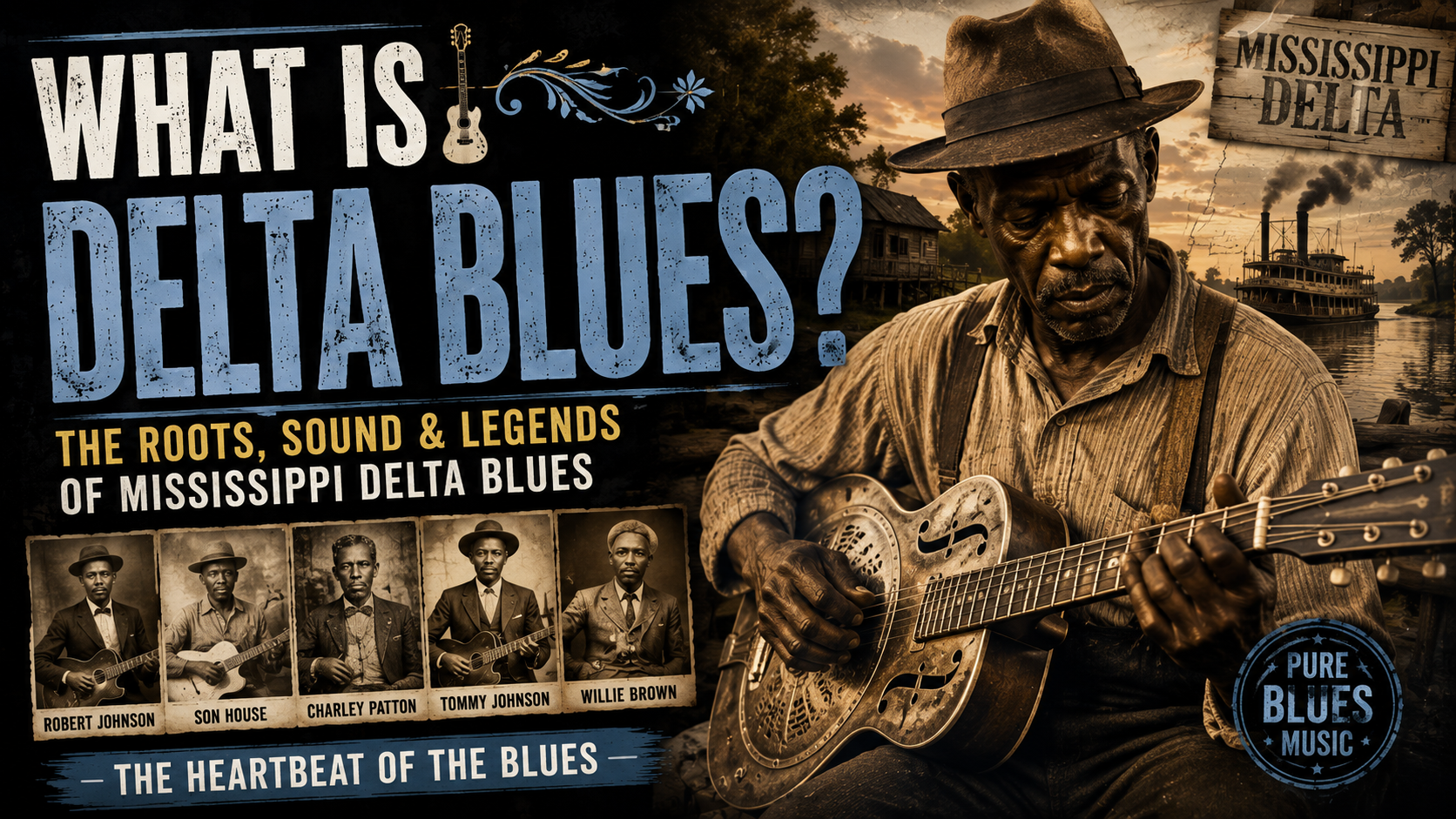

BluesMusica.com: What is Delta Blues? Delta Blues is one of the most influential styles in the history of blues music. Developed in the Mississippi Delta and surrounding areas of the American South, the style is known for its powerful vocals, expressive guitar playing, raw emotional character, and deeply personal storytelling.
Although Delta Blues is often associated with a single region, its influence eventually traveled far beyond the Mississippi Delta. Its guitar techniques, rhythms, vocal approaches, and songwriting became part of the foundation for Chicago Blues, electric blues, blues rock, and many other forms of modern music.
To understand Delta Blues is to understand one of the most important chapters in the history of American blues.
What Is Delta Blues?
Delta Blues is a traditional style of blues music associated primarily with the Mississippi Delta region.
The music developed among African American communities in the American South during the late 19th and early 20th centuries. Much of its early history was passed down through live performance and oral tradition, which means many of the musicians who helped shape the genre were never formally documented.
Delta Blues is particularly famous for its stripped-down sound. A singer might perform with an acoustic guitar, sometimes accompanied by harmonica, percussion, or another musician.
The result can sound simple on the surface, but the emotional intensity is often extraordinary.
Where Did Delta Blues Come From?
Delta Blues is strongly associated with the Mississippi Delta, a region located between the Mississippi and Yazoo Rivers in Mississippi.
The area became one of the most important environments for the development of blues music.
African American communities in the region developed musical traditions influenced by work songs, field hollers, spirituals, African American folk music, and other Southern musical forms.
These traditions gradually evolved into different forms of blues.
Delta Blues became one of the most recognizable of these regional styles.
Why Is It Called Delta Blues?
The name comes from the geographic region with which the music became closely associated.
The Mississippi Delta had a major agricultural economy, particularly cotton farming, and large African American communities lived and worked throughout the region.
Musicians traveled between towns, plantations, juke joints, streets, and other gathering places, spreading musical ideas from one community to another.
Because so much important early blues activity occurred in this area, the term Delta Blues eventually became associated with this distinctive musical tradition.
What Does Delta Blues Sound Like?
Delta Blues often has a raw and intimate sound.
Compared with later electric blues styles, early Delta Blues could be remarkably sparse. A single guitar and voice could be enough to create an entire musical atmosphere.
Common characteristics include:
- Acoustic guitar
- Slide guitar
- Expressive vocal delivery
- Call-and-response phrases
- Blues-based chord structures
- Repeated musical patterns
- Improvisation
- Strong rhythmic guitar playing
- Personal storytelling
- Raw and emotional performances
The guitar frequently acts almost like a second voice.
A musician can answer a vocal phrase with a guitar lick, bend a note to imitate the human voice, or use a slide to create a vocal-like cry.
Delta Blues Guitar
The guitar is one of the defining elements of Delta Blues.
Early Delta Blues guitarists developed techniques that would later influence generations of blues and rock guitar players.
One of the most recognizable techniques is slide guitar.
A musician places a smooth object, traditionally a piece of glass, metal, or another hard material, against the guitar strings and moves it along the fretboard.
This creates a smooth, vocal-like sound that can make the guitar cry, moan, or sing.
Delta Blues guitarists also used:
- Fingerpicking
- Open tunings
- Alternate tunings
- Hammer-ons and pull-offs
- String bending
- Vibrato
- Walking bass patterns
- Repeated guitar riffs
These techniques became fundamental vocabulary for later blues guitarists.
Delta Blues and the Human Voice
One reason Delta Blues can feel so powerful is the relationship between the voice and guitar.
The guitar does not simply provide background accompaniment.
It often responds directly to the singer.
A vocal line might be followed by a short guitar phrase. The singer pauses, and the guitar answers.
This creates a musical conversation.
This call-and-response approach has deep roots in African American musical traditions and became an important characteristic of blues performance.
What Instruments Are Used in Delta Blues?
Early Delta Blues was often performed with very few instruments.
The most important was the guitar.
Depending on the musician and setting, other instruments could include:
- Harmonica
- Second guitar
- Fiddle
- Simple percussion
- Drums in later arrangements
However, the classic image of Delta Blues is often a single musician with an acoustic guitar.
This minimal instrumentation gives the music an intimate quality that remains one of its greatest attractions.
Famous Delta Blues Artists
Several legendary musicians became closely associated with the Delta Blues tradition.
Robert Johnson
Robert Johnson is perhaps the most famous name associated with Delta Blues.
His recordings from the 1930s demonstrated remarkable guitar technique, complex rhythm, expressive vocals, and sophisticated songwriting.
Although his recorded output was relatively small, his influence became enormous after his death.
Johnson later became one of the most influential figures in blues and rock history.
Son House
Son House was known for an extremely powerful vocal style and intense guitar playing.
His performances demonstrated the emotional force that could be achieved with little more than voice and guitar.
His music became an important part of the Delta Blues legacy.
Charley Patton
Charley Patton is often regarded as one of the foundational figures of Delta Blues.
His aggressive guitar style, rhythmic approach, and powerful performance techniques influenced many musicians who followed him.
Willie Brown
Willie Brown was another important Delta Blues musician associated with the early Mississippi Delta tradition.
Although less commercially documented than some later blues stars, Brown’s influence on the Delta blues community was significant.
Tommy Johnson
Tommy Johnson became known for his distinctive guitar playing and haunting vocal style.
His recordings are an important part of the surviving musical history of early Mississippi blues.
Robert Johnson and the Delta Blues
Robert Johnson deserves special attention because his music demonstrates how sophisticated Delta Blues could become.
His guitar playing combined bass movement, rhythm, melody, and vocal accompaniment in ways that created the impression of several instruments being played simultaneously.
His recordings also show how blues musicians could transform traditional musical ideas into highly personal compositions.
Johnson’s legacy eventually reached blues-rock artists and guitarists around the world.
Delta Blues and the Blues Tradition
Delta Blues should not be considered the beginning of all blues music.
Blues developed through multiple African American musical traditions and regional styles.
The history of blues is therefore much broader than the Mississippi Delta alone.
However, the Delta became one of the most important centers for the development of the acoustic blues sound that later generations would associate with traditional blues.
For a broader look at the origins of blues music, read:
And for the person traditionally known as the Father of the Blues:
Who Is the Father of the Blues?
Delta Blues vs. Chicago Blues
One of the most important developments in blues history occurred when musicians from the American South moved to Northern cities.
During the Great Migration, many African Americans moved from Southern states to cities including Chicago.
Musicians brought Southern musical traditions with them.
In Chicago, these traditions evolved into a louder, amplified form of blues.
This became known as Chicago Blues.
While Delta Blues was often associated with acoustic guitar and intimate performances, Chicago Blues increasingly featured:
- Electric guitar
- Amplified harmonica
- Bass
- Drums
- Piano
The musical connection between the two styles is extremely important.
Delta Blues helped provide part of the musical vocabulary that later musicians transformed into electric urban blues.
Read more:
How Delta Blues Influenced Rock Music
The influence of Delta Blues eventually spread far beyond traditional blues.
British and American rock musicians discovered recordings by early blues artists and incorporated their guitar techniques, melodies, rhythms, and songwriting approaches into rock music.
Blues-based guitar became one of the foundations of blues rock and classic rock.
Techniques such as string bending, slide guitar, pentatonic phrases, and call-and-response guitar playing became essential parts of rock guitar vocabulary.
Without the influence of early blues traditions, the history of modern guitar music would look very different.
Why Does Delta Blues Still Matter?
Delta Blues remains important because it represents one of the clearest examples of how a relatively simple musical setup can produce enormous emotional impact.
A singer and guitarist can tell a complete story without a large band or sophisticated production.
The music is built around feeling, rhythm, phrasing, storytelling, and personality.
That simplicity is one reason Delta Blues continues to inspire modern musicians.
Is Delta Blues Still Played Today?
Yes.
Modern musicians continue to perform Delta Blues, both in traditional acoustic arrangements and in contemporary interpretations.
Some artists attempt to preserve the original style, while others combine Delta Blues techniques with electric blues, rock, folk, Americana, and modern blues production.
The sound has changed, but the musical vocabulary remains alive.
What Makes Delta Blues Different?
The biggest difference is its combination of simplicity and emotional intensity.
Delta Blues does not require a large arrangement to create atmosphere.
The voice, guitar, rhythm, and lyrics can work together to create an incredibly personal musical experience.
That is why a century-old blues recording can still feel emotionally relevant to a listener today.
Frequently Asked Questions
What is Delta Blues?
Delta Blues is a traditional style of blues associated primarily with the Mississippi Delta and surrounding areas of the American South.
Where did Delta Blues originate?
Delta Blues developed primarily in the Mississippi Delta region of the American South through African American musical traditions.
Who is the most famous Delta Blues musician?
Robert Johnson is one of the most famous musicians associated with Delta Blues, although many other important artists helped develop the tradition.
What instrument is most associated with Delta Blues?
The acoustic guitar is perhaps the instrument most strongly associated with traditional Delta Blues, particularly slide guitar and fingerstyle playing.
Is Delta Blues the same as Chicago Blues?
No. Delta Blues and Chicago Blues are different styles, although they are closely connected historically. Southern blues traditions helped influence the development of electric Chicago Blues.
Did Delta Blues come before Chicago Blues?
Traditional Delta Blues developed before the mature electric Chicago Blues style. Southern musicians later carried blues traditions north, where they evolved into urban electric styles.
Conclusion
Delta Blues is one of the most important roots of modern blues music.
Born from African American musical traditions in the Mississippi Delta and surrounding Southern communities, it developed a distinctive sound built around expressive vocals, acoustic guitar, slide guitar, rhythm, and storytelling.
Musicians such as Charley Patton, Son House, Tommy Johnson, Willie Brown, and Robert Johnson helped establish a musical tradition whose influence would eventually reach Chicago Blues, electric blues, blues rock, and modern guitar music.
Delta Blues proves that great music does not require complicated production.
Sometimes all it takes is a voice, a guitar, and a story.
BluesMusica.com: Continue exploring the history, artists, styles, and sounds that shaped blues music.


