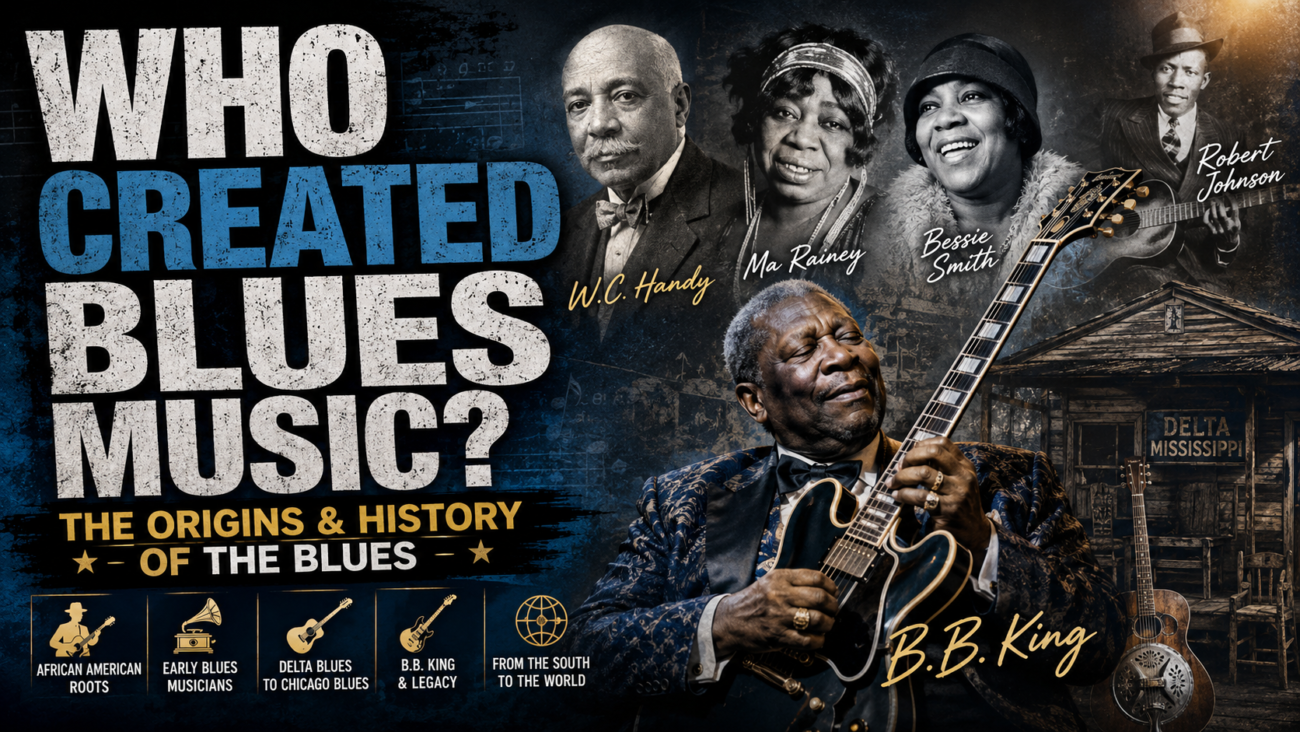
BluesMusica.com: Who is the Father of the Blues? The title is most commonly associated with W. C. Handy, the influential African American composer, bandleader, arranger, and music publisher who helped bring blues music from regional Southern traditions into the American popular music industry.
But there is an important distinction. W. C. Handy did not invent the blues, and he was not the first person to perform it. Blues music existed in African American communities before Handy published his famous compositions. His importance came from recognizing, arranging, documenting, publishing, and popularizing musical ideas that already existed in the American South.
The Smithsonian identifies W. C. Handy as the “Father of the Blues” and notes that his work helped bring this African American musical tradition to wider audiences and the music industry. :contentReference[oaicite:1]{index=1}
Who Is the Father of the Blues?
W. C. Handy, whose full name was William Christopher Handy, is widely known as the Father of the Blues.
Handy was born on November 16, 1873, in Florence, Alabama. He became a composer, musician, bandleader, arranger, and publisher whose career had a major impact on the development and popularization of blues music.
According to the Smithsonian’s W. C. Handy collection, Handy is known as the Father of the Blues because he collected and wrote down musical material that had been performed by working people and sharecroppers, helping give the blues a more formal presence in published American music. :contentReference[oaicite:2]{index=2}
His best-known compositions include “Memphis Blues” and “St. Louis Blues.”
Did W. C. Handy Invent the Blues?
No.
This is one of the most important points to understand when studying the history of blues music.
The blues developed from African American musical traditions in the American South long before W. C. Handy became famous. These traditions included field hollers, work songs, spirituals, ballads, and other forms of musical expression.
The exact origin of the blues cannot be attributed to one person. Smithsonian educational material explains that the roots of blues are difficult to trace to a single creator and are generally understood as a synthesis of several African American musical traditions in the rural Deep South. :contentReference[oaicite:3]{index=3}
So why is Handy called the Father of the Blues?
Because he played a crucial role in bringing the blues into written, published, commercial music.
Why Is W. C. Handy Called the Father of the Blues?
Handy’s importance comes from his ability to recognize musical ideas that were already being performed in African American communities and transform them into compositions that could be published, performed by bands, recorded, and distributed to a much wider audience.
Smithsonian describes Handy as an influential blues songwriter who helped give blues a contemporary form and move it from a regional musical tradition toward a major force in American music. :contentReference[oaicite:4]{index=4}
In other words, Handy helped create a bridge between traditional Southern blues and the commercial American music industry.
W. C. Handy and the Early Blues
Handy encountered blues musicians and African American musical traditions while traveling and performing throughout the South.
As a young musician, he became familiar with musical styles that were very different from the formal European musical education he had received.
These experiences influenced the way he composed and arranged music.
Rather than treating the blues as insignificant folk music, Handy recognized that its melodies, rhythms, emotional expression, and storytelling could be transformed into compositions that could reach a much larger audience.
Memphis Blues
One of W. C. Handy’s most important compositions was “Memphis Blues.”
Published in 1912, the composition became a landmark in the early commercial history of blues.
The Smithsonian identifies 1912 as the year Handy became known as the “Father of the Blues” through “Memphis Blues.” :contentReference[oaicite:5]{index=5}
“Memphis Blues” helped introduce blues-related musical ideas to audiences who may never have encountered the music in its original Southern community settings.
This was a major turning point.
The blues was moving from local performance traditions toward printed music and the national entertainment industry.
St. Louis Blues
Another major W. C. Handy composition was “St. Louis Blues.”
Published in 1914, the song became one of the most famous compositions associated with Handy.
It demonstrated his ability to combine blues elements with other popular musical traditions of the period.
The song eventually became an American musical standard and was performed and recorded in many different arrangements.
Handy’s legacy is therefore much larger than a single song. His compositions helped establish blues as a recognizable and commercially successful musical form.
W. C. Handy’s Role in Popularizing Blues
Before Handy’s success, many blues performers were unknown outside their local communities.
Much of the music existed through oral tradition and live performance.
Handy helped change that.
By writing and publishing compositions inspired by blues traditions, he gave the music a form that could circulate through sheet music, bands, performers, and commercial publishers.
The National Postal Museum notes that Handy believed the music of poor rural African Americans in the Mississippi Delta was worth documenting and arranging, and identifies him as the Father of the Blues. :contentReference[oaicite:6]{index=6}
Was W. C. Handy the First Person to Write Blues Music?
Not exactly.
Handy is sometimes described as the first person to write blues music, but that wording can be misleading.
Blues musicians were already creating and performing blues before Handy published his compositions.
Handy’s historical importance is that he was among the earliest major composers to document, arrange, publish, and commercialize blues-inspired music for a national audience.
That distinction is extremely important when discussing the origins of blues.
Where Did the Blues Really Come From?
The blues emerged from African American communities in the American South.
Its development was gradual rather than the invention of one individual.
Several musical traditions contributed to the evolution of blues, including:
- Field hollers
- Work songs
- Spirituals
- African American folk traditions
- Ballads
- Call-and-response singing
- Southern dance music
- Early guitar traditions
Smithsonian educational resources describe the blues as a synthesis of field hollers and rural Deep South ballads, while noting that the precise origins remain difficult to identify. :contentReference[oaicite:7]{index=7}
That means the blues should be understood as a cultural and musical evolution, not as a single invention.
The Mississippi Delta and the Blues
The Mississippi Delta became one of the most important regions in blues history.
Musicians developed distinctive guitar techniques, vocal styles, rhythms, and lyrical approaches that later became associated with Delta Blues.
Many musicians traveled throughout the South, carrying these musical ideas from one community to another.
Eventually, some of these musicians moved north during the Great Migration, helping transform the blues into new urban styles such as Chicago Blues.
Read our related article:
W. C. Handy and the Development of American Music
Handy’s influence extended beyond blues.
His compositions helped establish connections between blues, ragtime, popular music, marching-band traditions, and later developments in American music.
His career demonstrated that African American musical traditions could become an important part of the national music industry.
His influence eventually reached generations of composers, performers, jazz musicians, blues artists, and popular musicians.
W. C. Handy and Beale Street
Memphis played a major role in Handy’s career.
He established his musical career in Memphis and became closely associated with the city’s developing African American music culture.
Beale Street became an important center of entertainment and African American music, and Handy’s name became deeply connected with Memphis’s blues identity.
His compositions helped strengthen the city’s reputation as one of the important homes of American blues.
W. C. Handy’s Autobiography: Father of the Blues
Handy’s legacy is also preserved through his autobiography, Father of the Blues.
The book was originally published in 1941 and documents his life, musical experiences, career, and observations about the development of blues music.
The Smithsonian Libraries and Archives holds editions of Father of the Blues and identifies W. C. Handy as its author. :contentReference[oaicite:8]{index=8}
The autobiography itself became an important historical source for understanding Handy’s life and his perspective on blues music.
W. C. Handy’s Most Important Blues Compositions
Some of the compositions most closely associated with W. C. Handy include:
- Memphis Blues
- St. Louis Blues
- Beale Street Blues
- Yellow Dog Blues
- Chantez-Les-Bas
These compositions helped establish Handy as one of the most important early composers associated with the commercial development of blues.
W. C. Handy vs. the Blues Musicians Who Came Before Him
It is useful to separate two different parts of blues history.
Traditional blues musicians developed and performed the music in African American communities.
W. C. Handy helped document, arrange, publish, and popularize those musical ideas.
Without the earlier generations of unknown singers and musicians, there would have been no blues tradition for Handy to study and adapt.
At the same time, without figures such as Handy, the blues might have taken longer to enter the mainstream American publishing and entertainment industries.
Who Created the Blues?
There is no single person who can accurately be called the creator of the blues.
The music developed collectively through generations of African American musicians and communities in the American South.
That is why the question “Who created blues music?” has a different answer from “Who is the Father of the Blues?”
The first question concerns the complex origins of the genre.
The second refers to W. C. Handy and his enormous role in documenting and popularizing it.
For a deeper look at this question, read our related article:
How W. C. Handy Changed Blues History
Handy’s greatest contribution was helping the blues cross a cultural and commercial boundary.
Traditional blues could be heard in local communities, on streets, at gatherings, and through traveling musicians.
Handy’s published compositions allowed blues-inspired music to enter sheet-music collections, bands, theaters, recording studios, and homes across America.
He helped make the blues recognizable as a musical form to audiences who had previously been unfamiliar with its Southern African American roots.
Did W. C. Handy Influence Modern Blues?
Yes.
Although modern blues sounds very different from Handy’s early compositions, his work helped establish the commercial foundation through which later generations of blues musicians could reach wider audiences.
The evolution continued through Delta Blues, Chicago Blues, electric blues, rhythm and blues, blues rock, and countless modern blues styles.
Read our article about the development of Chicago Blues:
What Is Chicago Blues? History, Sound & Artists
Why W. C. Handy Still Matters
W. C. Handy remains important because he helped preserve and popularize a musical tradition that had largely existed outside the mainstream publishing industry.
His compositions demonstrated that blues could become part of America’s national musical vocabulary.
His work also helped establish a foundation for later generations of composers and performers.
Today, the phrase “Father of the Blues” remains permanently associated with his name.
Frequently Asked Questions
Who is the Father of the Blues?
W. C. Handy is widely known as the Father of the Blues.
Did W. C. Handy invent the blues?
No. Blues music existed before W. C. Handy. He helped document, arrange, publish, and popularize the music for a much wider audience.
Why is W. C. Handy called the Father of the Blues?
He is called the Father of the Blues because of his major role in transforming regional African American blues traditions into published and commercially successful compositions.
What was W. C. Handy’s most famous song?
One of his most famous compositions is “St. Louis Blues.” “Memphis Blues” is also extremely important to his legacy and to the early commercial history of blues.
Where was W. C. Handy born?
W. C. Handy was born in Florence, Alabama, in 1873.
Who created the original blues?
There is no single known creator of the blues. The genre developed collectively through African American communities and musical traditions in the American South.
Conclusion
So, who is the Father of the Blues?
The answer is W. C. Handy.
But calling Handy the Father of the Blues does not mean he invented the music.
The blues existed before him, created and developed by generations of African American musicians whose names are often unknown to history.
Handy’s extraordinary contribution was recognizing the power of this music and helping bring it into written composition, publishing, performance, and the national American music industry.
Through works such as “Memphis Blues” and “St. Louis Blues,” W. C. Handy helped establish blues as an influential American musical form.
His legacy is therefore best understood not as the man who invented the blues, but as one of the most important people who documented, shaped, preserved, and popularized it.
BluesMusica.com: Explore more blues history, legendary musicians, blues styles, and the stories behind America’s most influential blues music.