
Bluesmusica.com : Who created blues music? The short answer is that no single person created the blues. Blues music developed within African American communities in the Southern United States during the late 19th and early 20th centuries.
The music grew from a combination of African American work songs, spirituals, chants, field hollers, folk traditions, and other musical practices. Over time, these traditions developed into the musical form now recognized as the blues.
The origins of blues music are not completely documented because much of the early music was created and performed orally before it was commercially recorded or written down. The Library of Congress describes the blues as a genre created and sung by African Americans in the rural American South during the late nineteenth century.
Understanding who created blues music therefore requires looking at the communities, musicians, traditions, and historical circumstances that allowed the genre to develop.
Who Actually Created Blues Music?
There was no single inventor of blues music.
Instead, the blues emerged from generations of African American musicians and communities who developed musical traditions in the Southern United States.
These musicians performed in informal settings, churches, workplaces, homes, streets, juke joints, and local communities. Many early blues performers were never recorded, and their names have been lost to history.
The blues should therefore be understood as a community-developed musical tradition rather than a song invented by one specific person.
Where Did Blues Music Originate?
Blues music originated in the Southern United States, particularly in areas associated with the Deep South.
Important regions in the early development of blues included Mississippi, Louisiana, Texas, Tennessee, and other Southern states.
The Mississippi Delta later became particularly famous for its connection to acoustic country blues and musicians such as Charley Patton, Son House, and Robert Johnson.
The blues eventually traveled beyond the rural South as African American communities migrated to cities such as Chicago, Detroit, Memphis, St. Louis, and other urban centers.
This migration helped create new forms of blues, including the powerful electric sound now associated with Chicago Blues.
When Was Blues Music Created?
There is no exact year when blues music was created.
Historians generally place the emergence of the blues in the late 19th century and early 20th century.
Early references to the blues began appearing around the 1890s, but the musical traditions that eventually became blues had already been developing within African American communities before that period.
This means the blues developed gradually rather than appearing suddenly in one particular year.
African American Roots of the Blues
The history of blues music is deeply connected to African American history.
After generations of slavery and during the difficult social and economic conditions that followed the Civil War, African American communities maintained and developed musical traditions that expressed work, faith, hardship, relationships, hope, frustration, and everyday life.
Work songs, spirituals, chants, and field hollers all contributed elements that eventually became part of the blues.
These traditions did not automatically become blues, but they created a cultural and musical environment from which blues developed.
Work Songs and the Birth of Blues
Work songs played an important role in the development of African American musical traditions.
Workers often used rhythm, repetition, call-and-response patterns, and improvised vocal lines while working together.
These musical practices provided a foundation for later blues structures.
Some work songs were performed in agricultural settings, while others developed around railroad and industrial labor. Prison labor in the Southern states also became an environment where African American work songs and related musical traditions continued to evolve.
These traditions did not automatically become blues, but they contributed musical characteristics that became important to the developing genre.
Spirituals and the Blues
Spirituals were another important influence on early blues.
African American spirituals combined religious themes with powerful vocal expression, repetition, rhythm, and emotional intensity.
The blues later used some of these characteristics while shifting its focus toward personal experiences, relationships, hardship, travel, work, loneliness, and everyday life.
The connection between spirituals and blues demonstrates that early blues music developed from several traditions rather than a single musical source.
Field Hollers and Early Blues Singing
Field hollers were another important element in the development of blues music.
A field holler was often a solo vocal expression used by workers in agricultural environments. The singer could use flexible rhythm, pitch, repetition, and emotional vocal expression.
These characteristics later became recognizable in blues singing.
The intimate and highly personal nature of the blues vocal can therefore be connected to earlier African American vocal traditions in the South.
African Musical Influences on the Blues
The blues also developed within a broader African American musical culture that retained elements of African musical traditions.
Call-and-response, rhythmic emphasis, expressive vocal techniques, repetition, and flexible phrasing became important characteristics of African American music.
Over generations, these elements interacted with European American musical traditions and Southern folk music.
The resulting blues was a distinctly American musical form created through African American cultural expression.
Why Nobody Can Be Called the First Blues Musician
One reason it is difficult to identify the first blues musician is that the earliest blues was primarily an oral tradition.
Musicians performed songs without necessarily recording them or publishing written music.
Many early performers were working musicians whose names were never documented.
By the time commercial recordings and sheet music began documenting blues music, the genre had already existed within African American communities for years.
For this reason, identifying one person as the creator of blues would oversimplify a much larger cultural history.
Who Was W.C. Handy?
If someone asks who created blues music, one name frequently appears: W.C. Handy.
However, Handy did not actually invent the blues.
Instead, he was one of the most important musicians responsible for bringing existing African American blues traditions into published sheet music and commercial popular music.
W.C. Handy became known as the “Father of the Blues” because of his important role in composing, arranging, publishing, and popularizing blues-inspired music.
Why W.C. Handy Became Known as the Father of the Blues
W.C. Handy’s importance comes from his role as a composer, arranger, bandleader, and publisher of blues-inspired music.
He encountered African American musical traditions during his travels and helped transform some of those sounds into compositions that could be published and performed for wider audiences.
His work helped introduce blues characteristics to audiences who might never have heard rural Southern blues musicians perform in person.
That is why the nickname Father of the Blues became associated with W.C. Handy.
It is important, however, to distinguish between popularizing and documenting the blues and actually creating the musical tradition.
Memphis Blues and the Rise of Published Blues
W.C. Handy’s Memphis Blues, published in 1912, became an important milestone in the commercial history of blues music.
By this period, blues was becoming increasingly visible outside the communities where it had developed.
Sheet music allowed blues-inspired compositions to reach musicians and audiences across the United States.
This helped transform blues from a primarily local and oral tradition into a commercially distributed musical form.
Who Was the First Blues Singer?
There is no definitive answer to who the first blues singer was.
Many blues singers performed before commercial recording technology captured their music.
However, the early recording era produced several important artists whose work helped establish blues as a recognizable commercial genre.
Among the most important early blues singers were Mamie Smith, Ma Rainey, Bessie Smith, and others.
Mamie Smith and Crazy Blues
Mamie Smith became an important figure in recorded blues history when she recorded Crazy Blues in 1920.
The recording became a major commercial success and demonstrated the enormous audience for African American blues music.
The success of the recording helped open the commercial recording industry to more African American blues singers.
Ma Rainey and the Development of Classic Blues
Gertrude “Ma” Rainey became one of the most important early blues singers.
Rainey helped establish the classic blues vocal tradition and became an influential figure for later generations of blues and popular singers.
Her recordings helped preserve an important part of the early blues tradition during the 1920s.
Bessie Smith and the Blues Recording Era
Bessie Smith became one of the most famous blues singers of the 1920s.
Her powerful voice, emotional delivery, phrasing, and interpretation helped establish a standard for classic blues singing.
Although she did not create the blues, her recordings played an enormous role in shaping how later audiences understood the genre.
Robert Johnson and the Delta Blues Tradition
When people discuss the origins of blues music, Robert Johnson is often mentioned.
Johnson became one of the most influential figures in Delta Blues, particularly because of his guitar playing, songwriting, and recordings made in the 1930s.
However, Robert Johnson was born decades after the blues had already begun developing.
He therefore did not create the blues. Instead, he became one of its most influential interpreters and helped shape the Delta Blues tradition.
Learn more about the Southern acoustic tradition in our article about Delta Blues.
B.B. King and the Evolution of Blues
B.B. King became one of the most influential blues guitarists of the modern era.
His distinctive vibrato, expressive guitar phrasing, emotional singing, and relationship with his famous guitar “Lucille” helped introduce blues guitar to generations of listeners around the world.
Although B.B. King did not create the blues, his career represents an important stage in the evolution of the genre from its Southern roots into modern electric blues.
His career also demonstrates how blues could become internationally recognized without losing its connection to traditional blues guitar.
Why B.B. King Matters to Blues History
B.B. King helped connect traditional blues with a global audience.
His playing was built around expressive phrasing rather than simply playing large numbers of notes. His signature vibrato, bends, timing, and emotional control became influential among generations of guitarists.
King also demonstrated that blues could succeed on major stages and reach audiences far beyond the Southern United States.
His influence can be heard in blues, rock, soul, and modern guitar music.
Why the Mississippi Delta Became Important
The Mississippi Delta became one of the most famous regions associated with blues music.
The region produced generations of influential musicians whose guitar playing and vocal styles became central to the history of American blues.
Delta Blues often featured solo vocals accompanied by acoustic guitar, although musicians used different instruments and arrangements.
The raw and personal sound of Delta Blues later influenced electric blues, blues rock, rock and roll, and modern guitar music.
From Country Blues to Chicago Blues
The development of blues did not stop in the rural South.
During the 20th century, African American migration from the Southern states to Northern cities transformed blues music.
Chicago became one of the most important centers of this transformation.
Musicians began using electric guitars, amplified harmonicas, drums, bass, and larger ensembles.
This created the powerful sound now associated with Chicago Blues.
Muddy Waters and Electric Blues
Muddy Waters became one of the most important figures in the development of electric Chicago Blues.
His music connected the traditions of Mississippi Delta Blues with the amplified sound of Chicago.
His influence eventually reached British musicians and rock guitarists who studied Chicago blues recordings during the 1950s and 1960s.
This created a direct musical path from Southern blues to Chicago electric blues and eventually to British blues rock.
How Blues Influenced Rock Music
The influence of blues eventually spread far beyond the original communities where the music developed.
Rock and roll musicians adopted blues chord progressions, guitar riffs, vocal styles, rhythms, and lyrical themes.
British musicians later studied American blues artists and incorporated those ideas into rock music.
Guitarists such as Eric Clapton became important figures in this development.
Read more about this musical journey in our article about Eric Clapton’s Blues Career Path.
What Makes Blues Music Sound Like Blues?
Although blues can sound very different from one artist to another, several characteristics became strongly associated with the genre.
- Blue notes
- Call-and-response patterns
- Repeated lyrical phrases
- Emotional vocal expression
- Improvisation
- Blues guitar phrasing
- Strong rhythmic feeling
- Twelve-bar blues structures
- Personal storytelling
These characteristics helped create a musical language that could be adapted across different regions and generations.
Why Is the Blues Often About Sadness?
The word “blues” became strongly associated with feelings of sadness, hardship, loneliness, and emotional struggle.
However, blues music is not simply sad music.
Blues songs can express humor, confidence, desire, celebration, anger, resilience, travel, relationships, and everyday experiences.
The power of the blues comes from its ability to transform personal experiences into music.
Was the Blues Created by One Person?
No.
The blues was created through a long process of cultural development within African American communities.
Many unknown musicians contributed to this development before the music was commercially recorded.
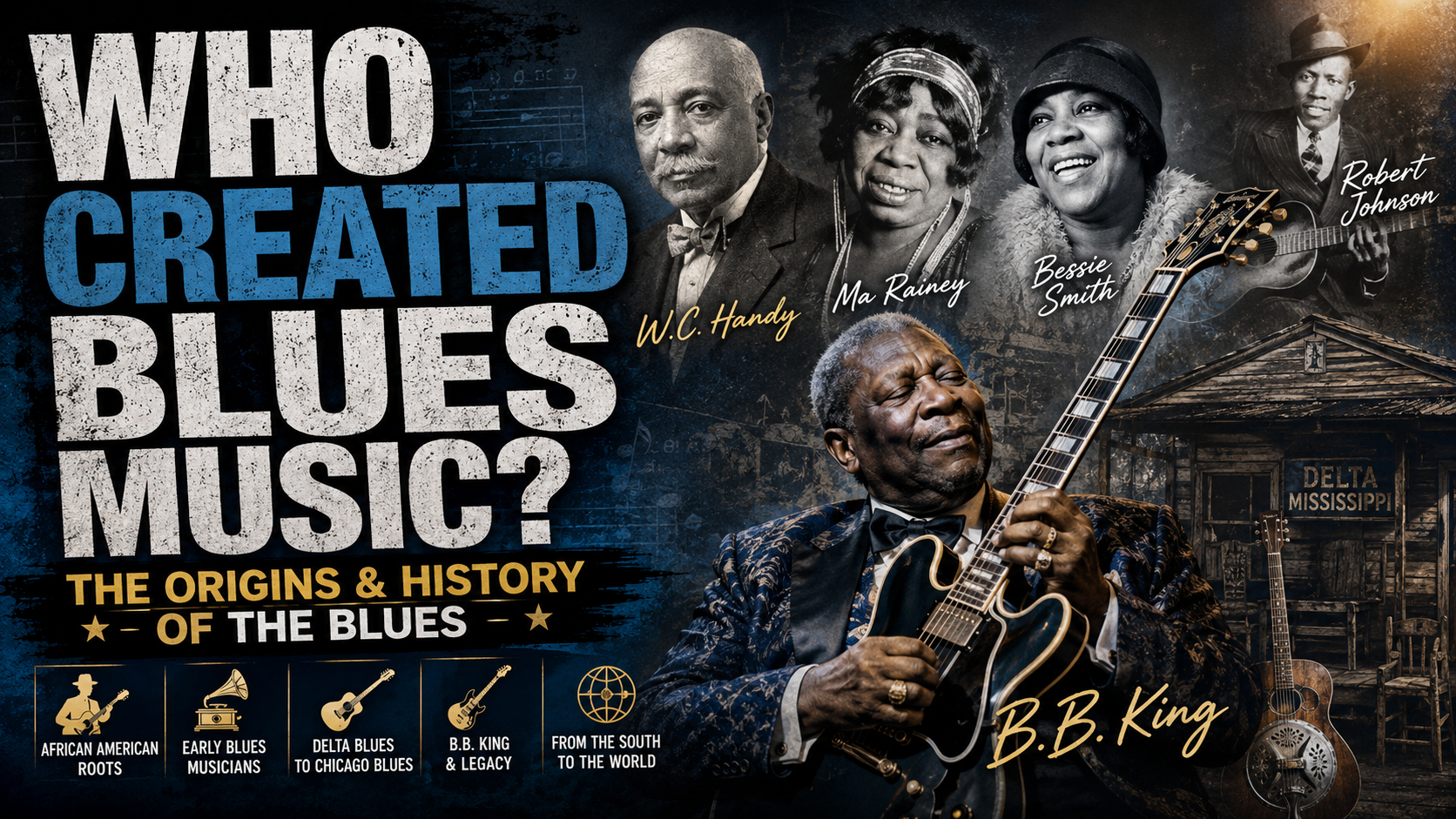
W.C. Handy helped popularize and document blues-inspired music. Mamie Smith helped demonstrate the commercial potential of recorded blues. Ma Rainey and Bessie Smith became major classic blues singers. Robert Johnson became a legendary Delta Blues figure. Muddy Waters helped establish electric Chicago Blues. B.B. King helped bring modern electric blues guitar to an international audience.
Each played a different role in the history of blues, but none can accurately be described as the sole creator of the genre.
Blues Music History Timeline
- Late 1800s: Blues begins developing within African American communities in the Southern United States.
- 1890s: Early references to blues begin appearing in historical documentation.
- Early 1900s: Blues traditions become increasingly recognizable as a distinct musical form.
- 1912: W.C. Handy publishes Memphis Blues.
- 1920: Mamie Smith records Crazy Blues.
- 1920s: Classic blues singers such as Ma Rainey and Bessie Smith become major recording artists.
- 1930s: Delta Blues artists such as Robert Johnson make influential recordings.
- 1940s–1950s: Blues develops into increasingly amplified urban forms.
- 1950s: Chicago Blues becomes a major electric blues style.
- 1960s: British blues musicians bring American blues influences into rock music.
- 1970s onward: Blues continues influencing rock, soul, R&B, and modern blues rock.
Listen to Modern Blues Music
The history of blues continues into modern music. Today’s blues artists combine traditional guitar language, emotional vocals, classic structures, and contemporary production.
The following performance is part of the continuing blues tradition and shows how blues-based music remains relevant to modern listeners.
For more blues performances and original blues music, visit the DEBAGONG Blues Channel.
The Global Journey of Blues Music
After developing in the American South, blues music traveled across the United States and eventually around the world.
Chicago Blues, Delta Blues, Texas Blues, Memphis Blues, and other regional styles developed their own characteristics.
American blues musicians influenced British artists, European musicians, African musicians, rock guitarists, soul singers, and modern blues performers.
The genre became one of the foundations of modern popular music.
Why Blues Music Still Matters Today
Blues remains important because it represents more than a musical formula.
It is a tradition built around personal expression, storytelling, rhythm, improvisation, and emotional honesty.
Modern blues artists continue to reinterpret those ideas through electric guitar, acoustic guitar, keyboards, drums, bass, and contemporary production.
This continuing evolution can be heard in Modern Blues Rock Songs and contemporary blues guitar performances.
Who Created Blues Music? The Final Answer
So, who created blues music?
The blues was not created by W.C. Handy, Robert Johnson, Muddy Waters, B.B. King, or any other single musician.
The blues developed gradually through African American communities in the Southern United States, drawing from work songs, spirituals, chants, field hollers, African musical traditions, folk music, and lived experiences.
Later musicians helped document, popularize, record, and transform the genre.
W.C. Handy became known as the “Father of the Blues” because of his important role in publishing and popularizing blues-inspired music, but the musical tradition itself existed before his compositions.
B.B. King, Muddy Waters, Robert Johnson, Ma Rainey, Bessie Smith, and countless other musicians then helped carry the blues into new generations and musical environments.
Understanding this distinction is essential to understanding blues history.
Frequently Asked Questions
Who created blues music?
Blues music was not created by one person. It developed within African American communities in the Southern United States during the late 19th and early 20th centuries.
Who invented the blues?
No single person invented the blues. The genre developed gradually from several African American musical traditions, including work songs, spirituals, chants, and field hollers.
Who is the Father of the Blues?
W.C. Handy is commonly known as the “Father of the Blues” because of his role in publishing and popularizing blues compositions, including Memphis Blues.
Where did blues music originate?
The blues originated in the Southern United States, particularly within African American communities in the rural South.
When did blues music begin?
The blues began developing during the late 19th century, with early historical references appearing by the 1890s.
Was Robert Johnson the creator of blues?
No. Robert Johnson was one of the most influential Delta Blues musicians, but blues music existed decades before his recordings in the 1930s.
Was W.C. Handy the first blues musician?
No. W.C. Handy was an important composer and popularizer of blues-inspired music, but African American blues traditions existed before his published compositions.
Who recorded the first commercial blues hit?
Mamie Smith recorded Crazy Blues in 1920, an important milestone in the commercial recording history of blues music.
How did blues become Chicago Blues?
African American migration from the Southern United States to cities such as Chicago helped transform rural blues into an amplified urban sound using electric guitars, harmonica, drums, and bass.
What was B.B. King’s contribution to blues?
B.B. King helped popularize modern electric blues guitar around the world. His distinctive vibrato, phrasing, tone, and expressive playing became influential among generations of blues and rock guitarists.
Explore More Blues History
Continue exploring the history and development of blues music through our related articles:
- What Is Chicago Blues?
- Delta Blues
- Blues Guitar
- Eric Clapton Blues Career Path
- Modern Blues Rock Songs
- Best Heavy Blues Songs
Conclusion
The history of blues music is the history of a musical tradition that grew from African American communities in the Southern United States and eventually influenced music around the world.
There was no single creator. Instead, generations of musicians developed the blues through work, faith, storytelling, hardship, love, humor, and everyday life.
From the rural South to Delta Blues, Chicago Blues, B.B. King’s electric blues, blues rock, and modern blues guitar, the music continues to evolve while maintaining the emotional foundation that made it powerful in the first place.
Blues Musica — The Global Home of Blues Music.
Who Created Blues Music