
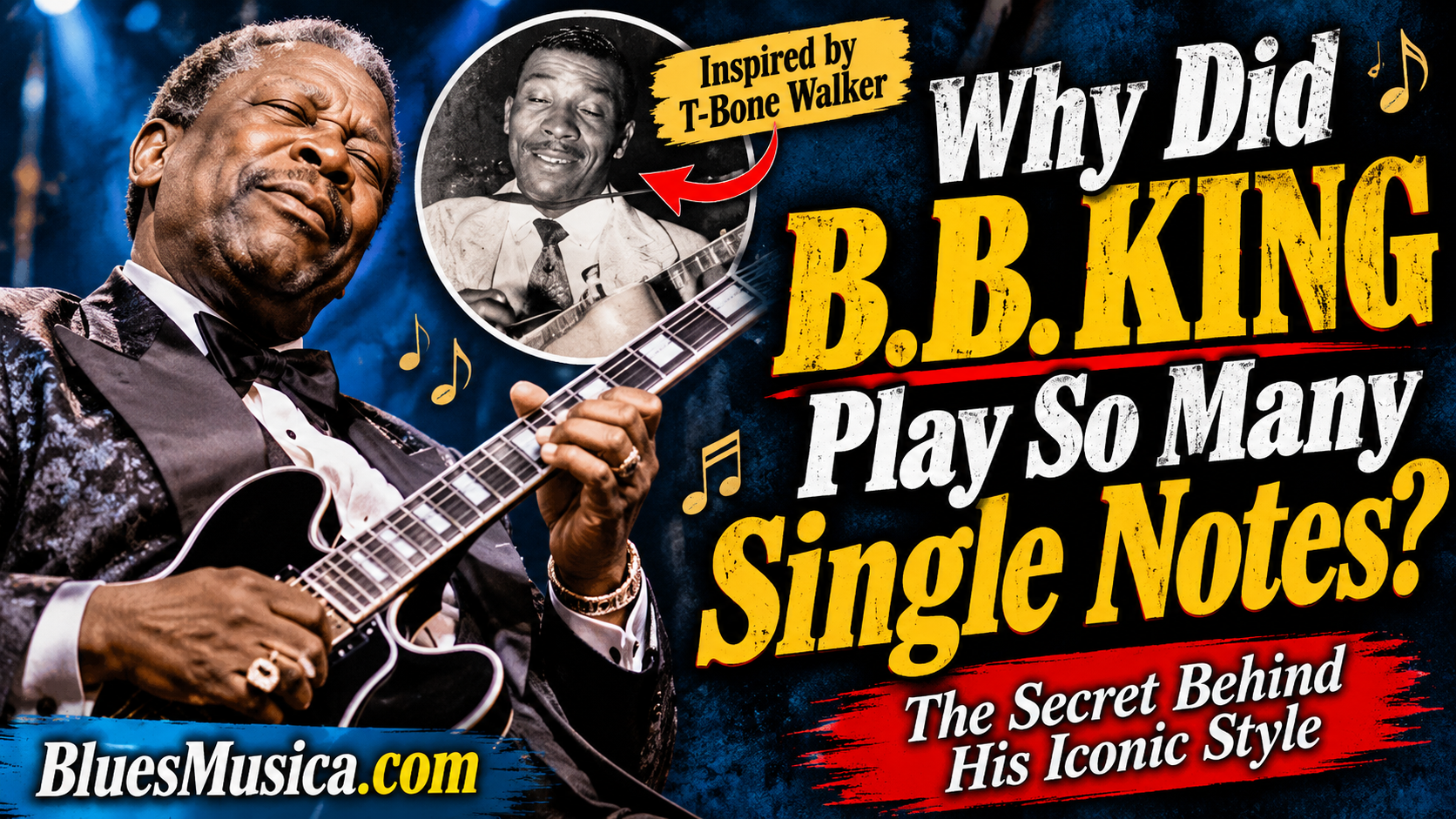

BluesMusica.com: When people think of B.B. King, they often remember his unforgettable guitar sound: a few carefully chosen notes, a powerful string bend, and that unmistakable vibrato. Unlike guitarists who filled their solos with fast runs and complicated chord patterns, King often made a single note feel like an entire musical conversation.
His approach was not an accident. It developed through his musical influences, his experiences playing in bands, and his personal understanding of how a guitar could communicate emotion. B.B. King believed that a guitar should be able to sing, and his single-note style became one of the most influential sounds in electric blues.
Why Did B.B. King Focus on Single Notes?
One of the clearest explanations came directly from B.B. King himself. In an interview with Terry Gross on NPR’s Fresh Air, King explained that whenever he worked with a band, he was usually featured as the lead guitarist.
Other musicians regularly encouraged him to take the solo instead of playing rhythm guitar. Over time, he became accustomed to playing lead lines and naturally placed more emphasis on single strings than on chords.
King openly admitted that he was not a great chord player. He could accompany a singer when another musician provided the harmonic foundation, but his greatest strength was expressing melodies through individual notes.
That practical experience helped shape the style that audiences around the world came to recognize.
T-Bone Walker Inspired His Single-String Electric Guitar Style
One of the most important influences on B.B. King’s approach was the legendary Texas blues guitarist T-Bone Walker.
King recalled that Walker was the first musician he heard playing single-note electric guitar in a way that truly captured his imagination. Before that experience, much of the guitar music King had encountered came from acoustic blues traditions.
Walker showed him how an amplified guitar could take the lead role, playing melodic lines with confidence, elegance, and expressive bends.
In an interview published by All About Jazz, King specifically identified T-Bone Walker as the first guitarist he heard using that single-note electric approach. He also acknowledged the earlier influence of Lonnie Johnson.
King did not simply copy Walker. He absorbed the idea and developed a more personal, vocal-like approach that became his own signature.
How Lonnie Johnson Helped Shape His Melodic Approach
T-Bone Walker was not the only important influence. B.B. King also admired Lonnie Johnson, whose guitar playing combined blues expression with sophisticated melodic phrasing.
Johnson demonstrated how a guitarist could create beautiful musical lines with carefully controlled notes. His influence can be heard in the melodic quality of King’s solos.
King also admired Blind Lemon Jefferson and other early blues musicians. Each influence contributed something different to his musical vocabulary.
Rather than reproducing one musician’s style, King combined the sounds he admired and transformed them into a distinctive electric blues language.
Why One Note Could Say More Than a Hundred
The power of B.B. King’s playing came from his ability to make every note count.
He understood that a guitar solo did not need to be crowded with constant movement. A sustained note, played with the right timing and expression, could create more emotional impact than a long sequence of fast notes.
Several elements made this approach so effective:
- Expressive bends: King pushed strings to change their pitch, creating a vocal-like crying sound.
- Signature vibrato: His wrist-driven movement gave sustained notes a distinctive trembling quality.
- Careful timing: He placed notes where they had the greatest emotional impact.
- Musical space: He allowed silence between phrases instead of filling every moment.
- Melodic phrasing: His guitar solos often sounded like a human voice singing a melody.
These elements turned a relatively simple musical idea into an unmistakable artistic identity.
His Guitar Was Like a Second Voice
B.B. King was not only a guitarist. He was also a singer and entertainer. His musical identity came from combining those two abilities.
When he sang, his guitar could answer the vocal line. When he stopped singing, Lucille seemed to continue the conversation.
This call-and-response relationship between voice and guitar became one of the most recognizable features of his performances.
King once explained that when he stopped singing orally, he began singing through Lucille. That idea captures the essence of his musical philosophy: the guitar was not simply an instrument accompanying the singer. It was another voice in the song.
Why B.B. King Did Not Need Complicated Chords
Many guitarists build their musical identity around rhythm patterns, chord progressions, and complex arrangements. King approached the instrument differently.
He generally left much of the chordal accompaniment to his band, allowing the piano, bass, rhythm guitar, and drums to establish the musical foundation.
This gave him room to concentrate on lead guitar. He could explore melodies, bends, vibrato, and pauses without competing with the rhythm section.
His approach was not a limitation. It was a specialization. By focusing on what he did best, King developed a sound that was immediately recognizable.
How His Single-Note Style Influenced Modern Guitarists
B.B. King’s approach helped shape the language of modern electric blues and influenced generations of blues and rock guitarists.
His phrasing, string bends, vibrato, and melodic economy became important lessons for musicians who wanted their solos to communicate emotion rather than simply demonstrate speed.
His influence can be heard in guitarists such as Eric Clapton, Stevie Ray Vaughan, George Harrison, and Jeff Beck, among many others.
The lesson was simple but powerful: a guitarist does not need to play constantly to hold an audience’s attention. A well-placed note can become unforgettable when it is delivered with feeling.
What Guitarists Can Learn from B.B. King
For guitarists who want to understand King’s style, the most important lesson is to focus on expression before speed.
- Start by playing a short melodic phrase using only a few notes.
- Practice bending strings accurately and listening carefully to the pitch.
- Develop a relaxed, controlled vibrato.
- Leave space between phrases instead of playing continuously.
- Try making the guitar answer a vocal melody.
- Listen to how King builds emotion through timing and dynamics.
Studying his performances can help guitarists understand that musical personality is often more important than technical complexity.
Frequently Asked Questions
Why did B.B. King play mostly single notes?
King explained that his bandmates frequently asked him to take the lead and play solos. Over time, he developed a stronger focus on single-string melodies than on chord playing.
Who inspired B.B. King’s single-note guitar style?
T-Bone Walker was a major inspiration. King also admired Lonnie Johnson, Blind Lemon Jefferson, and other blues musicians.
Did B.B. King play chords?
Yes. He could play chords, especially when accompanying another singer, but he preferred concentrating on lead guitar and melodic single-note phrases.
Why does B.B. King’s guitar sound like a human voice?
His expressive bends, vibrato, sustained notes, and call-and-response phrasing gave his guitar lines a vocal quality.
Can beginners learn B.B. King’s single-note style?
Yes. Beginners can start with simple melodies, accurate bends, controlled vibrato, and careful timing. The goal is to make every note sound intentional.
Final Thoughts: The Power of Playing Less
B.B. King proved that great guitar playing is not measured by the number of notes a musician can play. It is measured by how deeply those notes connect with the listener.
Inspired by T-Bone Walker and Lonnie Johnson, King developed a musical language built around single-note melodies, expressive bends, controlled vibrato, and carefully placed silence.
His guitar did not need to say everything at once. It only needed to say the right thing at the right moment.
That is why B.B. King’s sound remains timeless. He showed the world that sometimes, one note is enough to tell the whole story.
Explore more blues legends, guitar techniques, songs, and stories at BluesMusica.com — The Global Home of Blues Music.
Sources and Further Reading
- NPR Fresh Air – A Conversation With Blues Legend B.B. King
- All About Jazz – B.B. King on Finding His Style
- LA Phil – B.B. King
- MusicRadar – B.B. King: The Exclusive Interview
- Guitar World – Soloing Strategies: B.B. King