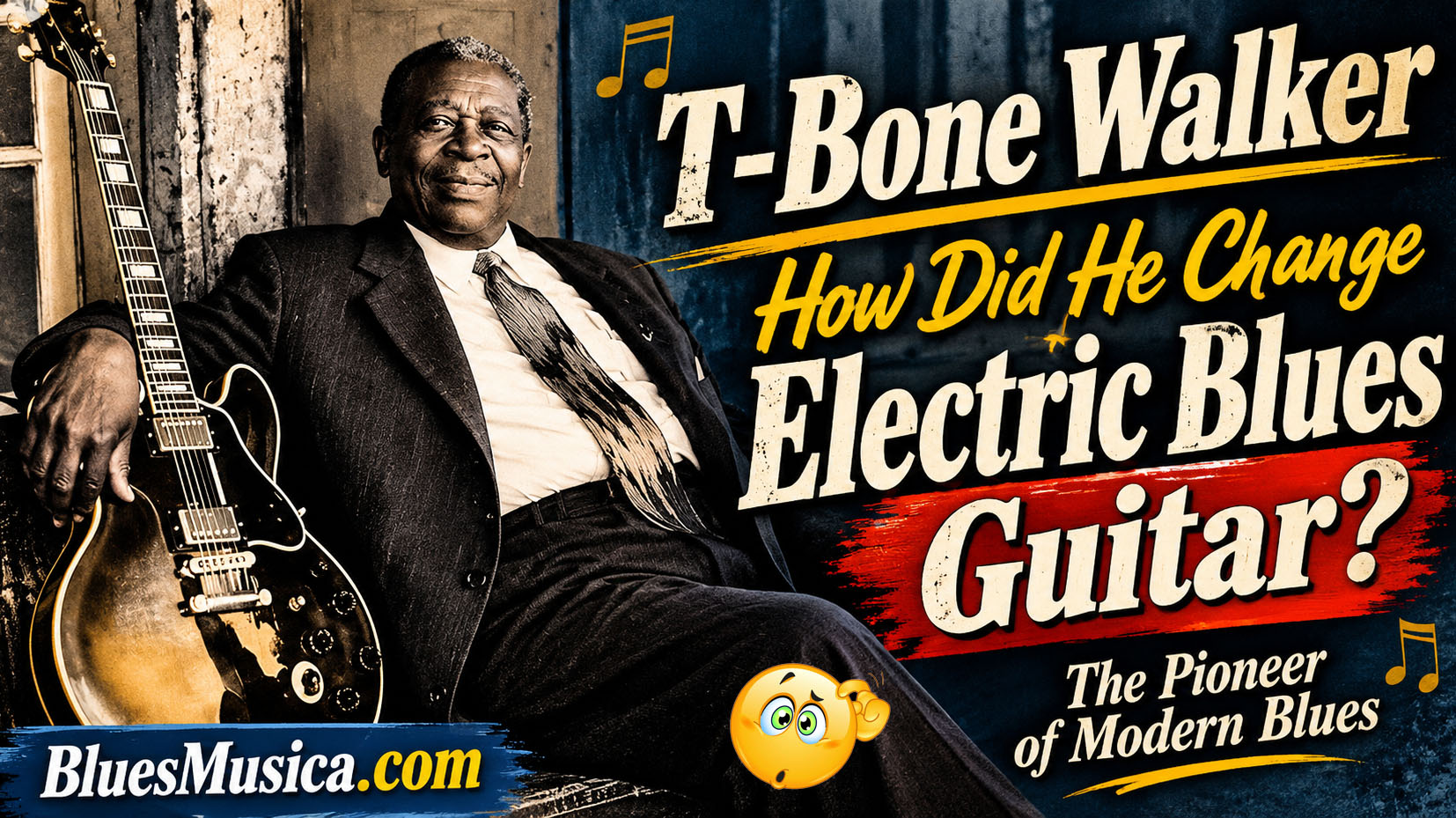

**BluesMusica.com: How Did T-Bone Walker Change Electric Blues Guitar?**
T-Bone Walker did more than make the electric guitar louder. He helped turn it into one of the most expressive lead instruments in blues music.
Before his influence spread across the blues world, guitarists often played a supporting role behind singers, horns, and rhythm sections. Walker helped change that expectation. With his amplified guitar, fluid single-note lines, expressive string bends, and unmistakable stage presence, he showed audiences that the electric guitar could sing, cry, answer a vocalist, and command the spotlight.
His influence reached far beyond Texas blues. B.B. King, Chuck Berry, Jimi Hendrix, Eric Clapton, and generations of guitarists carried elements of the musical language Walker helped establish.
But what exactly did T-Bone Walker change?
## Who Was T-Bone Walker?
T-Bone Walker was born Aaron Thibeaux Walker on May 28, 1910, in Linden, Texas. He became one of the most important pioneers of electric blues guitar and a major figure in the development of modern blues and rhythm and blues.
Growing up in a musical environment, Walker developed an interest in several instruments before becoming known for his guitar playing. His early musical experiences included the Dallas blues scene, where he encountered influential musicians and developed his own approach to performance.
He eventually moved to California, where his career expanded and his electric guitar style began attracting wider attention.
Walker was not simply a guitarist who played blues through an amplifier. He developed a distinctive musical vocabulary that helped establish the electric guitar as a powerful solo voice.
## 1. He Helped Make the Electric Guitar a Lead Instrument
One of T-Bone Walker’s most important contributions was helping establish the electric guitar as a leading voice in blues bands.
In earlier blues traditions, the guitar frequently provided rhythm, accompaniment, and support for the singer. Amplification changed what the instrument could do in larger ensembles, but technology alone did not create a new musical language.
Walker demonstrated how an amplified guitar could take extended melodic solos, respond to vocals, and stand alongside horns and other lead instruments.
His playing was clear, fluid, and expressive. Instead of simply filling the spaces between vocal lines with chords, he could create complete musical statements with his guitar.
This helped change how audiences and musicians understood the instrument.
## 2. He Popularized Expressive Single-Note Guitar Solos
Walker developed a sophisticated single-note approach that became a major influence on electric blues guitar.
He played melodic lines that sounded almost like a horn section. His notes were carefully shaped, connected, and delivered with a strong sense of rhythm.
Rather than relying only on chord patterns, he used individual notes to create phrases that could answer a singer or carry an entire instrumental passage.
This approach became one of the foundations of modern electric blues soloing.
It is particularly important when considering B.B. King. King openly acknowledged Walker as a major inspiration, and the influence can be heard in his emphasis on melodic single-string phrases.
Read more: **[Why Did B.B. King Play So Many Single Notes?](https://bluesmusica.com/why-did-bb-king-play-single-notes/)**
## 3. He Made String Bends and Vibrato More Expressive
T-Bone Walker understood that a guitar note did not have to remain fixed at its original pitch.
By bending strings and shaping sustained notes, he gave his guitar a vocal quality. His phrases could sound joyful, painful, playful, or deeply emotional.
His vibrato also helped give individual notes personality. Instead of treating technique as a display of speed, Walker used it to make melodies more expressive.
These techniques became essential parts of the electric blues vocabulary.
Later guitarists developed their own versions of these sounds, but Walker helped demonstrate how powerful they could be in a blues solo.
## 4. He Combined Blues with Jazz and Swing
Another important part of Walker’s style was his connection to jazz and swing.
His guitar playing was not limited to the rougher sounds of rural blues. He incorporated sophisticated phrasing, rhythmic flexibility, and melodic ideas associated with jazz and big-band music.
The result was a smooth, swinging electric blues sound that became particularly influential in the development of Texas blues and early rhythm and blues.
His guitar could sound elegant and polished while retaining the emotional character of the blues.
This combination helped expand the possibilities of electric blues beyond a single regional style.
## 5. His Stage Presence Changed the Image of the Blues Guitarist
T-Bone Walker was also a remarkable entertainer.
He understood that a performance was not only about playing the correct notes. It was also about connecting with an audience.
He became famous for playing the guitar in theatrical positions, including holding it behind his head and playing it while performing other stage movements.
His showmanship helped make the electric guitarist a visual attraction, not just a musician standing behind a microphone.
This performance style influenced later generations of guitar heroes. The theatrical possibilities of electric guitar playing would become especially visible in the performances of Jimi Hendrix and other rock musicians.
## 6. The Recordings That Helped Change Electric Blues
Some of Walker’s recordings demonstrate why his contribution was so important.
**Mean Old World**
Recorded during his 1942 session with Freddie Slack’s band, this performance showcases Walker’s early electric guitar vocabulary, including melodic lead phrases and expressive string work.
**I Got a Break, Baby**
Another important recording from the same session, it demonstrates how the electric guitar could take a prominent solo role within a band arrangement.
**Call It Stormy Monday (But Tuesday Is Just as Bad)**
Released in 1947, this became one of Walker’s signature songs. Its sophisticated arrangement, memorable vocal performance, and expressive guitar work helped define the sound of postwar electric blues.
**T-Bone Shuffle**
This recording highlights Walker’s swinging rhythm, melodic guitar phrasing, and ability to combine blues with a polished band sound.
Together, these recordings reveal an artist who helped move the electric guitar into a new position within blues music.
## 7. How T-Bone Walker Influenced B.B. King and Other Guitar Legends
T-Bone Walker’s influence can be heard across several generations of musicians.
B.B. King repeatedly acknowledged Walker as one of the musicians who inspired him to play electric blues guitar. King’s melodic single-note phrasing, expressive bends, and controlled vibrato developed into a distinctive style of their own, but Walker was an important part of that musical foundation.
Chuck Berry also absorbed elements of Walker’s guitar vocabulary, helping carry aspects of electric blues into early rock and roll.
Jimi Hendrix admired Walker’s showmanship and expanded the theatrical possibilities of electric guitar performance.
Eric Clapton and Stevie Ray Vaughan are also among the many guitarists whose musical language reflects the broader influence of early electric blues pioneers such as Walker.
The Rock & Roll Hall of Fame recognized Walker’s influence by inducting him in 1987 in its Musical Influence category.
His legacy is not limited to musicians who directly copied his style. His contribution helped establish the vocabulary that countless guitarists would later adapt and transform.
## 8. Why T-Bone Walker Still Matters Today
Modern blues guitarists continue to use many elements that Walker helped popularize.
Single-note melodic solos, expressive bends, vocal-like phrasing, controlled vibrato, and the relationship between guitar and singer remain essential parts of electric blues.
Even when a guitarist uses modern equipment or plays a completely different genre, the influence of early electric blues can still be heard in the way individual notes are shaped and delivered.
Walker helped establish an idea that remains central to blues guitar: a great solo is not simply a collection of notes. It is a musical voice.
## Frequently Asked Questions
### Was T-Bone Walker the first electric blues guitarist?
Walker was one of the pioneering figures in electric blues guitar. Other musicians also experimented with amplified guitars, so it would be inaccurate to describe him as the only first electric guitarist. His importance lies in how he developed and popularized a distinctive electric blues lead style.
### What was T-Bone Walker’s most famous song?
One of his best-known recordings is **Call It Stormy Monday (But Tuesday Is Just as Bad)**, released in 1947. It became a blues standard recorded by many other musicians.
### Did T-Bone Walker influence B.B. King?
Yes. B.B. King frequently identified Walker as a major inspiration. Walker’s expressive electric guitar playing helped shape the musical direction King later developed into his own signature style.
### What guitar did T-Bone Walker play?
Walker played several electric guitars during his career. One of his best-known instruments was a Gibson ES-5, which he used extensively during the late 1940s and following years.
### What made T-Bone Walker’s guitar style unique?
His style combined expressive single-note melodies, string bends, vibrato, jazz-influenced phrasing, swing rhythms, and theatrical performance. He helped establish a new vocabulary for electric blues guitar.
## Final Thoughts: The Guitar Found a New Voice
T-Bone Walker helped change the role of the electric guitar in blues music.
He showed that an amplified guitar could do much more than provide rhythm. It could lead a band, answer a singer, create emotional melodies, and become the center of a performance.
His influence reached B.B. King and many other musicians who carried electric blues into new generations.
The next time you hear a blues guitarist bend a single note until it sounds like a human voice, remember that this musical language has a history.
And T-Bone Walker helped write one of its most important chapters.
**Discover more blues legends, guitar history, and essential blues recordings at BluesMusica.com.**
## Sources and Further Reading
– [Rock & Roll Hall of Fame – T-Bone Walker]()
– [Texas State Historical Association – Blues]()
– [Guitar World – How T-Bone Walker Invented Electric Blues Guitar]()
– [AllMusic – T-Bone Walker Biography]()
## Watch and Explore
**Discover the blues guitar legacy of B.B. King:**
**Experience the sound of electric blues:**
Explore more stories about the blues guitar legends who shaped modern electric blues: