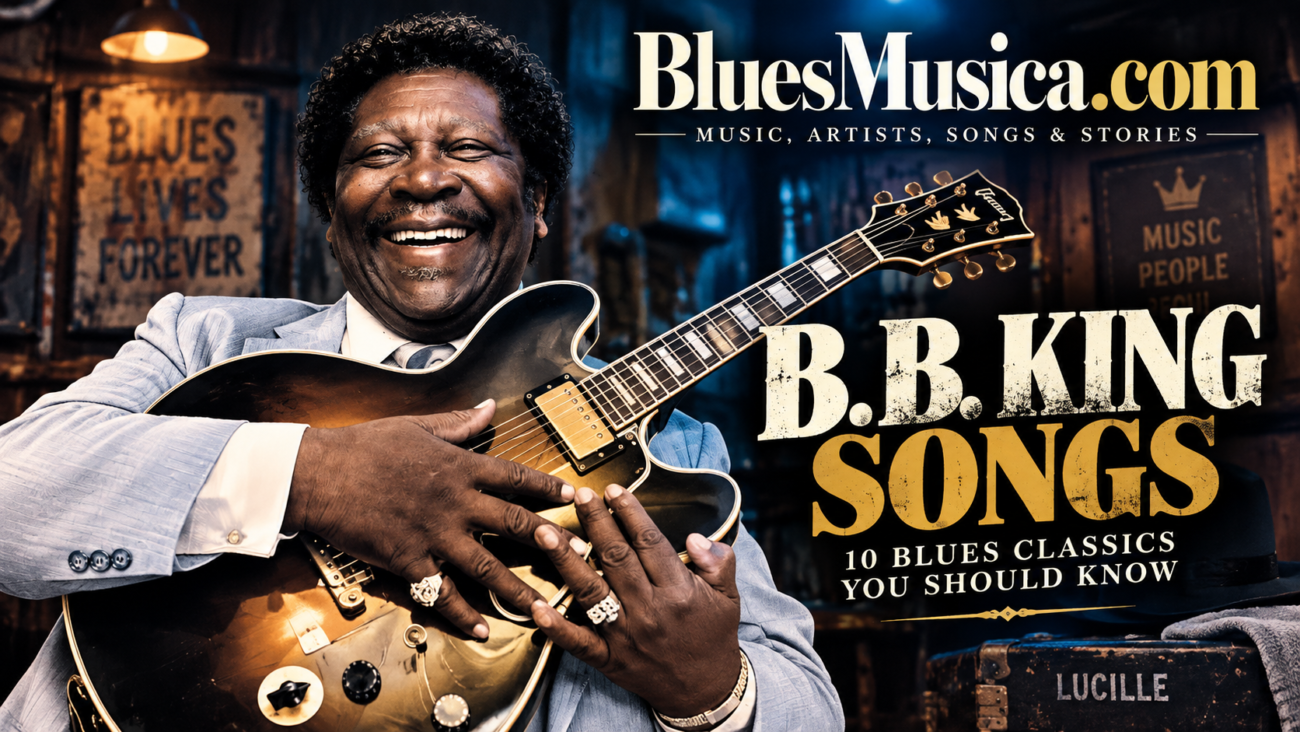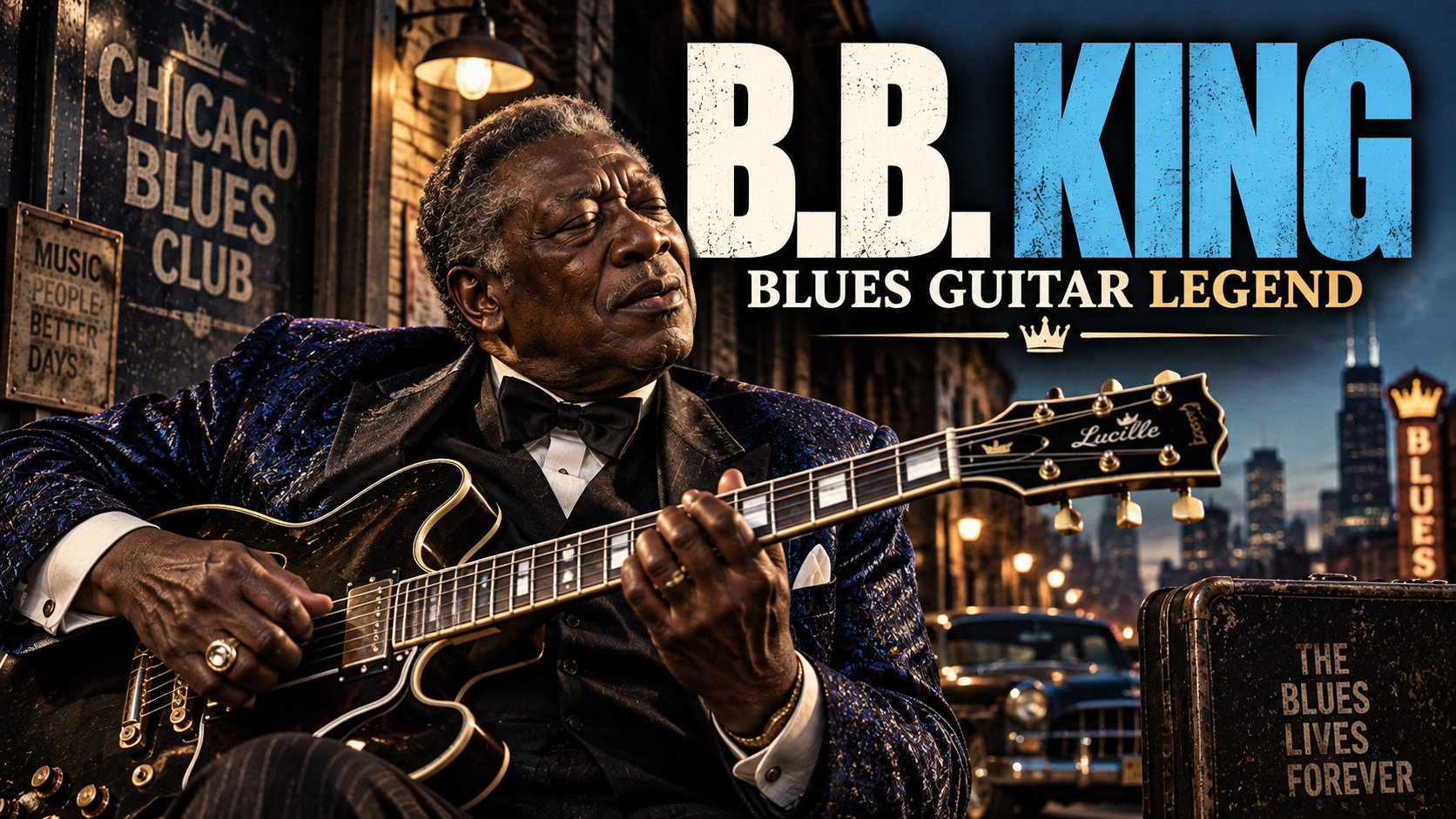

BluesMusica.com: Who was B.B. King? B.B. King was one of the most influential blues guitarists and singers in modern music history. With his expressive guitar playing, distinctive voice, and famous guitar Lucille, he helped introduce the blues to audiences around the world.
For more than half a century, B.B. King performed the blues on stages across the United States and internationally. His style was built around emotional phrasing, memorable melodies, precise vibrato, and the ability to make a single guitar note communicate an enormous amount of feeling.
His career also represents an important chapter in the evolution of electric blues. B.B. King took traditions rooted in the Mississippi Delta and combined them with the amplified sound of modern blues, creating a guitar style that influenced generations of musicians.
Who Was B.B. King?
B.B. King was an American blues singer, guitarist, and songwriter who became one of the best-known ambassadors of blues music.
He was born Riley B. King on September 16, 1925, near Berclair, Mississippi.
He grew up in the Mississippi Delta region, where blues, gospel, and other forms of Southern music were part of the cultural environment.
King eventually developed a passion for music and began learning guitar while still young.
His early musical experiences would eventually lead him to Memphis, Tennessee, where his professional career began to develop.
When Was B.B. King Born?
B.B. King was born on September 16, 1925, in Mississippi.
His childhood was connected to the rural Mississippi Delta, a region that produced many important blues musicians.
The environment exposed him to the traditions of field hollers, gospel singing, country blues, and other musical forms that would influence his later sound.
Although his career would eventually become international, the musical vocabulary of the Mississippi Delta remained an important part of his identity.
How Did B.B. King Start Playing Music?
King became interested in music through gospel and the blues.
He learned guitar and developed his musical skills while growing up in Mississippi.
After spending time working in the region, he eventually traveled to Memphis, where he pursued music more seriously.
Memphis was an important center for African American music and provided King with opportunities to meet musicians and develop his performance skills.
His time in Memphis became a major turning point in his career.
Why Was B.B. King Called B.B.?
The initials B.B. came from his broadcasting career in Memphis.
King became known as the “Beale Street Blues Boy,” which was eventually shortened to “Blues Boy” and then B.B.
The name B.B. King eventually became one of the most recognizable names in blues music.
B.B. King and Memphis Blues
Memphis played an important role in B.B. King’s musical development.
During his early career, he performed and worked in radio, gaining exposure to a wide variety of musicians and musical styles.
Memphis also connected him with Beale Street, one of the historic centers of African American music in the United States.
Through radio and live performances, King gradually developed a reputation as an exciting blues guitarist and singer.
His sound would eventually move beyond the traditional boundaries of regional blues.
What Made B.B. King’s Guitar Style Different?
B.B. King’s guitar style was immediately recognizable.
Unlike guitarists who filled every moment with fast runs and complicated passages, King often used relatively few notes.
What mattered was how he played those notes.
His signature characteristics included:
- Expressive vibrato
- Precise string bending
- Long sustained notes
- Strong melodic phrasing
- Call-and-response between voice and guitar
- Careful use of space
- Emotional dynamics
His guitar often sounded as though it were having a conversation with his voice.
He might sing a phrase and then answer it with the guitar.
This approach became one of the defining characteristics of his music.
What Guitar Did B.B. King Play?
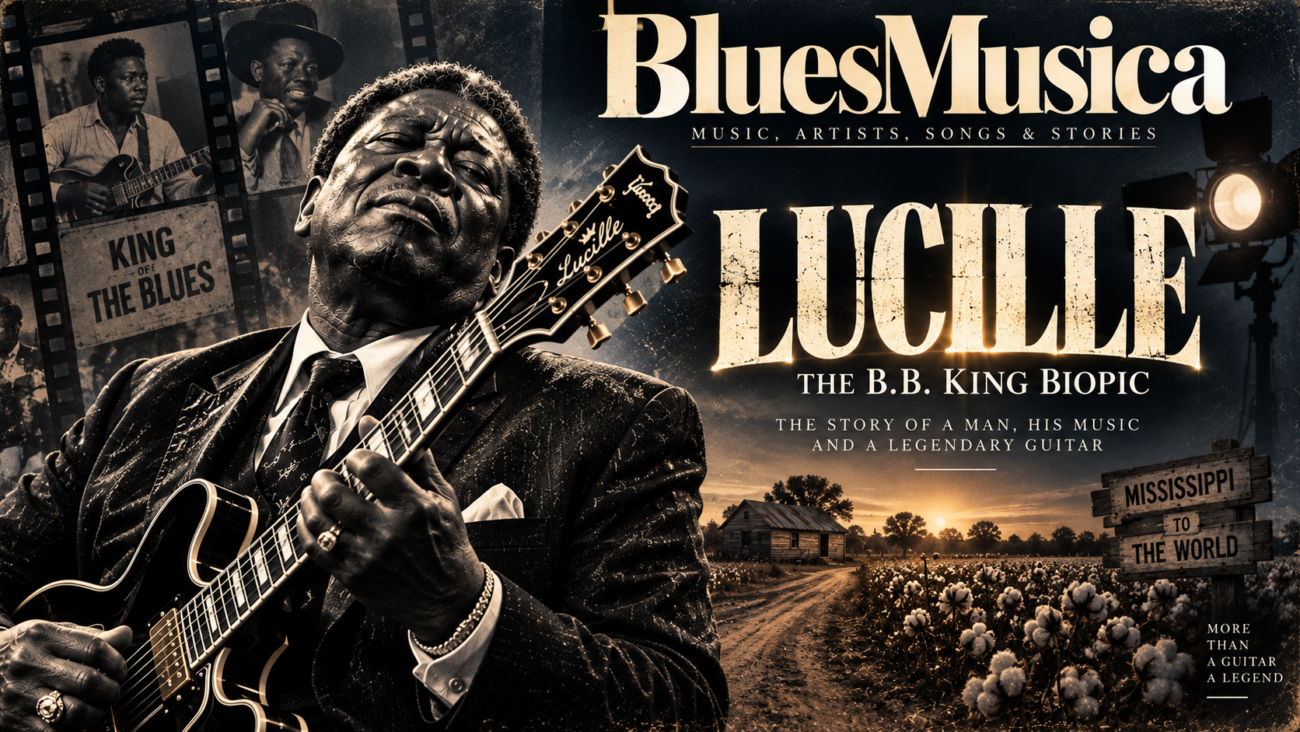
B.B. King became closely associated with his Gibson electric guitar, which he famously named Lucille.
Lucille became more than just an instrument. The name became part of B.B. King’s identity and stage image.
Over the course of his career, several Gibson guitars carried the Lucille name, including models specifically associated with King.
The Gibson ES-335 family and related semi-hollow designs became strongly connected with his image.
His use of a semi-hollow electric guitar helped produce the warm, singing tone that became characteristic of his recordings and performances.
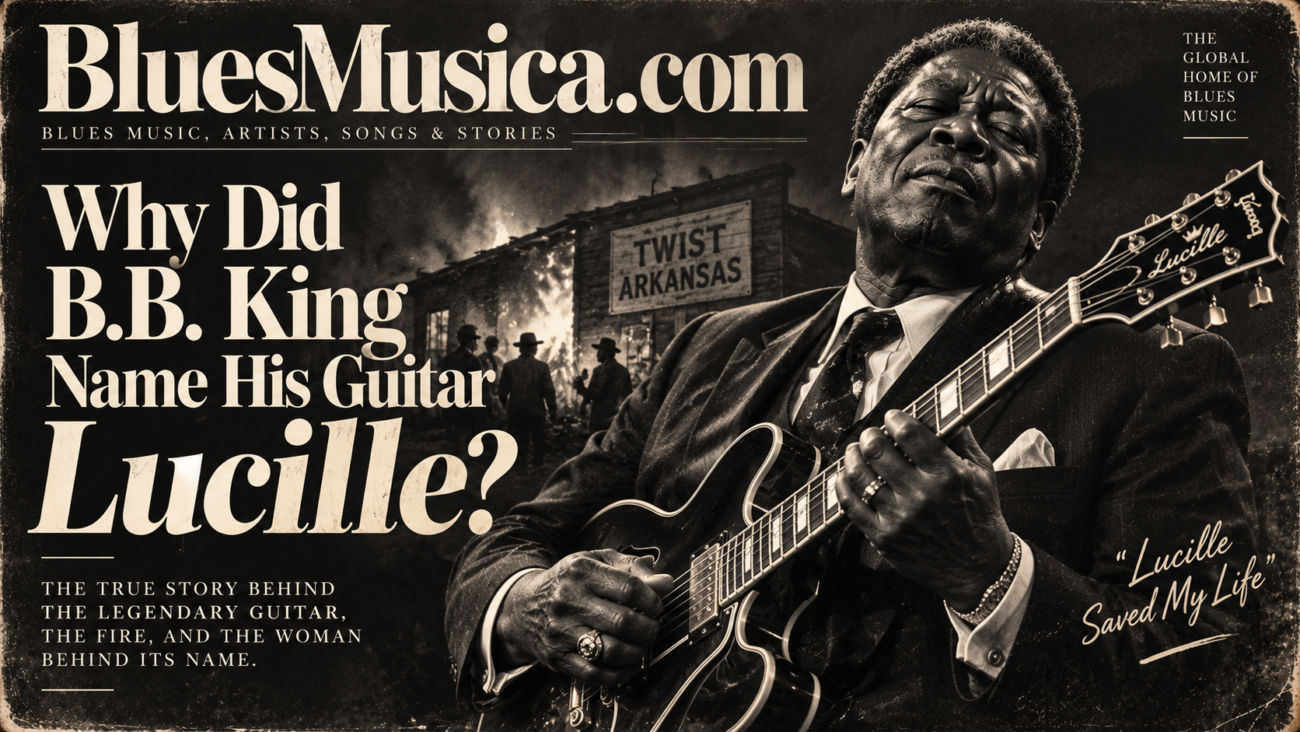
Why Did B.B. King Call His Guitar Lucille?
The story behind the name Lucille became one of the most famous pieces of blues history.
King had a dangerous experience involving a fire at a venue where he was performing. He later learned that he had risked his life returning inside the building to save his guitar.
He named the guitar Lucille after the woman whose presence had reportedly been connected to the incident.
From that point forward, the name Lucille remained attached to his guitars.
King also used the story as a reminder never to put himself in danger for a guitar again.
B.B. King’s Signature Guitar Sound
B.B. King’s tone was not based simply on equipment.
His sound came from the combination of amplifier settings, guitar technique, hand control, vibrato, bending, dynamics, and his understanding of musical space.
One of his greatest strengths was knowing when not to play.
A single sustained note could sometimes communicate more emotion than a long sequence of fast guitar notes.
This philosophy influenced generations of blues and rock guitarists.
B.B. King and Electric Blues
B.B. King became one of the central figures in the development and popularization of electric blues.
His music maintained the emotional foundation of traditional blues while using amplification and modern band arrangements.
This helped make the blues accessible to larger audiences.
His performances demonstrated that electric blues could be sophisticated, melodic, dramatic, and commercially successful without losing its roots.
Learn more about this development in our article about What Is Electric Blues?.
B.B. King’s Most Famous Songs
The Thrill Is Gone
The Thrill Is Gone became one of B.B. King’s signature recordings.
His version transformed the song into a powerful blues performance built around dramatic orchestration, emotional vocals, and his expressive guitar.
The recording introduced King’s music to a much wider audience and became one of the most recognizable blues recordings of the modern era.
Every Day I Have the Blues
Every Day I Have the Blues became another important recording in King’s career.
The song demonstrates his ability to combine a strong vocal performance with short, expressive guitar phrases.
Why I Sing the Blues
Why I Sing the Blues reflects King’s ability to use the blues as both music and storytelling.
The song connects personal experience with the broader history and cultural significance of the blues.
Rock Me Baby
Rock Me Baby became one of King’s recognizable blues recordings.
Its simple structure gave him plenty of space to demonstrate his distinctive guitar phrasing and vocal style.
Sweet Sixteen
Sweet Sixteen became another important part of B.B. King’s repertoire.
The recording highlights his ability to build emotional intensity through repetition, vocal dynamics, and expressive guitar playing.
B.B. King and the Blues Guitar Tradition
B.B. King was part of a long blues guitar tradition that included musicians from Mississippi, Chicago, Memphis, Texas, and other regions.
He was influenced by earlier blues musicians while also developing a highly individual style.
His playing demonstrated that blues guitar did not need to be technically complicated to be emotionally powerful.
His control of vibrato and bending became particularly influential among later guitarists.
B.B. King and Chicago Blues
B.B. King is often discussed alongside Chicago Blues musicians because of his role in the broader development of electric blues.
However, his musical identity was not limited to Chicago Blues.
His career connected several regional traditions, including Mississippi blues, Memphis music, and the larger American electric blues movement.
This distinction is important because the blues developed through many interconnected regional scenes rather than a single musical center.
Explore the Chicago tradition in What Is Chicago Blues?.
How Did B.B. King Influence Rock Guitar?
B.B. King’s influence extended far beyond traditional blues.
Rock guitarists studied his bending technique, vibrato, phrasing, tone, and use of musical space.
His approach demonstrated how blues guitar could become a foundation for expressive lead guitar playing.
Many later guitarists incorporated elements of his style into blues rock and rock music.
His influence was particularly important because he showed that emotional expression could be more important than technical speed.
B.B. King and Eric Clapton
Eric Clapton was among the many guitarists influenced by B.B. King and the wider blues tradition.
The relationship between blues and rock became increasingly important during the 1960s and 1970s.
British and American guitarists studied recordings by major blues musicians and introduced blues vocabulary into rock music.
B.B. King’s influence remained visible throughout this process.
B.B. King and Blues Rock
Blues rock developed partly from the meeting of traditional blues with amplified rock instrumentation.
B.B. King’s music provided an important model for guitarists who wanted to combine blues emotion with larger-stage production.
His music showed that the blues could work in intimate clubs as well as major concert venues.
His ability to communicate emotion through guitar became a reference point for generations of players.
Why Was B.B. King So Important to Blues?
B.B. King helped bring blues music to audiences who might never have encountered traditional Mississippi or Memphis blues.
His international touring career made him one of the most recognizable representatives of the genre.
He also demonstrated that a blues artist could maintain a long professional career while continuing to develop as a performer.
His combination of singing, guitar playing, storytelling, and stage presence made him an important ambassador for blues music.
B.B. King’s Legacy
B.B. King’s legacy extends across blues, guitar music, and popular music.
His guitar playing influenced countless musicians, while his recordings introduced millions of listeners to the blues.
His famous guitar Lucille became an iconic symbol of blues guitar.
Perhaps his most important contribution was demonstrating the expressive power of simplicity.
King showed that tone, timing, vibrato, phrasing, and emotion could make a small number of notes unforgettable.
What Can Guitarists Learn From B.B. King?
One of the most important lessons from B.B. King’s playing is the value of space.
Instead of constantly playing, King allowed phrases to breathe.
He also treated vibrato as an expressive tool rather than simply a technical effect.
His string bends were carefully controlled, often leading to notes that sounded almost vocal.
Another important lesson is listening.
King’s guitar interacted with his singing and the other musicians in the band.
This created a musical conversation rather than a continuous guitar solo.
B.B. King and the Global Blues Audience
Blues music began in specific African American communities in the United States, but artists such as B.B. King helped carry the music to audiences around the world.
His international performances contributed to the growing global appreciation of blues guitar.
Musicians from Europe, Asia, Australia, Africa, and the Americas studied his recordings and incorporated elements of his approach into their own music.
As a result, B.B. King became an important bridge between American blues history and the worldwide blues community.
Frequently Asked Questions About B.B. King
Who was B.B. King?
B.B. King was an American blues singer, guitarist, and songwriter who became one of the most influential figures in modern blues music.
What was B.B. King’s real name?
His birth name was Riley B. King.
Where was B.B. King born?
He was born in Mississippi in 1925 and grew up in the Mississippi Delta region.
What guitar did B.B. King play?
B.B. King became famous for playing Gibson electric guitars associated with the name Lucille.
Why was B.B. King’s guitar called Lucille?
King gave the name Lucille to his guitars after a dangerous fire-related incident early in his career.
What is B.B. King famous for?
He is famous for his expressive blues guitar playing, distinctive singing voice, international career, and his influence on generations of blues and rock guitarists.
What is B.B. King’s most famous song?
The Thrill Is Gone is widely regarded as one of his signature recordings.
Did B.B. King influence rock music?
Yes. His guitar phrasing, vibrato, bending, tone, and approach to blues guitar influenced many blues rock and rock guitarists.
Explore More Blues Music History
- Who Was Robert Johnson?
- Who Was Muddy Waters?
- What Is Delta Blues?
- What Is Chicago Blues?
- What Is Electric Blues?
- Where Did Blues Music Originate?
- How Did Blues Music Develop?
Final Thoughts
B.B. King became one of the defining voices of modern blues.
His career connected the musical traditions of the Mississippi Delta with Memphis, electric blues, blues rock, and an international audience.
But his greatest legacy may be found in the way he played the guitar.
He proved that a blues guitarist does not need hundreds of notes to create a powerful emotional experience.
A carefully bent note, a deep vibrato, a moment of silence, and the right phrase could tell an entire story.
That philosophy made B.B. King one of the most influential blues guitarists in history.
And every time a guitarist bends a note and makes the guitar sound like a human voice, the influence of B.B. King can still be heard.
https://youtu.be/of1lDzq6Rrw
https://youtu.be/fhl6biHJyQc