
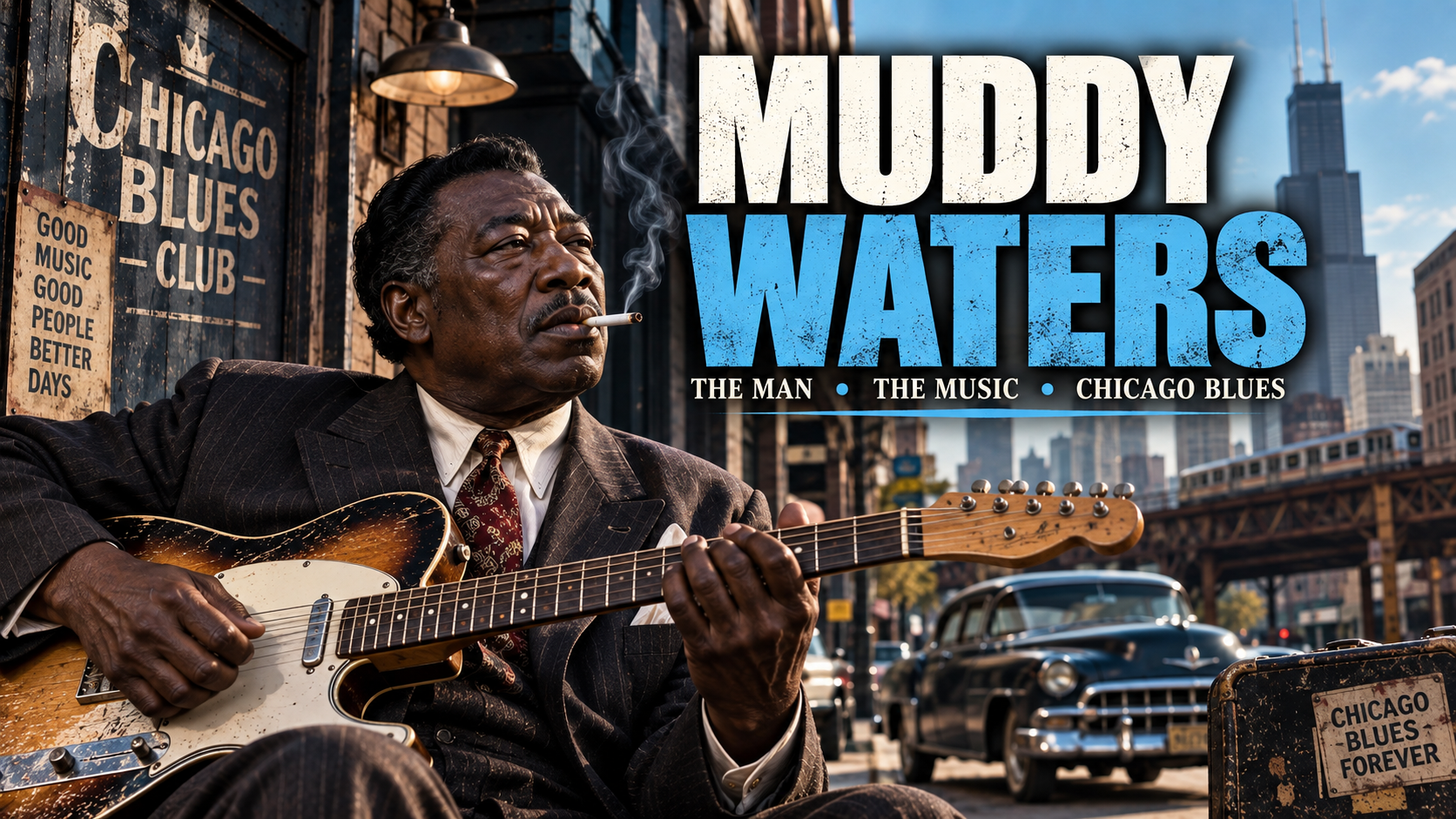

BluesMusica.com: Who was Muddy Waters? Muddy Waters was one of the most important figures in the history of Chicago Blues and electric blues. Born in Mississippi and deeply influenced by Delta Blues, he transformed traditional Southern blues into a powerful electric sound after moving to Chicago.
His recordings, guitar style, vocals, and legendary band helped establish the sound of modern Chicago Blues. His influence eventually reached far beyond the blues, inspiring generations of rock, blues rock, and guitar musicians around the world.
Who Was Muddy Waters?
Muddy Waters was the stage name of McKinley Morganfield, an American blues singer, guitarist, and songwriter who became one of the defining figures of postwar Chicago Blues.
He was born in Mississippi in 1913 and grew up surrounded by the musical traditions of the American South.
As a young musician, he developed his skills playing guitar and performing blues in the Mississippi Delta.
His early musical experiences were rooted in country and Delta Blues, but his career changed dramatically when he moved to Chicago.
There, he began using electric instruments and building a larger band sound that would become one of the foundations of modern electric blues.
When Was Muddy Waters Born?
Muddy Waters was born McKinley Morganfield on April 4, 1913, in Issaquena County, Mississippi.
He grew up in the Mississippi Delta region, an area that became one of the most important centers of blues music.
The musical environment around him included traveling musicians, juke joints, local performers, spiritual music, and the growing tradition of Delta Blues.
These early influences became an important foundation for his later career.
How Did Muddy Waters Start Playing Blues?
Muddy Waters began playing harmonica and later guitar while growing up in Mississippi.
He became increasingly involved in local blues performance and eventually developed into a respected musician in the Delta.
One of the most important events in his early career occurred when folklorist Alan Lomax recorded Waters for the Library of Congress in 1941 and again in 1942.
These recordings documented Waters performing in the acoustic Delta Blues tradition before his later transformation in Chicago.
They provide an important musical connection between the rural Mississippi blues tradition and the electric Chicago Blues sound that would later make him famous.
Muddy Waters and the Mississippi Delta
The Mississippi Delta had a profound influence on Muddy Waters.
He absorbed the guitar styles, rhythms, vocal techniques, and storytelling traditions of Delta Blues musicians.
Among the musicians who influenced the broader Delta tradition were Son House, Charley Patton, Robert Johnson, and many other performers.
Waters developed his own approach while performing throughout the region.
His music was deeply connected to the blues tradition, but he was also willing to adapt his sound as his circumstances changed.
This ability to evolve would become one of the most important characteristics of his career.
Explore the musical tradition that shaped Waters in our article What Is Delta Blues?.
Why Did Muddy Waters Move to Chicago?
In 1943, Muddy Waters moved from Mississippi to Chicago.
His move was part of a much larger migration of African Americans from the rural South to Northern and Midwestern cities.
Chicago offered new employment opportunities, larger African American communities, recording opportunities, and a growing nightlife scene.
For musicians, the city also provided new audiences and venues.
But Chicago presented a new musical challenge.
Bars, clubs, and taverns could be crowded and noisy. A quiet acoustic guitar was often not powerful enough to compete with the surrounding environment.
Electric amplification provided the solution.
How Did Muddy Waters Change the Blues?
Muddy Waters helped transform the sound of blues by combining the musical language of Delta Blues with electric instruments and a full band.
His music increasingly featured:
- Electric guitar
- Amplified harmonica
- Electric or upright bass
- Drums
- Piano
- Powerful blues vocals
- Strong rhythmic grooves
- Call-and-response arrangements
The result was a much louder and more powerful form of blues.
This sound became a defining part of Chicago Blues.
Read more about the genre in What Is Chicago Blues?.
Muddy Waters and Electric Blues
Muddy Waters became one of the central figures in the development of electric blues.
He did not abandon the Delta Blues tradition when he began playing electric guitar. Instead, he amplified it.
His guitar retained the rhythmic phrasing and emotional vocabulary of Southern blues while gaining more volume, sustain, and power.
His band created a larger sound that could fill Chicago’s clubs and reach increasingly large audiences.
This transformation became a major turning point in blues history.
For more information, see What Is Electric Blues?.
The Muddy Waters Band
Muddy Waters was not simply a successful solo performer. His band became one of the most influential ensembles in blues history.
Musicians associated with his band included Little Walter, Jimmy Rogers, Otis Spann, Willie Dixon, and other major figures.
Each musician brought a different musical voice to the group.
Little Walter helped define amplified blues harmonica. Willie Dixon became an important songwriter, bassist, and arranger. Otis Spann brought powerful piano playing to the band’s sound.
Together, they helped establish a blueprint for the classic Chicago Blues band.
What Did Muddy Waters Sound Like?
Muddy Waters’ music was powerful, rhythmic, expressive, and deeply rooted in the blues tradition.
His voice could be commanding and emotional, while his guitar playing often used short riffs and repeated phrases that interacted with the rest of the band.
His music frequently relied on call-and-response.
The singer would deliver a phrase, and the guitar, harmonica, piano, or entire band could answer.
This created a conversational quality that became one of the defining characteristics of Chicago Blues.
Muddy Waters’ Most Famous Songs
Hoochie Coochie Man
Hoochie Coochie Man was written by Willie Dixon and recorded by Muddy Waters in 1954.
The song became one of the defining recordings of Chicago Blues and helped establish Waters as a major blues star.
Its memorable riff and powerful vocal delivery became highly influential.
Mannish Boy
Mannish Boy became another signature Muddy Waters recording.
The song’s repetitive rhythmic structure and powerful vocal performance demonstrate the directness and intensity of his Chicago Blues style.
Got My Mojo Working
Got My Mojo Working became one of Waters’ best-known songs.
Its energetic rhythm and memorable vocal hook made it particularly effective as a live performance piece.
I Can’t Be Satisfied
I Can’t Be Satisfied was one of Waters’ important early Chicago recordings.
The song demonstrates how his Delta-influenced musical vocabulary was adapted to electric urban blues.
Rollin’ Stone
Rollin’ Stone was recorded by Waters in 1950.
The song is particularly important because its title later inspired the name of the famous rock band The Rolling Stones.
It also illustrates how Waters’ music became part of the foundation for the British Blues movement.
Muddy Waters and the Birth of Modern Chicago Blues
The importance of Muddy Waters to Chicago Blues cannot be separated from the musicians around him.
Chicago Blues developed as a collaborative musical culture.
Guitarists, harmonica players, pianists, bassists, drummers, singers, songwriters, and producers all contributed to the sound.
Waters became one of its most recognizable leaders.
His combination of Mississippi Delta traditions and Chicago electric instrumentation created a musical formula that would be copied and adapted by countless musicians.
Muddy Waters and Chess Records
Chess Records played an important role in documenting and promoting the Chicago Blues sound.
Muddy Waters recorded some of his most important work for Chess Records.
The label also recorded other major Chicago blues musicians, helping preserve and distribute the music to audiences across the United States.
Through records, radio, jukeboxes, and touring, Chicago Blues gradually reached listeners far beyond Chicago.
How Did Muddy Waters Influence Rock Music?
Muddy Waters became one of the most important blues influences on rock music.
During the 1950s and 1960s, young musicians in Britain discovered American blues recordings and became fascinated by Chicago Blues.
Musicians studied Waters’ guitar riffs, vocal style, rhythms, and band arrangements.
The Rolling Stones, in particular, were strongly influenced by Muddy Waters and other Chicago Blues musicians.
The connection between Waters and the Rolling Stones is one of the clearest examples of how Chicago Blues crossed the Atlantic and helped shape rock music.
His influence also reached musicians such as Eric Clapton, Led Zeppelin, and many other blues and rock performers.
Muddy Waters and the Rolling Stones
The Rolling Stones took their name from Muddy Waters’ 1950 recording Rollin’ Stone.
This small detail illustrates the enormous influence that Waters had on the British Blues movement.
British musicians did not simply listen to American blues. Many studied the recordings closely and performed their own interpretations of the music.
This helped introduce Chicago Blues to a new generation of European and American audiences.
Muddy Waters and the Evolution of Blues Guitar
Muddy Waters helped demonstrate the power of electric blues guitar as a lead instrument.
His approach was not based on playing as many notes as possible.
Instead, his guitar playing often relied on tone, rhythm, repetition, phrasing, and interaction with the band.
This approach became extremely influential among later blues guitarists.
The idea that a single guitar riff could become the central identity of a song became fundamental to blues rock and rock music.
Muddy Waters and Robert Johnson
Muddy Waters and Robert Johnson represent two important stages in the development of blues music.
Robert Johnson became one of the defining figures of acoustic Delta Blues, while Muddy Waters helped carry Southern blues traditions into the electric urban environment of Chicago.
Both musicians were connected to the Mississippi blues tradition, but they developed very different musical approaches.
Johnson demonstrated the possibilities of the solo acoustic guitarist.
Waters demonstrated how those blues traditions could be transformed into a powerful electric band sound.
Read our article Who Was Robert Johnson? to explore Johnson’s story.
What Made Muddy Waters Different?
Many blues musicians were active in Chicago, but Muddy Waters developed an especially powerful identity.
His voice had authority. His guitar tone was distinctive. His songs were memorable. And his band featured some of the finest musicians in the Chicago Blues tradition.
Perhaps most importantly, he understood how to preserve the emotional power of Delta Blues while adapting it to a new urban environment.
That combination made his music accessible to both traditional blues audiences and younger listeners searching for something more powerful.
Muddy Waters’ Legacy
Muddy Waters left an enormous legacy.
He helped establish Chicago as one of the world’s most important blues centers and became one of the principal architects of electric blues.
His influence can be heard in blues, blues rock, rock and roll, and modern guitar music.
His recordings continue to be studied by musicians who want to understand the foundations of electric blues.
His songs have been covered by countless artists, while his band became a training ground for some of the most important musicians in blues history.
Why Is Muddy Waters Important to Blues History?
Muddy Waters is important because he represents a crucial transition in the history of blues music.
He connected the acoustic blues traditions of Mississippi with the amplified sound of postwar Chicago.
That connection changed the future of blues.
Electric blues became louder, more powerful, and more suitable for large venues. It also became easier for younger musicians to adapt the blues into new forms.
Without musicians such as Muddy Waters, the development of blues rock and early rock music would have looked very different.
Frequently Asked Questions About Muddy Waters
Who was Muddy Waters?
Muddy Waters was an American blues singer, guitarist, and songwriter who became one of the most influential figures in Chicago Blues and electric blues.
What was Muddy Waters’ real name?
Muddy Waters was born McKinley Morganfield.
Where was Muddy Waters born?
He was born in Mississippi in 1913 and grew up in the Mississippi Delta region.
Why did Muddy Waters move to Chicago?
He moved to Chicago in 1943 as part of the larger migration of African Americans from the rural South to Northern and Midwestern cities. Chicago also offered new opportunities for musicians.
What type of music did Muddy Waters play?
Muddy Waters is primarily associated with Chicago Blues, electric blues, and the Delta Blues tradition that influenced his early musical development.
What are Muddy Waters’ most famous songs?
Some of his best-known recordings include Hoochie Coochie Man, Mannish Boy, Got My Mojo Working, I Can’t Be Satisfied, and Rollin’ Stone.
Did Muddy Waters influence rock music?
Yes. Muddy Waters had a major influence on British Blues and rock musicians, including the Rolling Stones and many later blues rock artists.
Did the Rolling Stones get their name from Muddy Waters?
Yes. The band’s name was inspired by Muddy Waters’ 1950 recording Rollin’ Stone.
Explore More Blues Music History
- Where Did Blues Music Originate?
- How Did Blues Music Develop?
- What Is Delta Blues?
- What Is Chicago Blues?
- What Is Electric Blues?
- Who Was Robert Johnson?
- Who Created Blues Music?
- Who Is the Father of the Blues?
Final Thoughts
Muddy Waters helped change the direction of blues music.
He took the musical traditions he learned in Mississippi and transformed them into a powerful electric sound in Chicago.
With his distinctive voice, electric guitar, unforgettable songs, and legendary band, he helped define the sound of modern Chicago Blues.
His influence then traveled across the Atlantic, inspiring British Blues musicians and helping lay the foundation for blues rock and rock music.
From the Mississippi Delta to Chicago and eventually the world, Muddy Waters demonstrated how the blues could evolve while preserving its emotional power.
His legacy remains one of the strongest foundations of modern blues music.
https://youtu.be/of1lDzq6Rrw
https://youtu.be/fhl6biHJyQc