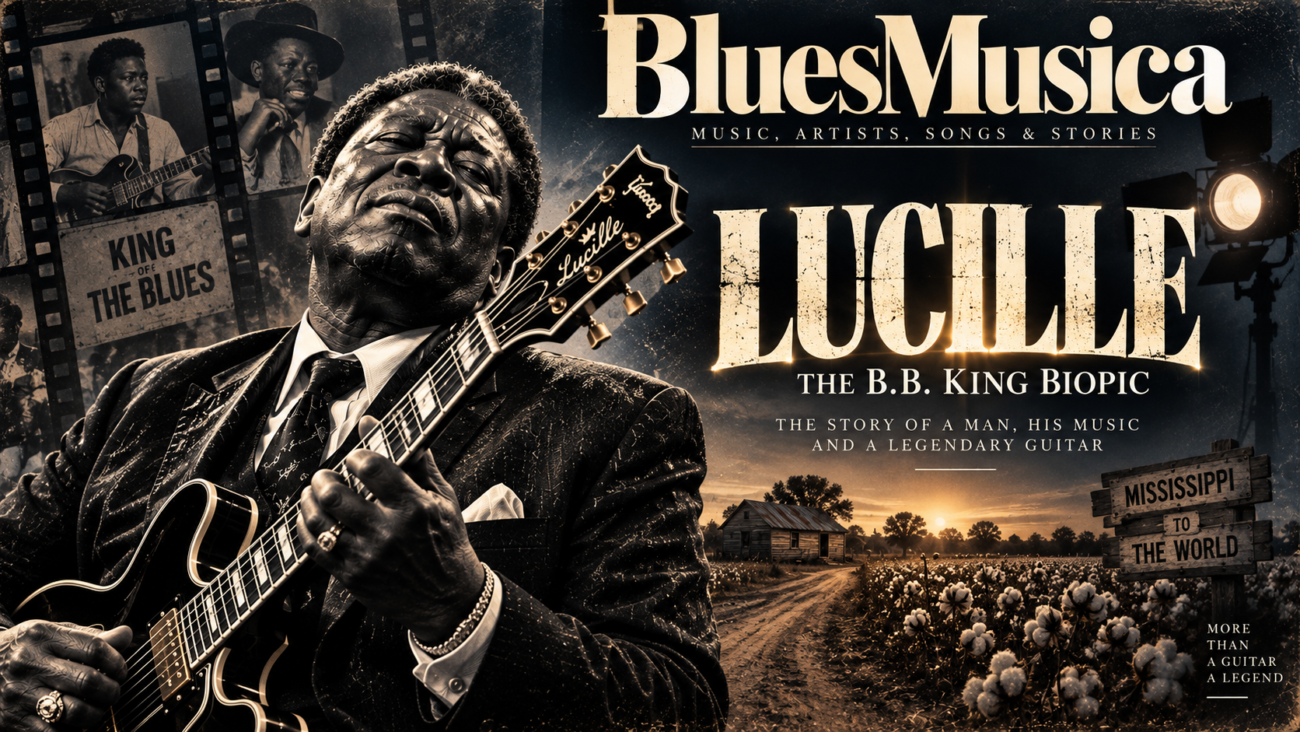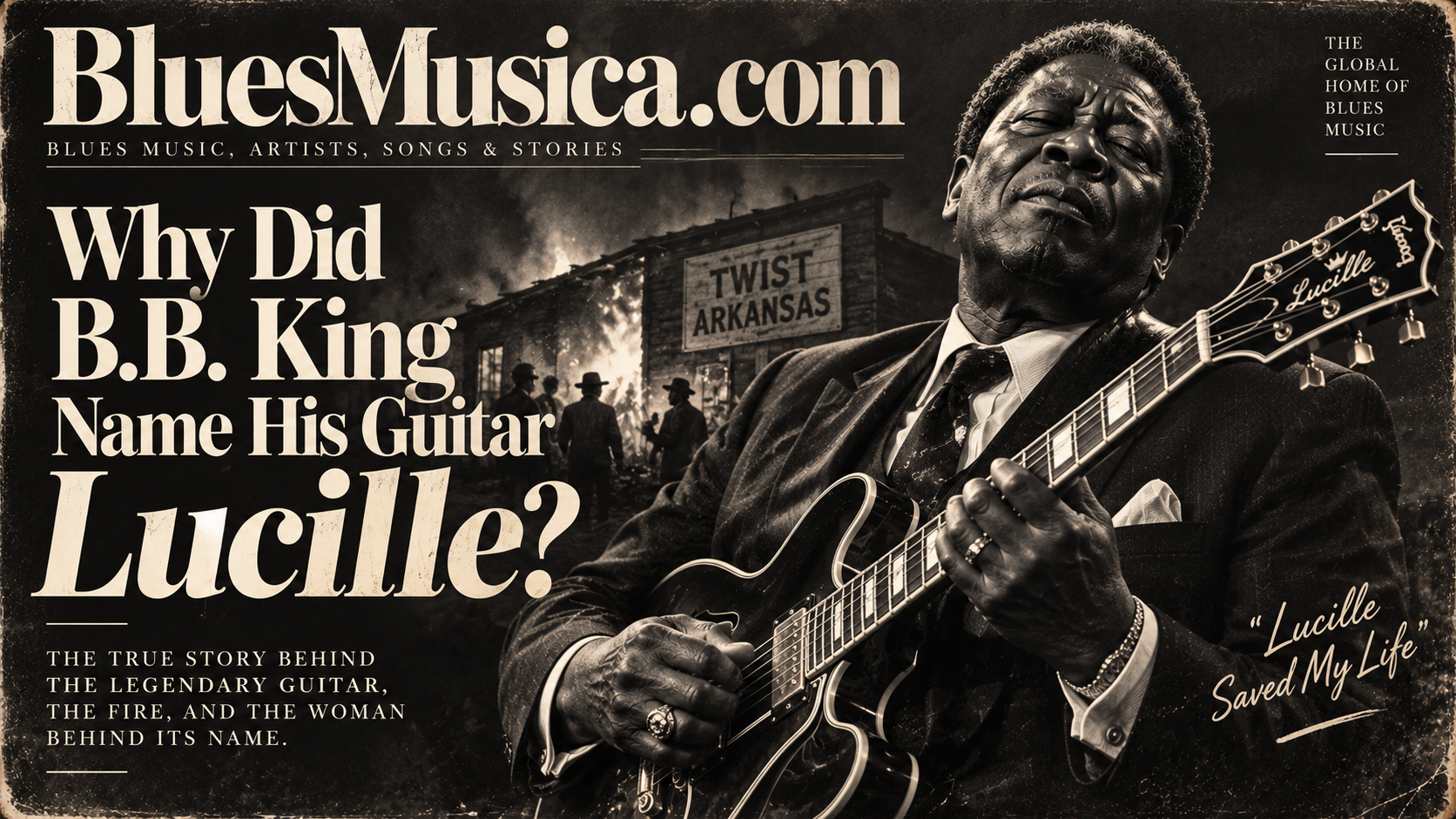

BluesMusica.com: Why did B.B. King name his guitar Lucille? The answer begins with a dangerous night in Arkansas, a burning dance hall, and a guitar that B.B. King risked his life to save.
For decades, the name Lucille became inseparable from B.B. King. When audiences saw the legendary blues guitarist walk onto a stage carrying his black Gibson guitar, they knew they were about to hear one of the most recognizable sounds in blues history.
But Lucille was more than a guitar.
For B.B. King, Lucille became a musical partner, a symbol of survival, and eventually one of the most famous guitar names in music history.
Why Did B.B. King Name His Guitar Lucille?
B.B. King named his guitar Lucille after an incident involving a woman named Lucille and a fire at a dance hall in Twist, Arkansas.
According to B.B. King’s official biography, King was performing at a dance hall when a fight broke out between two men. During the confrontation, a barrel containing kerosene was knocked over, causing a fire inside the building.
King escaped safely but realized that his guitar had been left inside.
He went back into the burning building to retrieve it.
The next day, King learned that the fight had reportedly been over a woman named Lucille.
From that point forward, he called his guitar Lucille as a reminder of what had happened and, importantly, never again to put himself in a situation like that because of a woman or anything else.
The story became one of the defining pieces of B.B. King’s personal mythology and remained closely connected to his relationship with the instrument. :contentReference[oaicite:1]{index=1}
The Night Lucille Was Born
The story took place in the winter of 1949 at a dance hall in Twist, Arkansas.
B.B. King was still a young musician building his career when the fire occurred.
The building was heated with a barrel of kerosene. During the fight, the barrel was knocked over and the fire spread.
King escaped with the other people inside.
But once he realized that his guitar was still in the building, he made the decision to go back inside.
He managed to retrieve the instrument.
That decision nearly cost him his life.
The next morning, he discovered why the fight had started: the two men had been fighting over a woman named Lucille.
King decided that the guitar would carry her name from then on.
Why Did the Name Lucille Stay With B.B. King?
One important detail is often misunderstood.
Lucille was not simply the name of one specific guitar.
Throughout B.B. King’s career, he owned and played different guitars, but he referred to his guitars as Lucille.
The name eventually became associated with the particular type of Gibson guitars that he favored during his later career.
B.B. King’s official biography explains that his famous Lucille guitars evolved through several Gibson models. By the 1960s, he was closely associated with Gibson ES-335 and ES-355 guitars. :contentReference[oaicite:2]{index=2}
Lucille Became B.B. King’s Musical Voice
B.B. King did not treat Lucille simply as a tool for playing guitar.
He often described the relationship between his voice and his guitar as a conversation.
He would sing a phrase and then answer it with his guitar.
This call-and-response approach became one of the most recognizable elements of his playing.
Instead of filling every measure with notes, King allowed individual notes to breathe.
A bend could answer a vocal line.
A sustained note could create tension.
A sudden pause could make the next phrase feel even more powerful.
Gibson describes King’s playing as highly expressive, particularly through his use of string bends, signature vibrato, single-note lines, and melodic phrasing. :contentReference[oaicite:3]{index=3}
The Sound of Lucille
The sound associated with B.B. King was not created by the guitar alone.
It came from the combination of the instrument, amplifier, his hands, and his unique musical phrasing.
King became famous for using a relatively simple musical vocabulary and making it deeply expressive.
His guitar could sound almost like another human voice.
This was one of the reasons his playing became so influential among blues guitarists.
What Kind of Guitar Was Lucille?
During different periods of his career, B.B. King used several Gibson guitars.
His later signature instruments were based around Gibson’s semi-hollow electric guitar designs.
The famous Lucille model became closely associated with the Gibson ES-355 family.
In 1980, Gibson introduced the B.B. King Lucille signature model, incorporating several modifications requested or preferred by King.
Among the notable features was the removal of the traditional f-holes, which helped reduce feedback.
The Lucille design also included stereo output and other features associated with King’s preferred setup. :contentReference[oaicite:4]{index=4}
Why Doesn’t B.B. King’s Lucille Have F-Holes?
One of the most recognizable details of the B.B. King Lucille design is what is missing from the body.
There are no traditional f-holes.
B.B. King wanted to reduce the possibility of unwanted feedback while performing at high volume.
Gibson’s current Lucille models continue to use this design feature, describing the semi-hollow body with a center block and the absence of f-holes as part of the instrument’s connection to B.B. King’s specifications. :contentReference[oaicite:5]{index=5}
Lucille and the Gibson ES-355
The Gibson ES-355 became one of the most important guitars in B.B. King’s career.
King’s preferred guitars evolved over time, but the semi-hollow Gibson design became strongly connected to his stage identity.
The combination of the semi-hollow construction, humbucking pickups, and King’s distinctive playing technique helped create the sound audiences associated with Lucille.
Today, Gibson and Epiphone continue to produce B.B. King Lucille models inspired by the guitars he played throughout his career. :contentReference[oaicite:6]{index=6}
Lucille Was More Than a Guitar
Over time, Lucille became part of B.B. King’s identity.
Fans did not simply recognize the guitarist.
They recognized the black guitar he carried.
The relationship between King and Lucille became so closely associated with his music that the instrument itself became part of the story of the blues.
When B.B. King played a long sustained note with his signature vibrato, listeners could immediately recognize the musical language.
That sound became part of the cultural identity of modern electric blues.
B.B. King and His Singing Guitar
One of the most important ideas behind B.B. King’s guitar playing was that the guitar should communicate.
He did not approach the instrument as a competition to see how many notes could be played.
Instead, he focused on expression.
His single-note phrases, bends and vibrato gave Lucille a vocal quality.
The result was a style that could be recognized after only a few notes.
This approach also helped make B.B. King an important influence on generations of blues and rock guitarists.
Did B.B. King Have More Than One Lucille?
Yes.
The name Lucille was used for multiple guitars throughout B.B. King’s career.
This is an important distinction because Lucille is often described as if it were one single instrument that remained unchanged for decades.
In reality, different guitars carried the Lucille name at different times.
The official B.B. King biography specifically notes that Lucille was actually many guitars over the course of his career. :contentReference[oaicite:7]{index=7}
The Modern B.B. King Lucille
The legacy of Lucille continues today through official Gibson and Epiphone instruments.
Modern versions retain several details associated with B.B. King’s specifications, including the semi-hollow body, center block, gold hardware, Varitone electronics and the Lucille name on the headstock.
The official B.B. King website currently features the Lucille Artist Collection Guitar as part of the estate’s guitar collection. :contentReference[oaicite:8]{index=8}
Gibson also continues to offer B.B. King Lucille models and tribute instruments based on the guitars associated with his career. :contentReference[oaicite:9]{index=9}
The Lucille Name in Blues History
Many musicians have famous instruments.
But very few instruments have a name that became almost inseparable from the musician who played them.
Lucille is one of those rare examples.
Like other famous musician-and-instrument partnerships, the guitar became part of the artist’s identity.
But Lucille has something else: a story.
A fire.
A dangerous decision.
A woman’s name.
And a lifetime of blues music.
Lucille and The Thrill Is Gone
When people hear B.B. King’s most famous recordings, they often remember the sound of his guitar as much as his voice.
The Thrill Is Gone is one of the clearest examples of King’s ability to make his guitar communicate emotion through relatively simple phrases.
His guitar does not compete with the vocal.
It responds to it.
That relationship between voice and guitar became one of the central characteristics of B.B. King’s sound.
Why B.B. King’s Guitar Style Still Matters
B.B. King’s influence can still be heard whenever a guitarist bends a note and allows it to sing.
His playing demonstrated that blues guitar does not require endless technical runs to create emotion.
Instead, a guitarist can use:
- String bending
- Vibrato
- Sustained notes
- Silence
- Call-and-response
- Melodic phrasing
- Dynamic control
These ideas remain fundamental to blues guitar.
What Can Guitarists Learn From B.B. King?
Perhaps the biggest lesson is simple: make the guitar speak.
B.B. King demonstrated that every note does not need to be complicated.
A single carefully bent note can sometimes communicate more than a long sequence of fast notes.
His playing teaches guitarists to listen to their own phrases and leave space for the music to breathe.
That philosophy is one reason B.B. King’s influence remains so strong decades after his early recordings.
Video – B.B. King and Lucille
Video – B.B. King Blues Guitar
Frequently Asked Questions About B.B. King and Lucille
Why did B.B. King name his guitar Lucille?
B.B. King named his guitar Lucille after a woman connected to a fight that caused a fire at a dance hall in Twist, Arkansas. King risked his life by returning to the burning building to save his guitar. :contentReference[oaicite:10]{index=10}
Was Lucille one specific guitar?
No. Lucille was the name B.B. King used for multiple guitars throughout his career. :contentReference[oaicite:11]{index=11}
What brand was B.B. King’s Lucille?
B.B. King became strongly associated with Gibson semi-hollow electric guitars, particularly instruments based on the ES-335 and ES-355 designs. Gibson later produced official B.B. King Lucille signature models. :contentReference[oaicite:12]{index=12}
Why did B.B. King’s Lucille have no f-holes?
The design helped reduce unwanted feedback. The absence of f-holes became one of the recognizable features of the B.B. King Lucille design. :contentReference[oaicite:13]{index=13}
Did B.B. King play the same Lucille his entire career?
No. He played different guitars during different periods of his career, with the Lucille name carried across those instruments. :contentReference[oaicite:14]{index=14}
What kind of guitar was B.B. King’s famous Lucille?
The Lucille models associated with B.B. King were semi-hollow electric guitars derived from Gibson’s ES family, with modifications made to suit King’s playing preferences. :contentReference[oaicite:15]{index=15}
B.B. King 101st Birthday
If you want to explore more about the man behind Lucille, read our previous BluesMusica.com article about what would have been B.B. King’s 101st birthday:
BluesMusica.com – B.B. King 101st Birthday | The King of Blues
Final Thoughts
Lucille is one of the most famous guitars in blues history, but the story behind the name is what makes it unforgettable.
A young B.B. King entered a burning building to save his guitar.
The next day, he learned that the fire had started during a fight over a woman named Lucille.
From that moment forward, the name stayed with him.
Over the following decades, Lucille became more than an instrument. She became the voice that answered B.B. King’s singing, the symbol carried onto stages around the world, and one of the most recognizable names in electric blues.
Today, the Lucille legacy continues through Gibson and Epiphone instruments inspired by the guitars B.B. King played.
But the original idea remains the same:
When B.B. King played Lucille, the guitar was not simply being played. It was speaking.
028-gutar luccile bb king