
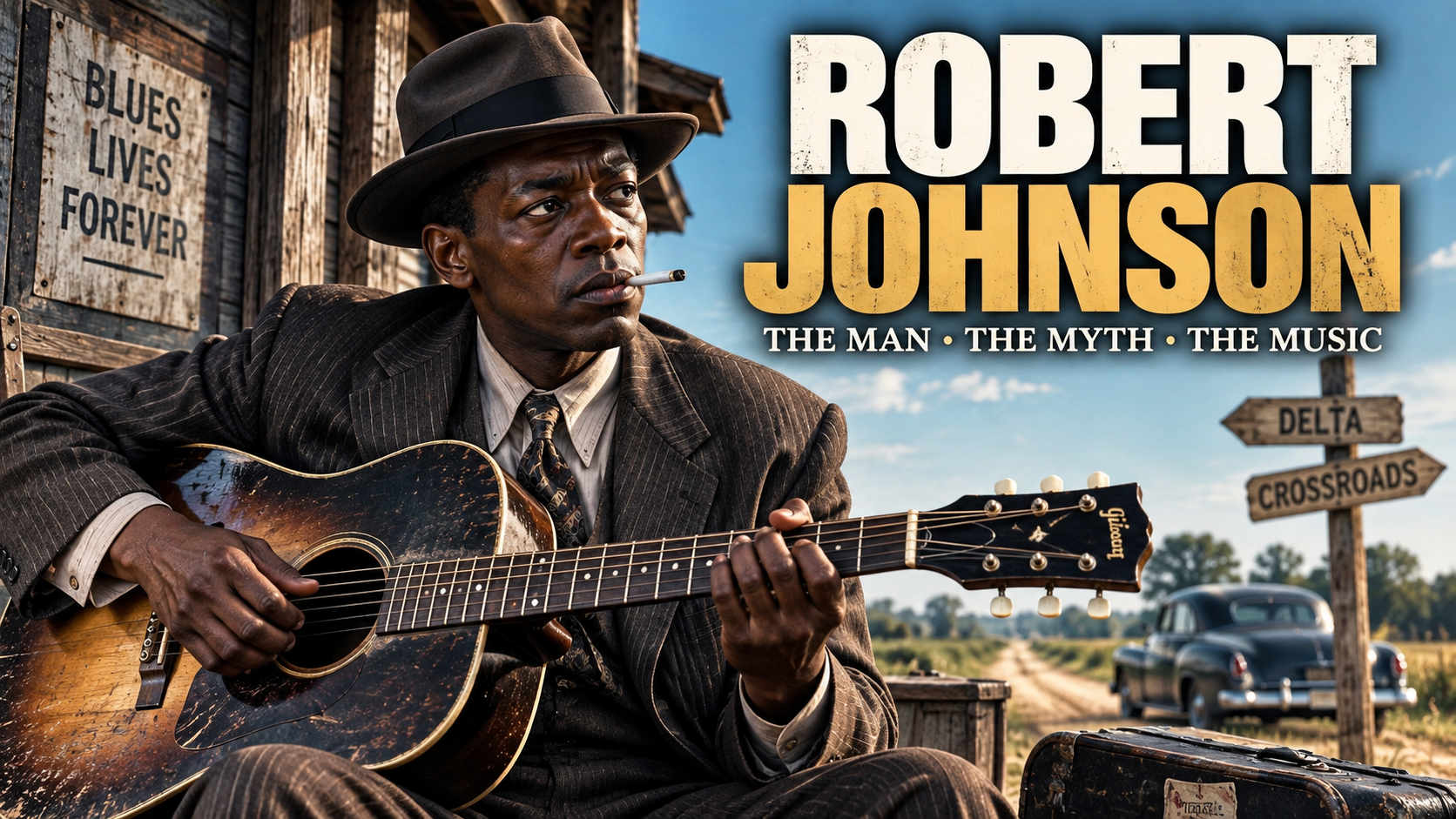

BluesMusica.com: Who was Robert Johnson? Robert Johnson is one of the most influential and mysterious figures in the history of blues music. Although he recorded only a small number of songs during his short career, his guitar playing, songwriting, vocal style, and legendary reputation had an enormous influence on Delta Blues and later generations of blues and rock musicians.
His life remains surrounded by unanswered questions. Very little reliable information exists about some periods of his life, and stories about a supposed deal with the devil helped create one of the most famous myths in music history.
Behind the legend, however, was a highly talented musician whose recordings demonstrate remarkable technical skill, emotional depth, and songwriting ability.
Who Was Robert Johnson?
Robert Johnson was an African American blues musician and songwriter who became one of the most important figures in the history of Delta Blues.
He was born in Mississippi in 1911 and spent much of his life traveling through the American South, performing in towns, juke joints, and other musical environments.
Johnson’s career was relatively short, but his recordings became highly influential after his death.
Today, he is often regarded as one of the greatest blues guitarists and songwriters of all time.
When Was Robert Johnson Born?
Robert Leroy Johnson was born on May 8, 1911, in Hazlehurst, Mississippi, according to widely accepted biographical records.
His family background was connected to the African American communities of Mississippi, a region that became one of the most important centers of early blues music.
Johnson later spent considerable time in the Mississippi Delta and surrounding areas, where he encountered many of the musicians who influenced his development.
How Did Robert Johnson Learn to Play Blues?
One of the fascinating aspects of Johnson’s story is the uncertainty surrounding his early musical development.
Johnson was not initially regarded as an exceptional guitarist. According to accounts from musicians who knew him, he spent time studying and practicing guitar before eventually returning as a remarkably skilled performer.
His sudden improvement contributed to the legend that he had acquired his musical abilities through supernatural means.
In reality, there is no reliable evidence that Johnson made a supernatural agreement to gain his musical talent.
It is far more reasonable to understand his development as the result of intense practice, musical experimentation, listening to other musicians, and years of performing.
Robert Johnson and the Mississippi Delta
The Mississippi Delta played an important role in Johnson’s musical identity.
The region had already produced several influential blues musicians, including Charley Patton and Son House.
Johnson absorbed elements of this musical environment and developed his own highly distinctive approach.
His music combined powerful guitar rhythms, intricate bass patterns, unusual chord voicings, slide guitar techniques, and expressive vocals.
He could create the impression of several musical parts happening simultaneously on a single guitar.
This technique became one of the most impressive characteristics of his playing.
For more background on the musical tradition that shaped Johnson, read our article What Is Delta Blues?.
What Made Robert Johnson’s Guitar Playing Special?
Johnson’s guitar technique was remarkably sophisticated for his era.
He frequently combined bass notes with rhythmic chords and melodic lines, creating a fuller sound than many solo acoustic blues performances.
His guitar often appeared to answer his own vocal phrases.
This created a powerful call-and-response relationship between voice and instrument.
His playing also featured:
- Complex fingerstyle techniques
- Strong rhythmic guitar patterns
- Slide guitar
- Blues-based melodic phrases
- Walking bass figures
- Unusual chord changes
- Expressive guitar bends
- Call-and-response between guitar and voice
- Improvisation
These techniques helped make his recordings sound much larger and more complex than the work of a typical solo guitarist.
Robert Johnson’s Recording Career : LIVE NOW
Robert Johnson recorded relatively few songs during his lifetime.
His first recording sessions took place in San Antonio, Texas, in November 1936. Additional sessions followed in Dallas in 1937.
Among the songs associated with these sessions are some of the most important recordings in blues history.
His recordings were released by Vocalion Records and became increasingly influential after his death.
Although his commercial success during his lifetime was limited compared with later blues stars, his recordings eventually became legendary.
Robert Johnson’s Most Famous Songs
Several Robert Johnson recordings have become essential parts of blues history.
Cross Road Blues
Cross Road Blues is perhaps Johnson’s most famous recording.
The song became closely associated with the later mythology surrounding Johnson, particularly the story of a mysterious crossroads where he supposedly made a supernatural bargain.
The original song itself is more complex than the later popular myth suggests and reflects themes of travel, isolation, danger, and uncertainty.
Hellhound on My Trail
Hellhound on My Trail is one of Johnson’s most haunting recordings.
The song features intense vocals and intricate guitar playing, creating an atmosphere of fear and pursuit.
It is also one of the recordings that contributed to Johnson’s mysterious reputation.
Sweet Home Chicago
Sweet Home Chicago became one of the most widely performed blues songs in history.
The song was later recorded and performed by numerous blues musicians and became strongly associated with Chicago Blues.
Its popularity demonstrates how Johnson’s Delta Blues songwriting eventually became connected with the development of urban blues.
Love in Vain
Love in Vain is another important Johnson composition.
The song later became famous through interpretations by other major musicians, helping introduce Johnson’s songwriting to audiences far beyond the traditional blues community.
Why Is Robert Johnson Associated With the Devil?
The story that Robert Johnson sold his soul to the devil at a crossroads is one of the most famous myths in music.
According to the legend, Johnson supposedly met a mysterious figure at a crossroads who tuned his guitar and gave him extraordinary musical abilities in exchange for his soul.
There is no reliable historical evidence proving that such an event occurred.
The story appears to have developed through a combination of folklore, Johnson’s mysterious biography, his sudden improvement as a guitarist, and the dark themes found in some of his songs.
The legend became even more powerful because relatively little reliable information exists about Johnson’s personal life.
The Crossroads Legend and Blues Mythology
The crossroads story became part of a much larger tradition of blues mythology.
Blues musicians frequently traveled between towns and performed in unfamiliar places. The lifestyle could be difficult, unpredictable, and sometimes dangerous.
Stories about musicians encountering supernatural figures, ghosts, spirits, or the devil were already part of Southern folklore.
Johnson’s music and mysterious reputation made him a perfect figure for this mythology.
However, separating historical evidence from folklore is important when discussing his life.
How Did Robert Johnson Die?
Robert Johnson died in August 1938 at approximately 27 years of age.
The exact circumstances surrounding his death remain uncertain.
There have been different theories concerning the cause, including poisoning, illness, and other possibilities.
Because reliable medical records from the time are limited, historians cannot establish every detail with complete certainty.
His death at such a young age contributed significantly to the mythology surrounding his career.
Why Is Robert Johnson So Important to Blues History?
Johnson’s importance is not simply the result of the myths surrounding his life.
His recordings demonstrate an unusually advanced understanding of guitar, rhythm, melody, and songwriting.
He also represented an important stage in the development of Delta Blues.
His music showed how a solo performer could create complex rhythmic and melodic textures using one guitar and a voice.
His songwriting also explored universal themes such as love, loneliness, betrayal, travel, fear, temptation, and hardship.
These themes helped his music remain relevant long after his death.
Robert Johnson and the Evolution of Blues Guitar
Johnson’s guitar techniques influenced the development of later blues guitar styles.
His combination of bass movement, chordal accompaniment, rhythm, and melody demonstrated what could be achieved with a single acoustic guitar.
Later electric blues musicians expanded these ideas using amplification and full bands.
The connection between Johnson’s Delta Blues and later Chicago Blues illustrates how blues music continuously evolved.
You can explore this next stage in our article What Is Chicago Blues?.
Robert Johnson’s Influence on Muddy Waters
The music of Robert Johnson became part of the larger Delta Blues tradition that influenced musicians who later moved north.
Muddy Waters was one of the musicians who helped transform Southern blues into the electric Chicago Blues sound.
Although their musical approaches were different, both artists represent important stages in the development of blues guitar and songwriting.
Johnson represents the highly expressive acoustic Delta tradition, while Waters became one of the central figures in the amplified urban blues revolution.
Robert Johnson and Rock Music
Robert Johnson’s influence eventually extended far beyond traditional blues.
During the blues revival of the 1960s, younger musicians rediscovered his recordings.
British and American rock musicians studied his guitar playing and songwriting, introducing his music to new generations.
Artists including Eric Clapton and other major rock musicians helped bring renewed attention to Johnson’s work.
His compositions were covered, adapted, and reinterpreted by musicians working in blues, rock, and other genres.
This helped establish Johnson as one of the bridges between early acoustic blues and the modern guitar-driven music that followed.
Robert Johnson’s Legacy
Today, Robert Johnson is regarded as one of the most important figures in blues history.
His influence can be heard in acoustic blues, electric blues, blues rock, and guitar music around the world.
His recordings continue to be studied by guitarists who want to understand traditional blues phrasing and rhythm.
His songwriting also remains influential because of its emotional intensity and memorable imagery.
Perhaps most importantly, Johnson demonstrates how a relatively small body of recorded work can have an enormous cultural impact.
Why Does Robert Johnson Still Matter?
Robert Johnson still matters because his music represents a critical moment in the evolution of American blues.
His recordings preserve an important example of Delta Blues while also demonstrating sophisticated guitar techniques that would influence later musicians.
His story also reminds us that blues history is not only about famous recordings and musicians. It is also about the communities, migration, folklore, hardship, creativity, and cultural experiences that shaped the music.
Frequently Asked Questions About Robert Johnson
Who was Robert Johnson?
Robert Johnson was an influential American Delta Blues musician and songwriter known for his sophisticated guitar playing, powerful vocals, and highly influential recordings.
What is Robert Johnson famous for?
He is famous for songs such as Cross Road Blues, Hellhound on My Trail, Sweet Home Chicago, and Love in Vain, as well as his distinctive guitar technique.
Did Robert Johnson really sell his soul to the devil?
There is no reliable historical evidence that Robert Johnson sold his soul to the devil. The crossroads story is generally understood as folklore and mythology surrounding his mysterious life.
How old was Robert Johnson when he died?
Robert Johnson was approximately 27 years old when he died in 1938.
What type of blues did Robert Johnson play?
Robert Johnson is primarily associated with Delta Blues and the broader country blues tradition of the American South.
Why is Robert Johnson important to guitar history?
Johnson developed an advanced solo guitar style that combined bass lines, rhythm, chords, melody, and vocal interaction. His techniques influenced generations of blues and rock guitarists.
Explore More Blues Music History
- Where Did Blues Music Originate?
- How Did Blues Music Develop?
- What Is Delta Blues?
- What Is Chicago Blues?
- What Is Electric Blues?
- Who Created Blues Music?
- Who Is the Father of the Blues?
Final Thoughts
Robert Johnson’s story sits at the intersection of history, music, folklore, and mystery.
Although many details of his life remain uncertain, his surviving recordings provide a clear picture of a remarkably talented blues musician.
His guitar playing helped demonstrate the possibilities of solo Delta Blues, while his songwriting gave future generations of musicians a powerful collection of songs to reinterpret.
From Mississippi Delta Blues to Chicago electric blues and eventually blues rock, Johnson’s influence became part of a much larger musical journey.
His life may have been short, but his music continues to travel far beyond the crossroads where his legend began.