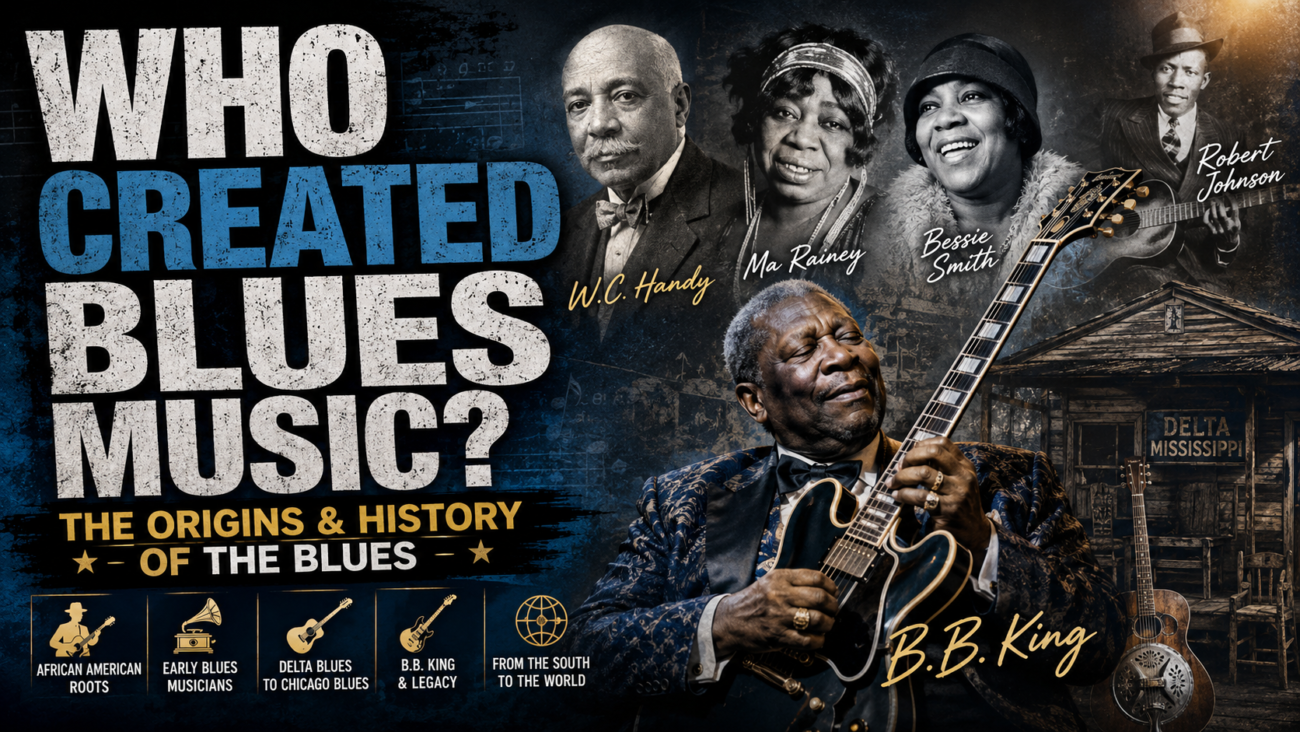
BluesMusica.com: How did blues music develop? The blues did not appear suddenly as a finished musical genre. It developed gradually through African American musical traditions, work songs, spirituals, field hollers, storytelling, dance music, and other forms of musical expression in the Southern United States.
Over several decades, the blues changed as musicians moved between rural communities and growing cities. Acoustic country blues eventually gave rise to powerful regional styles such as Delta Blues and Chicago Blues, while electric instruments transformed the sound again. The blues then became one of the most influential foundations of modern popular music.
How Did Blues Music Begin?
The development of blues music is closely connected to African American history in the United States.
After the end of slavery, African American communities throughout the South developed musical traditions that reflected everyday life, hardship, work, relationships, travel, religion, and personal experience.
These traditions included spirituals, work songs, field hollers, ring shouts, and African-derived rhythmic and melodic practices.
Over time, musicians combined these elements with other American musical traditions. The result was not one single sound but a broad family of musical practices that eventually became recognizable as the blues.
There is therefore no single person who can accurately be described as the inventor of the blues.
The blues was a cultural development that took place over generations.
The African Roots of the Blues : LIVE NOW
African musical traditions played an important role in the development of African American music.
Musical characteristics such as call-and-response, rhythmic complexity, expressive vocal techniques, and the importance of improvisation survived the Atlantic slave trade and continued to evolve in African American communities.
These traditions interacted with European American musical influences and the social conditions of the American South.
The result was a unique musical culture that eventually produced spirituals, gospel, blues, jazz, rhythm and blues, and many other forms of American music.
The blues should therefore be understood as part of a much larger African American musical history.
From Work Songs and Field Hollers to the Blues
One important part of the blues story involves the musical traditions of African American workers in the South.
Field hollers were often highly individual vocal expressions. A singer could stretch notes, change pitch, and use emotional vocal inflections to communicate feelings or simply accompany physical work.
Work songs could also create rhythm and coordination among groups of workers.
Call-and-response patterns became another important musical characteristic.
These practices did not constitute the blues by themselves, but they contributed musical ideas that later became central to blues performance.
The Rise of Country Blues
During the late nineteenth and early twentieth centuries, blues traditions became increasingly recognizable as a distinct musical form.
Country blues musicians often performed with acoustic guitars, harmonicas, banjos, or simply their voices.
Many musicians traveled between towns, plantations, railroad communities, juke joints, and other gathering places.
The music was often highly personal.
A blues performer could sing about love, loneliness, poverty, travel, work, conflict, humor, or everyday experiences.
This flexibility helped the blues spread from community to community.
When Was the Blues First Recorded?
The blues existed before commercial recording companies began documenting it.
The Library of Congress explains that the blues was generally being performed in the Southern United States by the 1890s, while the first blues recordings appeared during the 1910s.
Recording technology dramatically changed the future of the music.
For the first time, performances could be preserved and distributed to audiences far beyond the communities where the musicians originally performed.
Record companies began releasing blues recordings, and musicians who had previously been known primarily within regional communities could reach larger audiences.
W.C. Handy and the Popularization of the Blues
One important figure in the early commercial history of the blues was W.C. Handy.
Handy is often called the “Father of the Blues,” although he did not literally invent the blues.
His importance came from documenting, arranging, publishing, and popularizing blues-influenced music for wider audiences.
His 1912 publication of Memphis Blues helped bring blues musical ideas into the commercial music industry.
This was an important moment because blues-inspired music was beginning to move from local traditions into national popular culture.
For more background, read our article Who Is the Father of the Blues?.
How Did the Mississippi Delta Shape the Blues?
The Mississippi Delta became one of the most important regions in blues history.
The area produced musicians whose guitar styles, vocals, rhythms, and songwriting became foundational to what is now called Delta Blues.
Artists such as Charley Patton, Son House, Tommy Johnson, Willie Brown, and Robert Johnson became associated with the region’s powerful blues tradition.
Dockery Farms in Mississippi was particularly important as a meeting place for several influential musicians.
Delta Blues often emphasized raw acoustic guitar, rhythmic intensity, slide guitar, powerful vocals, and highly personal lyrics.
You can explore this style in greater detail in our guide to What Is Delta Blues?.
How Did the Great Migration Change the Blues?
One of the biggest turning points in blues history was the Great Migration.
During the twentieth century, millions of African Americans moved from the rural South to cities in the North, Midwest, and West.
Musicians were part of this movement.
They carried Southern musical traditions with them and introduced the blues to new urban audiences.
Cities such as Chicago became major centers of African American music.
The urban environment changed the blues.
Musicians were now performing in larger and noisier venues. Instead of relying only on acoustic instruments, they increasingly experimented with microphones, amplifiers, electric guitars, drums, bass, and larger ensembles.
From Delta Blues to Chicago Blues
Chicago became one of the most important destinations for Southern blues musicians.
The traditional language of Delta Blues remained, but the instrumentation became more powerful.
Electric guitar, amplified harmonica, piano, bass, and drums created a fuller sound that could fill crowded clubs and taverns.
Muddy Waters became one of the central figures in this transformation.
He brought Mississippi Delta traditions into Chicago and helped establish the powerful electric blues sound that became associated with the city.
Howlin’ Wolf, Little Walter, Elmore James, Willie Dixon, and many other musicians also played important roles in the development of Chicago Blues.
Learn more in our article What Is Chicago Blues?.
The Electric Blues Revolution
Electric amplification changed the possibilities of blues performance.
Guitarists could produce louder tones and more sustain. Harmonica players could use microphones and amplifiers to create aggressive lead sounds. Bass and drums created a stronger rhythmic foundation.
The result was electric blues.
Electric blues retained many characteristics of earlier blues, including the blues scale, call-and-response, repeated riffs, improvisation, expressive vocals, and familiar chord structures.
But amplification gave the music a completely different physical presence.
Instead of an intimate acoustic performance, blues could now become loud, powerful, and suitable for large urban venues.
Read more about this transformation in What Is Electric Blues?.
The Development of Blues Guitar
The guitar became one of the defining instruments of blues music.
Early country blues guitarists developed techniques that remain essential to blues guitar today.
- String bending
- Slide guitar
- Vibrato
- Repeated riffs
- Call-and-response phrases
- Improvisation
- Walking bass patterns
- Rhythmic guitar accompaniment
Electric amplification allowed guitarists to take these techniques even further.
Players could control volume, sustain, distortion, tone, and dynamics to create highly expressive sounds.
This eventually helped establish the electric guitar as one of the most important instruments in modern popular music.
How Did Blues Become More Popular?
Several factors helped blues reach increasingly large audiences.
Recording technology allowed performances to be distributed beyond local communities. Radio introduced blues and blues-influenced music to wider audiences. Record companies promoted successful musicians, while touring performers carried the music between cities.
The growth of African American urban communities also created important markets for blues recordings and live performances.
By the middle of the twentieth century, blues had become an important part of American popular music.
The Connection Between Blues and Rhythm and Blues
As popular music changed after World War II, blues became increasingly connected with rhythm and blues.
Rhythm and blues incorporated blues traditions with stronger rhythms, gospel influences, jazz elements, and other musical approaches.
This new musical environment helped create a bridge between traditional blues and later forms of soul, funk, rock, and popular music.
Many musicians and producers who worked in rhythm and blues were deeply influenced by blues musicians and blues songwriting.
How Did Blues Influence Rock Music?
The development of blues did not stop with electric blues.
During the 1950s and 1960s, blues became a major source of inspiration for rock musicians in the United States and Britain.
Guitar riffs, blues scales, 12-bar structures, vocal approaches, improvisation, and amplified guitar tones became central elements of early rock.
British musicians in particular studied American blues recordings and introduced their own interpretations of the music to new audiences.
This helped create British Blues and eventually influenced the development of blues rock and hard rock.
The relationship between blues and rock is one of the most important chapters in the history of modern music.
The Role of B.B. King in Modern Blues
B.B. King helped demonstrate how traditional blues could continue evolving while remaining deeply connected to its roots.
His distinctive electric guitar style emphasized expressive bends, vibrato, controlled phrasing, and emotional storytelling.
His guitar, Lucille, became one of the most recognizable instruments in blues history.
King also helped introduce blues to enormous international audiences and became one of the most influential guitarists of the twentieth century.
His career demonstrated that blues could remain relevant even as popular music continued to change.
Blues Continues to Evolve
Blues music never stopped developing.
Traditional acoustic blues continues to be performed alongside electric blues, Chicago Blues, Texas Blues, blues rock, contemporary blues, and many other variations.
Modern musicians may combine blues with rock, soul, country, gospel, funk, or other musical traditions.
Yet the basic emotional language of the blues remains recognizable.
A powerful vocal line, a bending guitar note, a repeated riff, or a simple call-and-response phrase can still communicate feelings that audiences understand across generations and cultures.
Why Is the Development of Blues Important?
Understanding how blues music developed helps explain why the genre has had such an enormous influence on modern music.
The blues was not created in isolation.
It emerged from African American cultural traditions and continued changing as musicians responded to migration, technology, urban life, recording industries, and new audiences.
Delta Blues helped establish a powerful rural guitar tradition. Chicago Blues transformed that language through electric instruments. Later musicians carried blues ideas into rock, rhythm and blues, soul, country, jazz, and many other genres.
The history of blues is therefore also a history of musical transformation.
Frequently Asked Questions About Blues Development
How did blues music develop?
Blues developed gradually from African American musical traditions in the Southern United States, including spirituals, work songs, field hollers, and other musical practices. It later evolved through country blues, Delta Blues, Chicago Blues, and electric blues.
When did blues music begin?
The blues developed during the late nineteenth and early twentieth centuries. The Library of Congress notes that blues was being performed in the Southern United States by the 1890s, while commercial recordings began appearing in the 1910s.
Did one person invent the blues?
No. The blues developed collectively over generations within African American communities. W.C. Handy became famous for helping document and popularize blues music, but he did not invent the genre.
Why did blues become electric?
Urban venues were often louder than rural performance environments. Electric guitars, amplified harmonicas, microphones, bass, and drums allowed musicians to create a stronger sound that could reach larger audiences.
How did Chicago change the blues?
Chicago musicians transformed Southern blues traditions into a powerful urban sound featuring electric guitar, amplified harmonica, piano, bass, drums, and larger ensembles.
Did blues influence rock music?
Yes. Blues was one of the most important foundations of rock music. Blues guitar techniques, riffs, chord structures, rhythms, vocal styles, and improvisation strongly influenced rock musicians.
Explore the History of Blues Music
- Where Did Blues Music Originate?
- Who Created Blues Music?
- Who Is the Father of the Blues?
- What Is Delta Blues?
- What Is Chicago Blues?
- What Is Electric Blues?
Final Thoughts
Blues music developed through generations of creativity, cultural exchange, migration, technology, and personal expression.
From African American musical traditions in the Southern United States to Delta Blues, from the Great Migration to Chicago Blues, and from acoustic guitars to powerful electric bands, every stage added something new to the story.
The blues survived because it was flexible enough to evolve without losing its emotional identity.
That evolution continues today.
The blues may sound different from one generation to another, but its heart remains the same: honest stories, expressive music, and the freedom to turn life experiences into sound.
Blues Music- How Did Blues Music Develop