
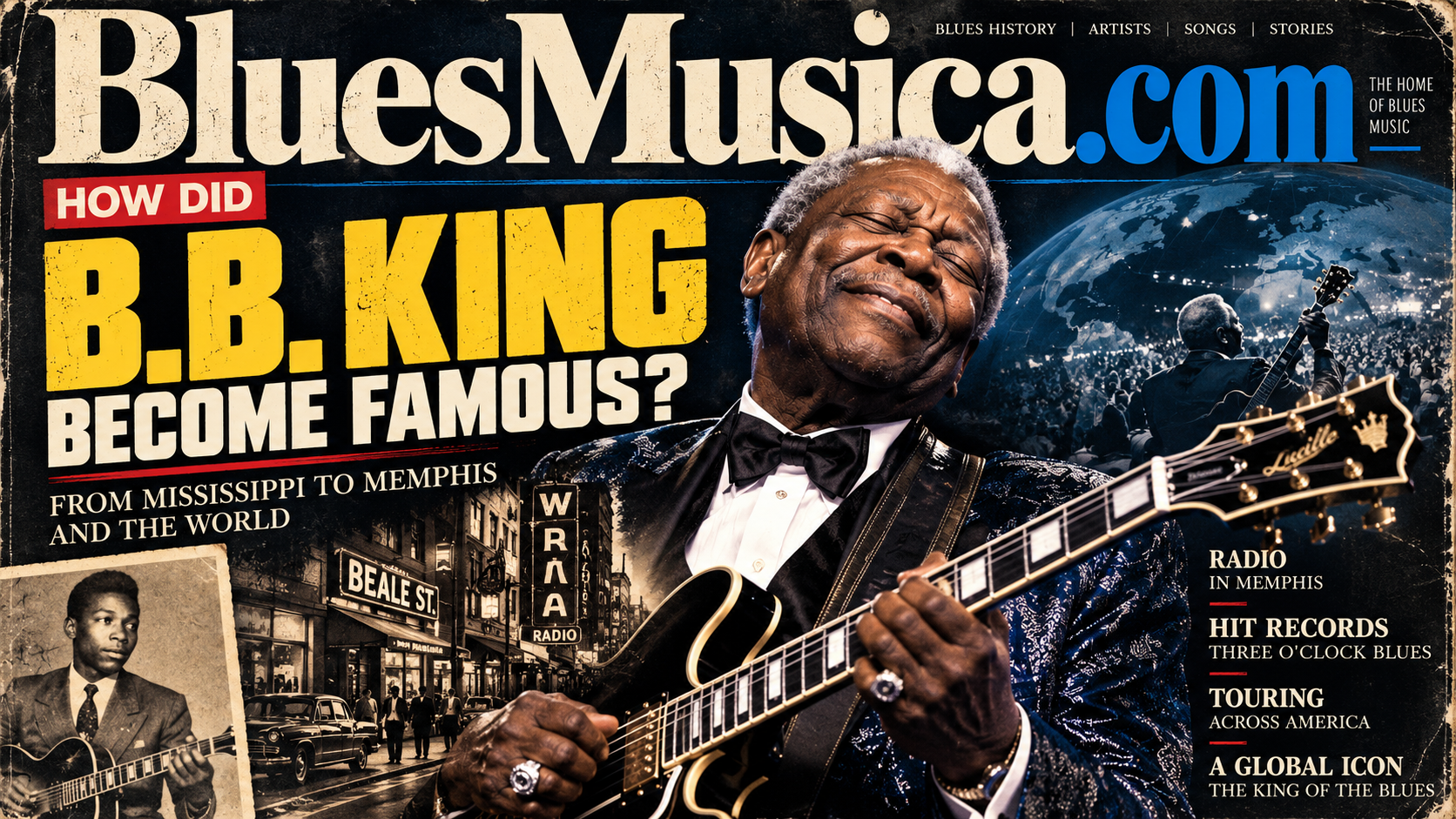

BluesMusica.com: How did B.B. King become famous? Before he became known around the world as the King of the Blues, B.B. King was Riley B. King, a young musician from Mississippi trying to build a career with his guitar and voice.
His journey from the Mississippi Delta to Memphis, radio, record labels, theaters, and eventually international stages is one of the most remarkable stories in blues history.
B.B. King did not become famous overnight. His career developed over decades through relentless touring, radio exposure, hit records, and a unique guitar style that made his sound instantly recognizable.
Who Was B.B. King Before He Became Famous?
B.B. King was born Riley B. King on September 16, 1925, in Mississippi.
Music became an important part of his early life, and the guitar eventually became the instrument through which he would build his career.
As a young man, King moved toward Memphis, Tennessee, where the city’s thriving blues scene offered opportunities that were difficult to find in rural Mississippi.
Memphis would become one of the most important places in the development of his career.
Memphis Helped Launch B.B. King’s Career
Memphis was a major center for African American music during the 1940s and 1950s. Blues musicians, singers, radio personalities, and record companies were creating a musical environment that attracted performers from across the South.
King became part of this scene and began performing on Beale Street.
His appearances on WDIA, one of the most influential Black radio stations in the United States, became particularly important.
Radio gave B.B. King something that live performances alone could not provide: access to a much larger audience.
How Did B.B. King Get His Famous Name?
His famous name also developed during his Memphis years.
King became known as the Beale Street Blues Boy, which was later shortened to Blues Boy. Eventually, the name became the legendary initials we know today: B.B. King.
The name became inseparable from his identity as a blues performer.
Read the complete story here:
How Did B.B. King Get His Name?
His Radio Career Expanded His Audience
Radio was one of the most powerful tools available to musicians during B.B. King’s early career.
His performances and radio appearances helped listeners throughout the Memphis area discover his voice and guitar playing.
King understood the importance of connecting with an audience. His personality, singing voice, and distinctive guitar style made him different from many other performers competing for attention.
Instead of treating the guitar as simply an accompanying instrument, King made it an emotional voice of its own.
His First Recordings Started Building His Reputation
B.B. King’s recording career began in the late 1940s.
His early recordings established him as a serious blues artist, but his breakthrough would take time.
During these early years, King continued developing his sound and building an audience through constant performances.
His career demonstrates how important touring was to the development of blues musicians before the modern internet and streaming era.
Three O’Clock Blues Became a Major Breakthrough
One of the most important early moments in B.B. King’s career came with Three O’Clock Blues.
Released in 1951, the song became a major blues hit and helped establish King as one of the leading blues performers of his generation.
The success of the recording significantly expanded his reputation and gave him greater opportunities to perform for larger audiences.
It was one of the recordings that helped transform B.B. King from a regional performer into a nationally recognized blues artist.
B.B. King Built His Fame Through Touring
Recording success was only part of the story.
B.B. King became famous partly because he was one of the hardest-working touring musicians in American music.
For decades, he performed hundreds of shows each year across the United States and eventually around the world.
This constant touring allowed audiences to experience his music directly and helped turn his name into a major blues brand.
King’s live performances also gave him the opportunity to develop his interaction with audiences, singers, and other musicians.
His Guitar Style Made Him Instantly Recognizable
Another major reason B.B. King became famous was his guitar playing.
His style was remarkably different from guitarists who focused on speed and technical complexity.
King used expressive bends, controlled vibrato, carefully chosen notes, pauses, and call-and-response phrases to make his guitar sound almost like another human voice.
That distinctive approach eventually became one of the most influential guitar styles in blues history.
His famous guitar, Lucille, became another important part of his public identity.
What Guitar Did B.B. King Play?
Why Did B.B. King Name His Guitar Lucille?
Why Did B.B. King Stand Out From Other Blues Musicians?
There were many talented blues musicians during B.B. King’s rise to fame.
What separated King was the combination of several elements:
- A distinctive and emotional singing voice
- A highly recognizable guitar tone
- His signature vibrato and string bends
- Strong stage presence
- Exceptional storytelling through music
- A relentless touring schedule
- The ability to connect with audiences
He developed a sound that listeners could identify within only a few notes.
The Thrill Is Gone Took B.B. King to a New Audience
B.B. King had already established himself as a blues star long before The Thrill Is Gone.
However, the song became one of the most important recordings of his career.
Released in 1969, the recording introduced King’s blues sound to a much broader mainstream audience.
The song became a major commercial success and reached the Billboard Hot 100 in 1970. It also won King a Grammy Award for Best R&B Vocal Performance, Male.
The success demonstrated that traditional blues could reach listeners far beyond the genre’s traditional audience.
B.B. King Crossed Into Rock and Popular Music
As B.B. King’s reputation grew, his music increasingly reached rock audiences.
British and American rock musicians had already been drawing heavily from American blues, and many of them regarded King as an essential influence.
His collaborations and performances with major musicians helped introduce his music to people who might not normally listen to traditional blues.
This crossover helped establish B.B. King as something much bigger than a successful blues musician.
His Influence Reached Eric Clapton and Stevie Ray Vaughan
B.B. King’s influence could be heard throughout the blues-rock guitar movement.
Guitarists such as Eric Clapton and Stevie Ray Vaughan helped carry the blues tradition into new generations of rock and blues audiences.
King’s influence was not simply about copying his guitar licks. His deeper lesson was about emotional phrasing, tone, timing, and making every note meaningful.
This philosophy remains central to modern blues guitar.
How B.B. King Became an International Blues Icon
By the 1970s, B.B. King was no longer simply a successful American blues musician.
He had become an international ambassador for the blues.
He performed in countries around the world and appeared at major festivals and prestigious venues.
His music crossed cultural boundaries because the emotional language of his guitar and voice was easy to understand even when listeners did not know the history of American blues.
B.B. King Became Known as the King of the Blues
The title King of the Blues eventually became almost inseparable from B.B. King.
It reflected more than his commercial success. It represented his enormous influence on the development and international recognition of modern blues.
His career connected several generations of blues musicians and helped preserve the importance of traditional blues while introducing it to new audiences.
Watch B.B. King Perform
Watching B.B. King perform helps explain why his live career was so important to his rise. His interaction with the audience, his voice, and the expressive sound of Lucille all became part of his legendary stage presence.
B.B. King’s Most Important Career Milestones
- 1925: Riley B. King is born in Mississippi.
- 1940s: King develops his career in Memphis and becomes connected with Beale Street.
- 1940s: His radio appearances on WDIA help introduce him to a wider audience.
- 1951: Three O’Clock Blues becomes a major blues hit.
- 1950s–1960s: King establishes himself as one of the most important touring blues performers.
- 1960s: His reputation expands beyond the traditional blues audience.
- 1969: The Thrill Is Gone is released.
- 1970: The Thrill Is Gone becomes a major mainstream hit.
- 1971: King wins a Grammy Award for the recording.
- 1970s onward: King becomes an international ambassador for blues music.
Frequently Asked Questions
How did B.B. King become famous?
B.B. King became famous through a combination of Memphis radio exposure, successful recordings, relentless touring, and his distinctive blues guitar and vocal style. His 1951 hit Three O’Clock Blues was an important early breakthrough.
What was B.B. King’s first big hit?
Three O’Clock Blues, released in 1951, became one of B.B. King’s first major commercial successes and helped establish his national reputation.
When did B.B. King become internationally famous?
King’s international reputation grew substantially during the 1960s and 1970s as his recordings, touring, collaborations, and appearances reached audiences outside the United States.
What song made B.B. King famous to mainstream audiences?
The Thrill Is Gone was particularly important in bringing B.B. King to a broader mainstream audience. The recording became a major hit around 1970 and earned him a Grammy Award.
Why was B.B. King so important to blues music?
B.B. King helped bring traditional blues to international audiences while influencing generations of guitarists. His expressive guitar style became one of the defining sounds of modern electric blues.
Conclusion
So, how did B.B. King become famous?
It was not the result of one song or one performance. His rise came from decades of work: Memphis radio, Beale Street performances, early recordings, major hits, relentless touring, and an unmistakable guitar style.
He transformed the electric blues guitar into an emotional voice that could communicate with audiences around the world.
From Three O’Clock Blues to The Thrill Is Gone, B.B. King’s career shows how a musician can build a lasting legacy by staying true to the blues while continuing to reach new generations.
That journey ultimately turned Riley B. King into one of the most recognizable names in music history: B.B. King, the King of the Blues.
Related B.B. King Articles:
- How Did B.B. King Get His Name?
- What Guitar Did B.B. King Play?
- How Did B.B. King Influence Guitar Players?
- 10 B.B. King Songs You Should Know
- Why Did B.B. King Name His Guitar Lucille?
B.B. King from Memphis to the World