
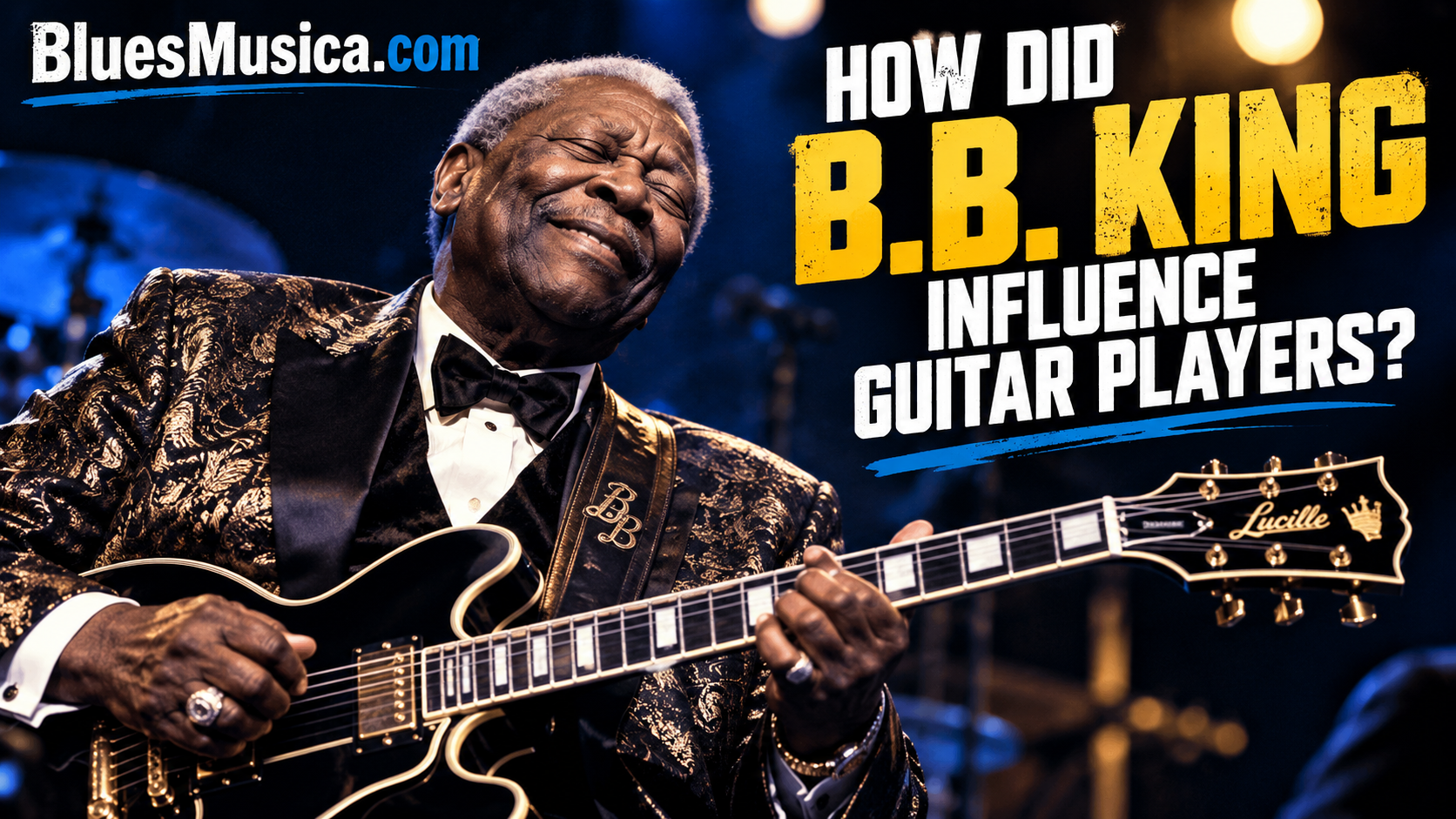

BluesMusica.com: How did B.B. King influence guitar players around the world? Few musicians changed the language of blues guitar as profoundly as B.B. King. His influence was not built on complicated scales or endless guitar solos. Instead, King showed generations of guitarists how much emotion could come from a single note, a carefully placed bend, expressive vibrato, and the power of silence.
Known as the King of the Blues, B.B. King developed a guitar style that became instantly recognizable. His sound combined emotional phrasing, powerful string bends, distinctive vibrato, and the warm singing tone of his famous Gibson guitar, Lucille.
His approach influenced blues musicians, blues-rock guitarists, and players across multiple generations. From Eric Clapton and Stevie Ray Vaughan to modern blues artists, the fingerprints of B.B. King’s playing can still be heard today.
B.B. King Changed the Way Guitarists Used Emotion
One of B.B. King’s greatest contributions to guitar was demonstrating that technical complexity was not necessary to create a powerful solo.
King could make a short phrase sound more emotional than a long sequence of notes. He carefully controlled the timing, pitch, dynamics, and vibrato of each note.
This became one of the most important lessons for blues guitarists: the emotional quality of a note can matter more than the number of notes being played.
His Signature Vibrato Became a Blues Guitar Trademark
B.B. King’s vibrato is one of the most recognizable sounds in blues guitar.
Instead of simply shaking the string randomly, King developed a controlled and highly expressive vibrato. His fretting hand could make a sustained note seem to sing, cry, or speak.
For many guitarists, learning B.B. King’s vibrato became almost a rite of passage. It demonstrated that guitar technique could be used to imitate the emotional expression of a human voice.
B.B. King Mastered Expressive String Bending
String bending was another essential part of King’s style.
He did not treat bending as simply a technique for reaching another pitch. His bends were part of the emotional vocabulary of his music.
A B.B. King bend could begin slightly below the target note, slowly rise into pitch, and then be combined with vibrato. That subtle movement gave his guitar a vocal quality.
This approach became enormously influential among blues and rock guitarists.
He Proved That One Note Can Be Powerful
One of the most important lessons from B.B. King is the importance of restraint.
Rather than filling every second with guitar notes, King understood how to make individual notes stand out. He frequently used short phrases followed by silence.
That space gave the listener time to absorb the emotion of the phrase.
This philosophy influenced countless guitarists who learned that great blues playing is not necessarily about playing more. Sometimes, playing less creates a stronger emotional impact.
Call and Response Became a Central Part of His Guitar Style
B.B. King often treated his guitar almost like another singer in the band.
He would sing a phrase and answer it with Lucille. Then the guitar might respond to another vocal phrase with a completely different musical statement.
This call-and-response approach is deeply rooted in blues tradition, but King turned it into a highly personal guitar language.
His guitar was not simply accompanying the singer. Lucille was part of the conversation.
B.B. King Taught Guitarists How to Play Behind the Vocal
Another important part of King’s influence was his ability to understand when the guitar should step forward and when it should stay in the background.
Many inexperienced guitarists try to play continuously during a vocal performance. King demonstrated the opposite approach.
He understood that a guitar phrase can become more powerful when it responds to the singer instead of competing with the singer.
This lesson became particularly important for blues musicians performing with vocalists and full bands.
Lucille Helped Define His Sound
B.B. King’s guitar tone was inseparable from his playing style.
His famous Gibson guitars, collectively associated with the name Lucille, helped produce the warm, singing tone that became his trademark.
King eventually became closely associated with the Gibson ES-335 and ES-355 family of guitars. His later signature Gibson Lucille incorporated design changes that reflected his performance preferences.
To learn more about the instruments behind his sound, read our complete guide:
What Guitar Did B.B. King Play?
And the story behind the legendary name Lucille is equally fascinating:
Why Did B.B. King Name His Guitar Lucille?
His Influence on Eric Clapton
B.B. King’s influence reached far beyond traditional blues.
British blues-rock guitarists helped introduce American blues vocabulary to a massive international audience, and B.B. King became one of the essential blues guitar references for players such as Eric Clapton.
Clapton’s playing demonstrated how blues phrasing, bending, vibrato, and expressive guitar solos could be incorporated into rock music.
The connection between blues and rock guitar helped establish many of the techniques associated with modern electric guitar.
His Influence on Stevie Ray Vaughan
Stevie Ray Vaughan was another major guitarist deeply connected to the B.B. King tradition.
Although Vaughan developed a much heavier Texas blues sound, his playing shared important characteristics with King’s approach: expressive bends, powerful vibrato, emotional phrasing, and a strong connection between the guitar and the human voice.
The influence demonstrates an important point: musicians did not need to copy B.B. King’s exact tone or equipment to learn from his musical philosophy.
His Influence on Modern Blues Guitar
B.B. King’s influence continues through contemporary blues guitarists.
Modern players may use different amplifiers, pedals, guitars, and recording technology, but the basic principles remain familiar:
- Make every note meaningful.
- Use vibrato to create emotion.
- Bend notes with intention.
- Leave space between phrases.
- Listen to the vocalist.
- Use call and response.
- Build tension before releasing it.
- Choose tone carefully.
These ideas remain fundamental to blues guitar education.
Why B.B. King Did Not Need Complicated Guitar Runs
One of the most interesting aspects of B.B. King’s playing is how rarely he relied on excessive technical displays.
His solos could contain relatively few notes, yet those notes had strong rhythmic and emotional purpose.
Instead of asking, “How many notes can I play?” King’s approach suggested another question:
“How much emotion can I put into this note?”
That idea continues to influence guitarists who want their playing to sound expressive rather than merely impressive.
What Guitarists Can Learn From B.B. King
For beginners and experienced guitarists alike, B.B. King’s style provides several valuable lessons.
1. Practice Vibrato
A controlled vibrato can transform an ordinary sustained note into an expressive musical statement.
2. Learn to Bend in Tune
Blues bends should have purpose. Practice reaching the correct pitch rather than simply pushing the string upward.
3. Use Silence
Do not feel obligated to fill every space. Silence can create anticipation and make the next phrase more powerful.
4. Listen Before You Play
B.B. King’s style was based heavily on responding to what was happening around him. Listening is therefore just as important as technique.
5. Make Short Phrases Count
A simple three- or four-note phrase can become memorable when it has the right rhythm, dynamics, bending, and vibrato.
B.B. King’s Greatest Guitar Lesson
The greatest lesson from B.B. King may be that blues guitar is fundamentally about communication.
His guitar did not need hundreds of notes to communicate sadness, tension, joy, loneliness, confidence, or hope. A single bend could tell a story.
That is why his influence remains so powerful decades after he first began recording and performing.
His most famous songs provide countless examples of this philosophy. For a starting point, explore our guide to 10 B.B. King Songs You Should Know.
Watch B.B. King Perform
Watching B.B. King perform is one of the best ways to understand his influence. Pay attention not only to the notes he plays, but also to his timing, facial expression, pauses, bends, vibrato, and interaction with the vocalist.
Frequently Asked Questions
How did B.B. King influence guitar players?
B.B. King influenced guitar players through his expressive vibrato, emotional bends, simple but powerful phrasing, call-and-response technique, use of silence, and distinctive guitar tone.
Why is B.B. King’s guitar playing so influential?
His playing demonstrated that emotional expression could be more important than technical complexity. He showed guitarists how to make a small number of carefully chosen notes communicate powerful emotions.
What guitar technique is B.B. King famous for?
He is particularly famous for his expressive string bending and distinctive vibrato, combined with precise phrasing and controlled dynamics.
Did B.B. King influence rock guitar?
Yes. His blues vocabulary influenced generations of blues-rock guitarists and helped shape the expressive guitar techniques that became central to rock music.
What can beginners learn from B.B. King?
Beginners can learn to bend notes accurately, develop controlled vibrato, use musical pauses, practice call and response, and focus on emotional phrasing instead of simply playing fast.
Conclusion
B.B. King influenced guitar players by changing the way they thought about expression. He proved that a guitar does not need to play complicated passages to tell a powerful story.
His vibrato, bends, phrasing, tone, timing, and use of silence became part of the vocabulary of modern blues guitar. His influence can be heard in blues, blues rock, rock, and contemporary guitar music.
More than a guitarist, B.B. King became a teacher without needing a classroom. Through Lucille, he showed generations of musicians that one great note can sometimes say more than a hundred ordinary ones.
For more stories about the King of the Blues, explore our B.B. King collection on BluesMusica.com.
Related B.B. King Articles:
- How Did B.B. King Get His Name?
- What Guitar Did B.B. King Play?
- Why Did B.B. King Name His Guitar Lucille?
- 10 B.B. King Songs You Should Know
Why Did B.B. King Name His Guitar Lucille?