BluesMusica.com: Before the world knew him as B.B. King, he was Riley B. King, a young musician from Mississippi searching for a way to build a life around music.
His journey from the Mississippi Delta to Memphis eventually gave him one of the most recognizable names in blues history.
But how exactly did Riley B. King become B.B. King?
The answer begins with Memphis, Beale Street, and a radio station that helped introduce his music to a much larger audience.
Who Was Riley B. King?
B.B. King was born Riley B. King on September 16, 1925, in Mississippi.
Growing up in the Mississippi Delta, King was surrounded by gospel music and the blues. Music eventually became more than an interest. It became the path he wanted to follow.
In the 1940s, King traveled to Memphis, Tennessee, where he sought out his mother’s cousin, blues musician Bukka White.
White helped the young guitarist develop his musical skills and introduced him to the demanding musical environment of Memphis.
Memphis would become one of the most important places in Riley King’s transformation into B.B. King.
Why Memphis Was Important to B.B. King
During the 1940s, Memphis was one of the major centers of African-American music in the United States.
Beale Street was particularly important. Blues musicians, singers, clubs, businesses, and audiences created a vibrant musical community around the famous street.
For a young musician like Riley King, Memphis offered something Mississippi could not provide on the same scale: a much larger audience and a professional music industry.
King began performing around Memphis while continuing to develop his distinctive approach to blues guitar.
From Beale Street Blues Boy to Blues Boy King
Riley King’s early career was closely connected with radio.
In 1948, he performed on a Memphis radio program hosted by Sonny Boy Williamson. His appearance helped him gain attention, and he eventually received an opportunity to perform regularly on WDIA, one of the most influential Black-oriented radio stations in Memphis.
At WDIA, King developed an audience beyond the clubs and streets of Memphis.
His original nickname was reportedly “Beale Street Blues Boy.”
The name was eventually shortened to “Blues Boy” King.
And eventually, it became the name the world would remember:
B.B. King.
Where Did the Initials B.B. Come From?
The initials B.B. were connected to the shortened version of his radio nickname, “Blues Boy.”
The name was simple, memorable, and easy for radio listeners to recognize.
At a time when radio was one of the most powerful ways for a musician to reach a mass audience, having a memorable name was important.
Riley King was becoming a professional entertainer, and the name B.B. King gradually became attached to his music and personality.
B.B. King and WDIA Radio
WDIA played an important role in the early development of B.B. King’s career.
King eventually hosted a regular radio segment known as “King’s Spot.”
Through radio, listeners could hear his singing, guitar playing, and personality without having to attend one of his performances.
This helped him establish something every emerging artist needs: recognition.
The name B.B. King became increasingly familiar to Memphis listeners.
The Name Became Bigger Than Memphis
Once B.B. King began recording professionally, the name followed him beyond Memphis.
His first commercial recording, “Miss Martha King,” was released in 1949.
In 1951, King recorded “3 O’Clock Blues.”
The song became a major breakthrough and reached No. 1 on the Billboard R&B chart in early 1952.
At that point, B.B. King was no longer simply a Memphis radio personality.
He was becoming a nationally recognized blues artist.
How B.B. King Became a Blues Legend
The name B.B. King may have started as a radio identity, but the legend was built through decades of music.
King became known for a distinctive guitar style built around expressive bends, vibrato, sustained notes, timing, dynamics, and space.
Instead of filling every moment with guitar notes, he often allowed individual phrases to breathe.
His guitar seemed to answer his voice.
This call-and-response relationship between singer and guitar became one of the defining characteristics of his style.
B.B. King and Lucille
There is another name that became inseparable from B.B. King:
Lucille.
King gave the name Lucille to his guitars, and over the years the name became almost as famous as B.B. King himself.
For King, Lucille was more than a musical instrument. The guitar became an important part of his identity and his sound.
Every time audiences heard B.B. King play one of his signature guitar lines, they were hearing a musical voice that had been developed over decades.
Read more about the story behind the name Lucille in our previous article:
Why Did B.B. King Name His Guitar Lucille?
From Small Stages to the World
Long before B.B. King performed in major concert halls, he was playing smaller venues and working relentlessly to establish himself.
His early career was built through radio, clubs, touring, and constant performances.
That journey is important because B.B. King did not begin as an international superstar.
He began as Riley B. King, a young Mississippi musician trying to make his way in Memphis.
The stages became larger.
The audiences became larger.
But the blues remained at the center of his music.
B.B. King and the Title King of the Blues
The name B.B. King came before the title King of the Blues.
Over the course of his career, King’s influence grew across generations and geographical boundaries.
He became one of the most internationally recognized blues musicians of the twentieth century and helped bring electric blues to audiences around the world.
His career also influenced generations of guitarists who studied his phrasing, vibrato, bends, and approach to musical expression.
What Were B.B. King’s Most Famous Songs?
Once the B.B. King name became established, he built an enormous catalog of blues recordings.
Some of his best-known songs include:
- 3 O’Clock Blues
- Every Day I Have the Blues
- Sweet Little Angel
- You Upset Me Baby
- Rock Me Baby
- How Blue Can You Get?
- Paying the Cost to Be the Boss
- Why I Sing the Blues
- The Thrill Is Gone
His 1969 recording of “The Thrill Is Gone” became one of the most recognizable recordings of his career and introduced his music to an even broader audience.
Read our complete guide here:
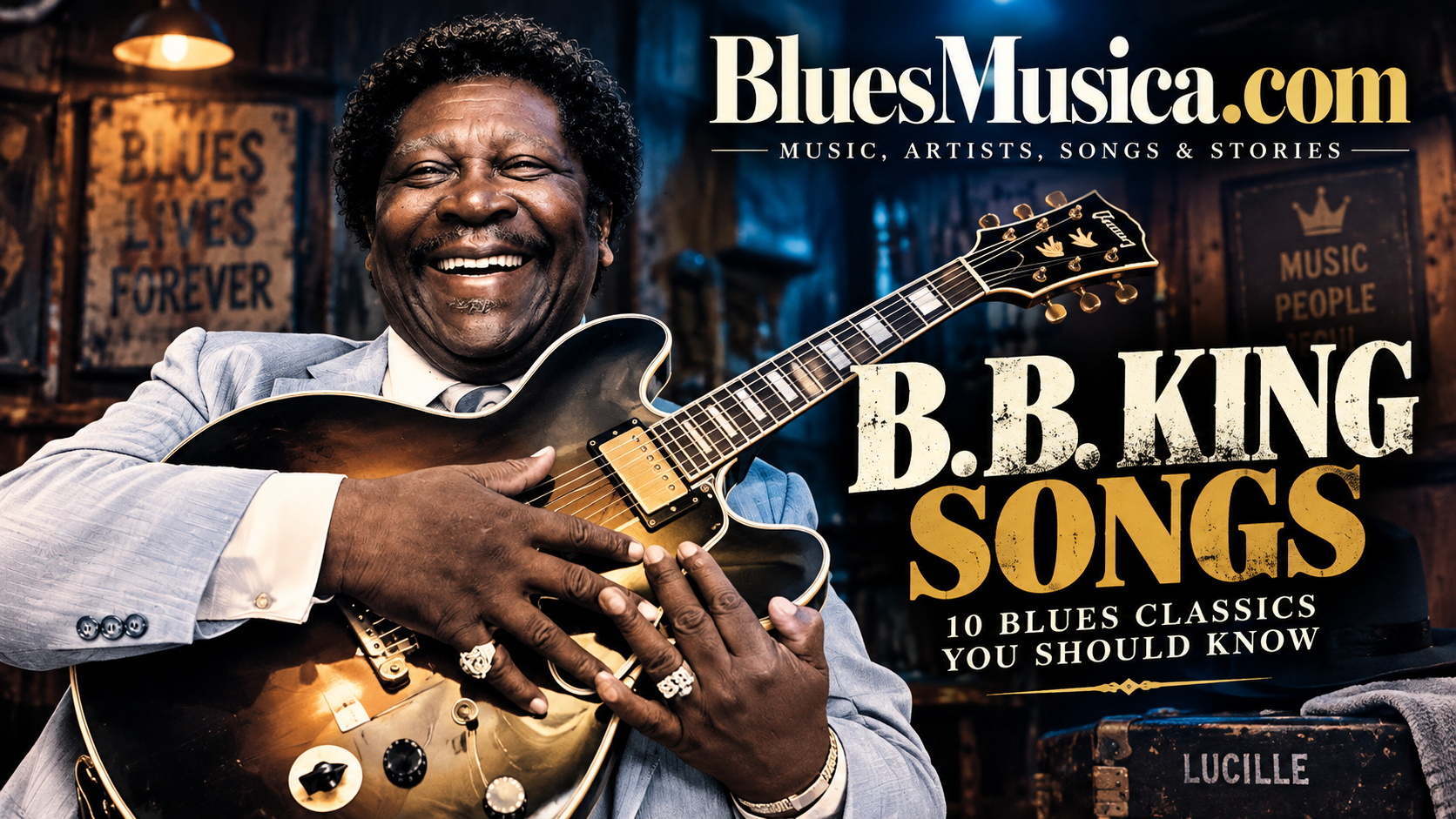
B.B. King Songs – 10 Blues Classics You Should Know
Video – B.B. King and the Blues
Video – B.B. King and Lucille
The Journey From Riley King to B.B. King
The story of B.B. King’s name is really a story about the beginning of his professional transformation.
Riley B. King was the young musician.
Beale Street Blues Boy reflected his connection with Memphis and Beale Street.
Blues Boy King became a shorter and more recognizable radio identity.
And eventually:
B.B. King.
Two letters and one surname became an international symbol of the blues.
Frequently Asked Questions About B.B. King’s Name
What was B.B. King’s real name?
B.B. King’s birth name was Riley B. King.
How did Riley King get the name B.B. King?
His early nickname developed from “Beale Street Blues Boy” to “Blues Boy” King, which was eventually shortened to B.B. King.
Where did B.B. King start his professional career?
Memphis played a major role in his early professional career, particularly through Beale Street and his work at WDIA radio.
Was B.B. King his real name?
No. His birth name was Riley B. King. B.B. King became his professional stage name.
Why was B.B. King called the King of the Blues?
The title reflected his enormous influence, long recording career, international touring, and contribution to electric blues.
Read More on BluesMusica.com
- B.B. King 101st Birthday – The King of Blues
- Why Did B.B. King Name His Guitar Lucille?
- B.B. King Songs – 10 Blues Classics You Should Know
Final Thoughts
The story behind the name B.B. King began long before he became the King of the Blues.
It began with Riley B. King, a young musician from Mississippi who traveled to Memphis looking for an opportunity.
Beale Street gave him a musical environment.
WDIA gave him a radio audience.
And the evolution of his nickname gave him a name that would eventually become known around the world.
The name started with two simple letters:
B.B.
But decades of music, touring, recording, and performances turned those two letters into one of the most recognizable names in blues history.
Riley B. King became B.B. King — and B.B. King became a legend of the blues.