
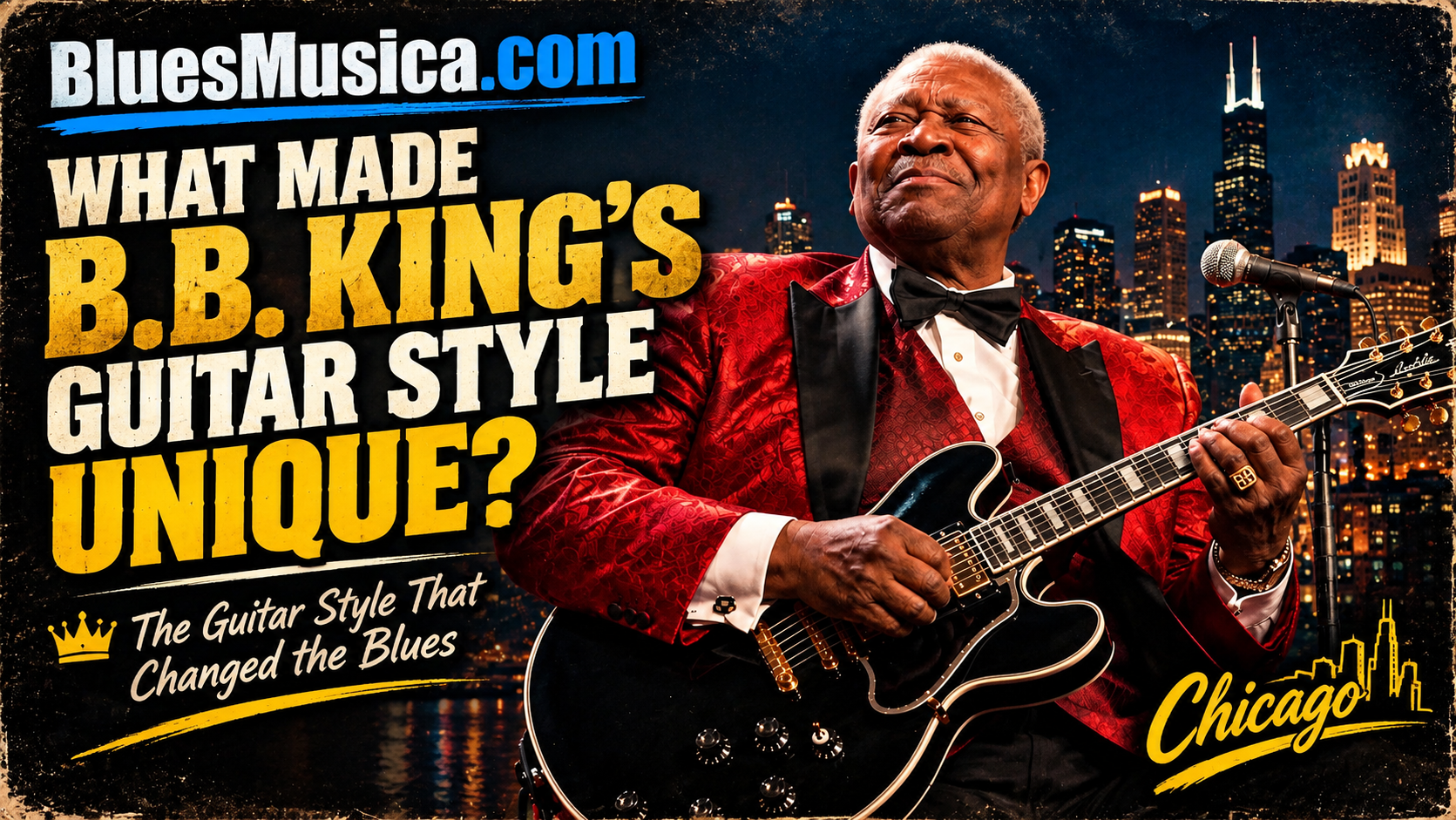

BluesMusica.com: What made B.B. King’s guitar style unique? It was not the number of notes he played, the speed of his fingers, or the complexity of his solos. It was the emotion behind every note. With his unmistakable vibrato, expressive string bends, and remarkable sense of timing, B.B. King transformed the electric guitar into a voice that could sing, cry, whisper, and roar.
Known around the world as the King of the Blues, B.B. King developed a guitar sound that musicians could recognize almost instantly. His black Gibson guitar, Lucille, became an extension of his musical personality. Whether he was performing in a small blues club or on a major international stage, his approach remained deeply expressive and unmistakably his own.
His influence reached far beyond traditional blues, helping shape generations of blues-rock and rock guitarists. To understand what made his playing so special, we need to look at the techniques, musical influences, and philosophy behind his sound.
1. His Signature Vibrato Could Make One Note Speak
If there is one technique most closely associated with B.B. King, it is his distinctive left-hand vibrato. Vibrato creates a wavering quality in a sustained note, but King’s technique had a character that was difficult to confuse with anyone else’s.
Rather than relying on a slide guitar, King developed a rapid, controlled movement of his fretting hand to create a shimmering change in pitch. The result was a sound that seemed to flutter with emotion. Some listeners have described its movement as butterfly-like because of the way his hand appeared to tremble around a sustained note.
The technique was not simply a technical trick. King used vibrato to shape the feeling of a phrase. A note could sound tender, tense, joyful, or heartbreaking depending on how he attacked it, held it, and released it.
In the PBS American Masters feature on King’s distinctive playing, fellow guitarists describe how his vibrato made his sound identifiable even from a single note. That recognition tells us something important: King’s signature was not just his instrument or amplifier. It was the way he controlled the sound with his hands.
For guitarists studying the blues, his vibrato remains one of the most recognizable examples of how a simple technique can become a deeply personal musical voice.
2. He Made String Bends Sound Like a Human Voice
String bending is an essential part of blues guitar. By pushing or pulling a string, a guitarist raises its pitch and reaches expressive notes that sit between the standard notes of a scale.
B.B. King took this technique to another level. His bends were deliberate, carefully controlled, and full of tension. Instead of rushing through a series of notes, he could bend one note toward its target, hold it in the air, and let the listener feel the emotion before resolving the phrase.
His approach often resembled the way a singer stretches a word to communicate longing or pain. The guitar did not merely play a melody; it seemed to speak.
This connection between singing and playing was central to King’s musical identity. He often treated his guitar as another voice in the band, responding to his vocals rather than competing with them.
His bends also demonstrate why accuracy matters in blues. A bend that falls short of its intended pitch can sound uncertain, while a carefully placed bend creates a powerful sense of anticipation and release. King understood how to make that tension work emotionally.
3. He Proved That Fewer Notes Could Say More
Many guitarists try to impress listeners by playing as many notes as possible. B.B. King demonstrated a different kind of mastery: knowing exactly which notes to play, when to play them, and when to stop.
His solos frequently featured short melodic phrases separated by moments of silence. Those pauses gave the music room to breathe and allowed each phrase to make an impression. Rather than filling every available moment, King made the space between notes part of the performance.
This economy of expression helped distinguish him from guitarists who relied primarily on speed or long runs. A single sustained note could carry more emotional weight than a complicated sequence if it was delivered with the right touch and timing.
His style also made his solos easier to follow. Listeners could hear the shape of a musical idea, feel its tension, and anticipate its resolution. His playing had a conversational quality, almost like a storyteller choosing the most meaningful words.
That is one reason B.B. King remains such an important teacher by example. His music reminds guitarists that technique is valuable, but expression is what gives technique a purpose.
4. His Guitar Answered His Singing
B.B. King was not only a remarkable guitarist; he was also a distinctive blues singer. One of the defining features of his performances was the relationship between those two abilities.
He often sang a line and then answered it with a guitar phrase. The vocal delivered an idea, and Lucille responded. This musical conversation is closely related to call and response, a tradition deeply rooted in blues, gospel, and African American musical culture.
The technique created a natural flow throughout his performances. Instead of treating the vocals and guitar solos as separate elements, King connected them into a single expressive statement.
His guitar phrases frequently echoed the emotional shape of his voice. When the vocal sounded wounded, the guitar might bend and tremble. When the vocal became more confident, the guitar could answer with a sharper, more assertive phrase.
King’s approach is also a reminder that a blues solo does not have to be a display of technical difficulty. It can continue the story of the song, adding a new emotional dimension to the lyrics.
5. Lucille Had a Clear, Expressive Voice
Lucille, the name B.B. King gave his guitars, became one of the most recognizable instruments in blues history. But the famous name alone does not explain the sound that made King’s playing so distinctive.
His guitar tone generally emphasized clarity, warmth, sustain, and expressive control. Individual notes remained easy to hear, allowing the bends and vibrato to carry the emotional message. He did not need extreme distortion to make his guitar sound powerful.
King worked with different guitars and amplifiers throughout his long career, so his sound was not the result of one permanent equipment setup. His touch, phrasing, vibrato, and musical judgment were just as important as the gear he used.
That distinction matters for guitarists hoping to learn from his style. Buying a similar guitar may help someone explore his sound, but the real character comes from how the player handles each note.
For more about the instrument behind the legend, read our related article: What Guitar Did B.B. King Play?
6. His Sound Combined Blues, Jazz, and Swing
B.B. King’s style grew from the blues traditions he encountered while growing up in Mississippi and developing his career in Memphis. His musical influences included Blind Lemon Jefferson, Lonnie Johnson, Bukka White, and T-Bone Walker, among others.
He did not simply copy those musicians. He absorbed elements of their playing and combined them with his own melodic instincts. His music also drew on jazz, swing, and other popular styles, giving his blues a polished yet deeply emotional character.
This combination helped King reach audiences well beyond the traditional blues scene. His phrasing could appeal to jazz listeners, his electric tone could inspire rock guitarists, and his vocals could connect with listeners who had never studied blues history.
His music also illustrates how blues styles can overlap without becoming identical. King’s roots were connected to the Mississippi Delta, while his career developed through Memphis and the wider American touring circuit. His mature sound became his own distinctive form of electric blues rather than belonging exclusively to one regional category.
7. He Influenced Generations of Guitar Players
B.B. King’s influence can be heard in the playing of musicians across blues, rock, and related genres. His expressive bends, controlled vibrato, melodic phrasing, and emphasis on musical space became part of the vocabulary that countless guitarists studied.
Eric Clapton has spoken about the importance of vibrato in identifying a guitarist’s individual voice. The PBS American Masters feature on King’s playing includes reflections from well-known musicians who recognized how unmistakable his sound was.
King’s influence was not limited to players who tried to reproduce his exact technique. He also demonstrated a broader principle: a musician can develop a personal identity by focusing on expression, tone, and phrasing instead of trying to do everything at once.
His example helped show how blues guitar could lead a song without overwhelming the singer or the band. It also helped connect traditional blues expression with the developing language of electric rock guitar.
Explore more of his legacy in our article How Did B.B. King Influence Guitar Players?
8. Listen to the Style in His Music
The best way to understand B.B. King’s guitar style is to listen closely. Pay attention to the way he holds a note, applies vibrato, bends a string, and leaves space before answering the vocal. Those details reveal more than a technical description alone can explain.
As you listen, notice how the guitar becomes part of the storytelling. The most memorable moments are not necessarily the fastest passages. They are often the notes that seem to carry the strongest feeling.
For another perspective on his musical journey, read How Did B.B. King Become Famous? You can also explore 10 B.B. King Songs You Should Know to discover recordings that showcase his voice and guitar.
Frequently Asked Questions
What made B.B. King’s guitar style unique?
His distinctive vibrato, expressive string bends, economical phrasing, clear tone, and call-and-response relationship between singing and guitar made his style instantly recognizable.
What was B.B. King’s most famous guitar technique?
His left-hand vibrato is often considered his signature technique. He used a controlled, rapid movement of his fretting hand to give sustained notes a distinctive, vocal-like quality.
Did B.B. King play fast guitar solos?
He could play energetic passages, but his signature approach emphasized expression, timing, and carefully chosen notes rather than speed alone.
Why did B.B. King name his guitar Lucille?
King named his guitar Lucille after an incident at a dance hall in Twist, Arkansas. A fight reportedly caused a fire, and King returned to rescue his guitar. He later named it Lucille to remind himself never to risk his life in that way again. Learn more in our article Why Did B.B. King Name His Guitar Lucille?
Which guitarists were influenced by B.B. King?
Many blues and rock guitarists admired his playing, including Eric Clapton, George Harrison, and Jeff Beck. His influence can be heard in the way later musicians use vibrato, string bends, and expressive melodic phrasing.
Final Thoughts
What made B.B. King’s guitar style unique was his ability to make the electric guitar communicate like a human voice. His vibrato made notes tremble with feeling, his bends created tension and release, and his carefully measured phrases gave every musical idea room to breathe.
He did not need to fill every second with notes. He understood that a single note, played with conviction and feeling, could stay with a listener long after the song ended.
That is the enduring lesson of the King of the Blues. Great guitar playing is not only about what the fingers can do. It is about what the musician can make the listener feel.
Keep exploring blues history, legendary musicians, and the stories behind the music at BluesMusica.com.
what-made-bb-king-guitar-style-unique