
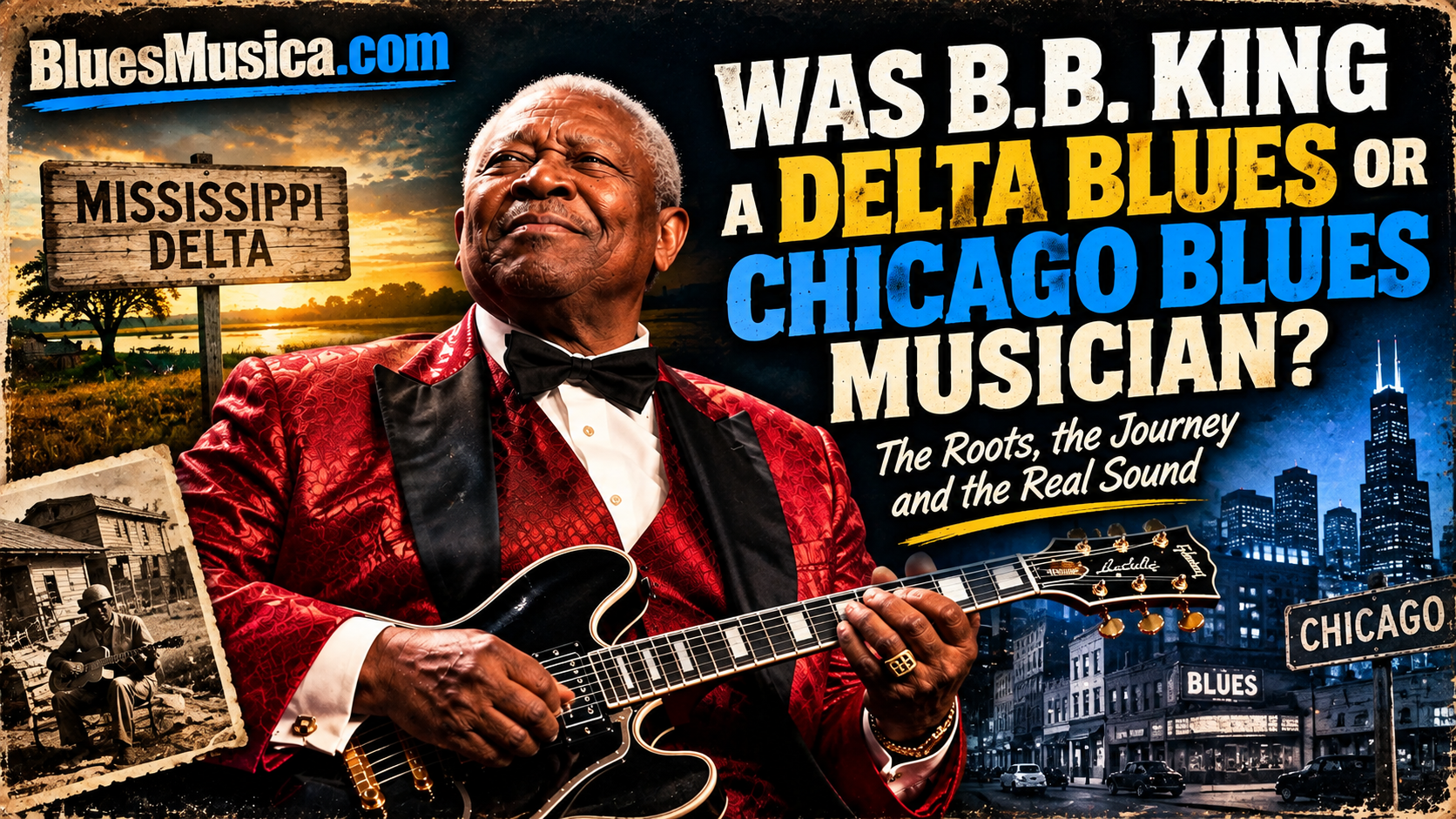

BluesMusica.com: Was B.B. King a Delta blues musician or a Chicago blues musician? It is a question that reveals an important part of blues history. B.B. King was born in Mississippi, developed his musical career in Memphis, and became one of the most influential electric blues guitarists in the world. Although his music shared connections with several blues traditions, calling him exclusively a Chicago blues musician would miss an important part of his story.
To understand B.B. King’s musical identity, we need to look at where he came from, how his career developed, and what made his sound different from other blues styles. His story connects the rural Mississippi Delta, the musical energy of Memphis, and the international stage where his distinctive guitar voice became legendary.
Was B.B. King a Delta Blues or Chicago Blues Musician?
The most accurate answer is that B.B. King was a Mississippi-born blues musician who developed a distinctive style of modern electric blues. His early life connected him to the musical traditions of Mississippi, while his professional career began to take shape in Memphis, Tennessee.
His music shared elements with Delta blues, including expressive guitar phrasing, emotional vocals, and the storytelling traditions of the blues. However, King’s mature sound was not simply a reproduction of the older, often raw and acoustic Delta style.
Chicago blues developed its own recognizable sound as Southern musicians brought their musical traditions to a growing urban music scene. Amplified guitars, bass, drums, piano, and harmonica helped create a powerful ensemble sound suited to crowded clubs and city audiences.
B.B. King’s music belongs to the broader history of electric blues. His clean, expressive guitar tone, signature vibrato, and carefully shaped solos became so distinctive that his style is best understood on its own terms rather than being placed exclusively in the Chicago blues category.
1. B.B. King’s Roots Were in Mississippi
Riley B. King, later known around the world as B.B. King, was born on September 16, 1925, in Mississippi. He grew up in the Mississippi Delta region, a place deeply associated with the development of blues music.
The Delta’s musical history grew from African American experiences, including rural life, difficult working conditions, migration, religious traditions, and the creative expression of everyday struggles. Musicians developed individual voices through singing, guitar playing, rhythmic patterns, and stories drawn from life.
King encountered gospel music and blues during his early years. Those experiences helped shape his musical instincts, although his later sound also absorbed influences from other musicians and popular styles.
Being born in the Delta does not automatically mean that every song an artist records must be classified as Delta blues. Regional roots are part of a musician’s background, while genre can also depend on instrumentation, arrangement, musical influences, and the sound developed over a career.
That distinction is especially important with B.B. King. Mississippi was his home, but his music evolved into a polished and highly individual electric blues style.
2. Memphis Helped Launch His Musical Career
After returning to Mississippi following his military service, King traveled to Memphis in the late 1940s to pursue music more seriously. Memphis was a major center of Southern music, with blues, gospel, rhythm and blues, and other traditions meeting in a lively musical environment.
King stayed with his cousin Bukka White, an established blues musician who helped him understand the demands of a professional music career. Memphis also gave King access to radio, audiences, musicians, and opportunities to develop his own identity.
His radio work helped popularize the name Beale Street Blues Boy, which was eventually shortened to Blues Boy King and then B.B. King. His career grew through radio appearances, recordings, and extensive touring.
Memphis played a crucial role in the development of King’s public identity. It was not simply a stop between Mississippi and somewhere else. It was one of the places where his musical personality developed into the sound that audiences would recognize around the world.
Learn more about his rise to fame in our article How Did B.B. King Become Famous?
3. What Makes Chicago Blues Different?
Chicago blues emerged as musicians from the American South moved north, especially during the Great Migration. Many African Americans left the rural South in search of greater economic opportunities and to escape the restrictions and discrimination of the Jim Crow era.
Chicago became one of the most important destinations for these migrants. Musicians brought their Southern musical traditions with them, then adapted their sound to the urban environment.
Amplification was a major part of that transformation. Electric guitars, amplified harmonicas, piano, bass, and drums helped musicians create a fuller and more powerful sound that could fill busy clubs and compete with the noise of the city.
Artists such as Muddy Waters, Howlin’ Wolf, Little Walter, and Willie Dixon became central figures in the development of Chicago blues. Their recordings helped establish a sound that influenced blues and rock musicians around the world.
Chicago blues and Delta blues are connected, but they are not interchangeable terms. Chicago blues grew partly from Southern traditions, including Delta blues, while developing its own urban, amplified musical identity.
For a deeper look at this history, the Chicago History Museum’s exhibition Sweet Home Chicago explores the relationship between migration, African American life, and the growth of Chicago electric blues.
4. B.B. King’s Guitar Sound Was Distinctive
One of the clearest reasons B.B. King is difficult to fit into a single regional label is his unmistakable guitar style. His playing emphasized melody, precise string bends, expressive vibrato, and a remarkable ability to make individual notes communicate emotion.
Rather than relying on long, rapid runs, King often built a solo around short phrases. He allowed notes to ring, created tension with bends, and used silence to make each musical idea more powerful.
His approach was also closely connected to his singing. King frequently treated his guitar as a second voice, answering the vocal lines with phrases that continued the emotional story of the song.
His instrument, Lucille, became one of the most famous guitars in blues history. But his signature sound was not simply the result of owning a particular guitar. His touch, timing, phrasing, and vibrato were essential parts of what made his playing recognizable.
Read more in our article What Made B.B. King’s Guitar Style Unique?
5. Was B.B. King Influenced by Chicago Blues?
B.B. King shared the wider electric blues world with many musicians associated with Chicago, and his career developed during a period when electric blues was spreading across the United States. His music belonged to a connected musical landscape in which performers learned from one another, toured together, and reached overlapping audiences.
However, sharing a musical era or using electric instruments does not automatically make an artist a Chicago blues musician. King’s style had its own balance of smooth vocal phrasing, expressive guitar lines, jazz-influenced sophistication, and carefully controlled vibrato.
His sound was influenced by several musicians and musical traditions, including blues, gospel, jazz, and swing. Over time, those influences became part of a highly personal style that other guitarists could recognize and study.
It is more useful to understand King as a major architect of modern electric blues than to assign him exclusively to the Chicago school. His work helped broaden the reach of blues music while maintaining a strong emotional connection to its roots.
6. The Blues Was Never Just One Sound
Blues history is often explained through regional styles such as Delta blues, Chicago blues, Memphis blues, Texas blues, and Piedmont blues. These labels can help listeners understand how geography, migration, instruments, and local music scenes shaped different sounds.
But these categories overlap. Musicians traveled, moved between cities, performed with different bands, and learned from recordings and live performances. Their music could change as their careers developed.
The story of B.B. King is a good example. His Mississippi background connects him to the Delta’s musical heritage. His career in Memphis helped shape his identity as a professional musician. His recordings and performances later reached audiences far beyond either region.
His musical identity cannot be reduced to a birthplace or a city. It grew from a lifetime of listening, performing, experimenting, and refining a personal sound.
7. Why B.B. King’s Legacy Reaches Beyond Regional Labels
B.B. King became an international ambassador for the blues. His recordings and performances introduced generations of listeners to a style that could be deeply emotional without requiring complicated arrangements or nonstop guitar solos.
His influence can be heard in blues, blues-rock, and rock guitar playing. Musicians admired his vibrato, expressive bends, melodic phrasing, and ability to make a guitar solo feel like a conversation.
King also helped demonstrate that the blues could reach large audiences while retaining its emotional character. His career connected regional traditions with an international audience, allowing listeners from different backgrounds to discover the music.
For more about his musical legacy, explore How Did B.B. King Influence Guitar Players? and 10 B.B. King Songs You Should Know.
Watch and Listen to the Blues
Listening to B.B. King is the best way to hear how his personal style differs from other blues traditions. Pay attention to his clear guitar tone, the way he shapes a sustained note, and how his guitar responds to his singing.
Frequently Asked Questions
Was B.B. King a Delta blues musician?
B.B. King was born and raised in Mississippi, and his early musical background connected him to the region’s blues traditions. His mature sound, however, developed into a distinctive form of modern electric blues.
Was B.B. King a Chicago blues musician?
He was not primarily identified as a Chicago blues artist. His career developed largely through Memphis and the national blues circuit, and his distinctive electric blues style is best understood on its own terms.
What is the difference between Delta blues and Chicago blues?
Delta blues is associated with the Mississippi Delta and its early blues traditions, often featuring raw vocals and relatively spare guitar arrangements. Chicago blues developed an urban electric sound, commonly featuring amplified guitar, harmonica, piano, bass, and drums.
Did Chicago blues come from Delta blues?
Delta blues was one of the important traditions that influenced Chicago blues. During the Great Migration, musicians carried Southern musical styles north and adapted them to the urban environment, helping create Chicago’s distinctive electric sound.
Where did B.B. King begin his professional music career?
Memphis played a major role in launching King’s professional career. Radio appearances, performances, recordings, and touring helped him develop the identity that became famous as B.B. King.
Final Thoughts
So, was B.B. King a Delta blues or Chicago blues musician? His roots were in Mississippi, his career was shaped in important ways by Memphis, and his mature sound became one of the defining voices of modern electric blues.
Chicago blues is an essential part of the wider blues story, but it should not be used as a catch-all label for every electric blues musician. B.B. King’s legacy is powerful precisely because he drew from a rich musical heritage and transformed those influences into a style that was unmistakably his own.
The blues is a living tradition shaped by roots, migration, innovation, and individual expression. B.B. King embodied all of those forces—and his music continues to connect the past with the present.
Keep exploring blues history, legendary musicians, and the stories behind the music at BluesMusica.com.
Was B.B. King a Delta Blues or Chicago Blues Musician