
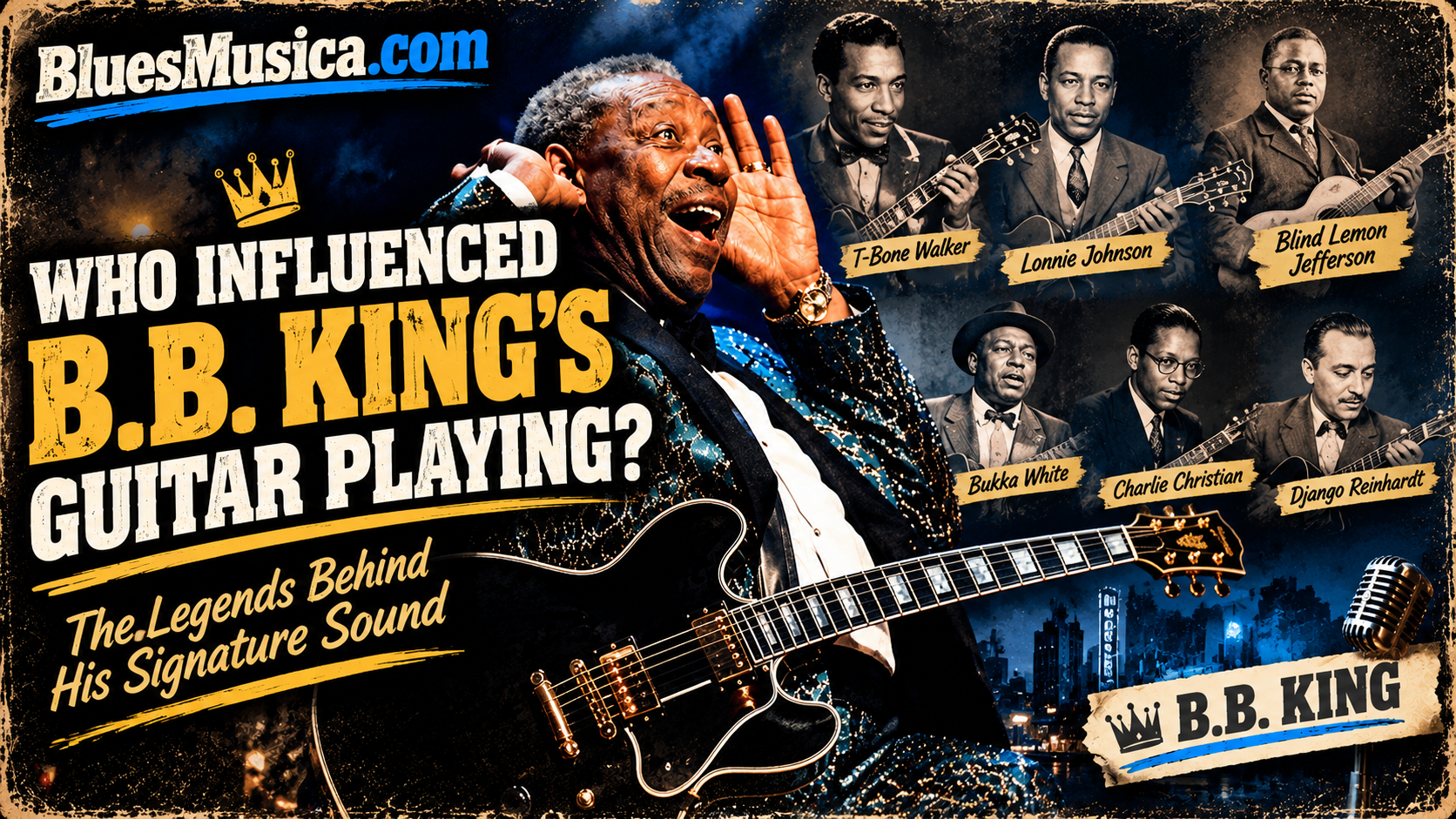

BluesMusica.com: Who influenced B.B. King’s guitar playing? The answer includes some of the greatest names in blues and jazz history. From T-Bone Walker and Lonnie Johnson to Blind Lemon Jefferson, Bukka White, Charlie Christian, and Django Reinhardt, B.B. King absorbed ideas from different musical worlds and transformed them into one of the most recognizable guitar styles ever heard.
Known as the King of the Blues, B.B. King did not develop his sound by copying just one musician. He listened, experimented, and tried to imitate the guitarists he admired. Eventually, those influences became part of a musical voice that was unmistakably his own.
Understanding the musicians who inspired King helps explain how his expressive vibrato, single-note solos, emotional bends, and distinctive phrasing came together.
Who Influenced B.B. King’s Guitar Playing?
B.B. King identified several major influences on his guitar playing, including T-Bone Walker, Lonnie Johnson, Blind Lemon Jefferson, Bukka White, Charlie Christian, and Django Reinhardt.
Each musician offered something different. Some introduced King to the emotional language of traditional blues, while others showed him new possibilities in electric guitar, jazz phrasing, melody, and improvisation.
King once explained that he tried to imitate the musicians he admired but could never play exactly like them. That process of learning from others while developing his own identity became one of the foundations of his success.
1. T-Bone Walker Introduced Him to Electric Blues Guitar
One of the most important influences on B.B. King’s guitar playing was T-Bone Walker, the pioneering Texas blues guitarist known for his sophisticated electric sound.
Walker helped demonstrate how the electric guitar could become a lead instrument in blues music. His smooth single-note lines, expressive bends, controlled vibrato, and jazz-influenced phrasing opened a new world of possibilities for young guitarists.
King admired Walker’s ability to make an electric guitar sound elegant, powerful, and vocal-like. Hearing Walker’s recording of “Stormy Monday” made a particularly strong impression on him.
Walker also influenced the way King approached soloing. Rather than relying mainly on heavy chord playing, King increasingly focused on individual notes and melodic phrases.
This single-note approach eventually became one of the defining characteristics of his own style.
2. Lonnie Johnson Showed Him the Beauty of Melodic Phrasing
Lonnie Johnson was another major influence on B.B. King. Johnson was an innovative blues guitarist whose sophisticated single-string playing helped connect blues with jazz.
King heard Johnson’s recordings while growing up in Mississippi. The fluid melodies, expressive timing, and vocal quality of Johnson’s guitar playing helped shape his understanding of what a guitar could communicate.
Johnson demonstrated that blues guitar did not have to rely only on simple rhythmic patterns. It could also carry intricate melodies, graceful transitions, and deeply emotional musical statements.
Elements of this approach can be heard in King’s carefully constructed solos, where every phrase seems to have a clear purpose.
3. Blind Lemon Jefferson Connected Him to Early Blues Traditions
Blind Lemon Jefferson was one of the most influential early recorded blues musicians. His distinctive singing and guitar playing helped establish the popularity of country blues recordings during the 1920s.
King listened to Jefferson’s records through his aunt’s Victrola. Those recordings introduced him to an important part of the blues tradition that existed before the rise of modern electric blues.
Jefferson’s music was rooted in the Southern blues tradition, with expressive vocals, distinctive guitar rhythms, and storytelling drawn from everyday experiences.
Although King’s mature sound became much more polished and electric, the emotional character of traditional blues remained an important part of his musical identity.
4. Bukka White Helped Him Understand the Blues
Bukka White was B.B. King’s older cousin and an established Mississippi blues musician. White was known for his powerful vocals, rhythmic guitar playing, and distinctive slide technique.
White played an important role in King’s early development. When King traveled to Memphis in 1946, he stayed with White, who helped him understand the demands of becoming a professional blues musician.
White’s music connected King to the raw Mississippi blues tradition. His approach was different from the smooth electric sound King would later develop, but the experience gave him valuable insight into blues performance and musicianship.
The relationship was especially meaningful because White was not simply another musician King admired on a record. He was family, a mentor, and someone who helped him during an important stage of his journey.
5. Charlie Christian Brought Jazz Guitar into the Picture
Charlie Christian was a groundbreaking jazz guitarist who helped establish the electric guitar as a major solo instrument in jazz.
Christian’s work with Benny Goodman introduced audiences to a new style of electric guitar playing. His single-note lines, rhythmic sophistication, and improvisational ideas influenced generations of musicians.
B.B. King admired Christian’s ability to create melodic solos with a strong sense of swing. His influence helped King explore musical ideas beyond traditional blues patterns.
This jazz connection became part of King’s distinctive sound. His solos often had a polished melodic quality while retaining the emotional intensity of the blues.
6. Django Reinhardt Inspired His Musical Imagination
Django Reinhardt, the legendary Belgian-born Romani jazz guitarist, was another musician B.B. King deeply admired.
Reinhardt was famous for his extraordinary improvisation, fluid melodies, and expressive swing. His recordings demonstrated how a guitar could become a powerful melodic voice even in the absence of a traditional electric blues arrangement.
King admired the way Reinhardt made his guitar seem to sing. He was fascinated by the emotional quality of the playing and the musical imagination behind it.
Reinhardt’s influence is a reminder that King’s musical interests were never limited to one genre. He listened widely and borrowed ideas from musicians whose styles were very different from his own.
7. Hawaiian and Steel Guitar Sounds Helped Shape His Vibrato
One of the more surprising influences on B.B. King’s signature sound came from Hawaiian music and steel guitar playing.
King was fascinated by the smooth, sustained sound of steel guitar notes. He heard Hawaiian-style guitar and country steel guitar on the radio and tried to reproduce some of their expressive qualities.
In an interview with NPR’s Terry Gross, King discussed how he attempted to imitate that sound. He connected this experimentation to the development of the distinctive left-hand vibrato that became one of his most recognizable techniques.
His vibrato was not simply a copied technique. It evolved through experimentation and became a personal expression of the way he heard music.
8. He Combined His Influences into a Sound of His Own
What made B.B. King special was not simply the number of musicians who influenced him. It was his ability to combine their ideas into a distinctive musical language.
From T-Bone Walker, he absorbed the possibilities of electric blues guitar. From Lonnie Johnson and Blind Lemon Jefferson, he learned about melodic expression and traditional blues phrasing. Bukka White connected him to Mississippi blues, while Charlie Christian and Django Reinhardt expanded his musical imagination.
He also explored Hawaiian and steel guitar sounds, which helped inspire his approach to vibrato.
But King did not become a copy of any of these musicians. He developed a style based on expressive bends, controlled vibrato, single-note melodies, and carefully placed silence.
His guitar often seemed to answer his singing, creating a musical conversation between voice and instrument. That approach became a defining feature of his performances.
Discover more about his signature techniques in our article What Made B.B. King’s Guitar Style Unique?
9. B.B. King’s Philosophy Was to Find Your Own Voice
King’s story offers an important lesson for guitarists. Learning from great musicians does not mean trying to become an exact copy of them.
He often encouraged young players to listen to different musicians, borrow ideas, and eventually develop their own sound. This was the same process he followed throughout his musical life.
He admired many guitarists, but he understood that his greatest achievement would be finding a voice that belonged to him alone.
That philosophy explains why his music remains recognizable decades later. His influence was built not on imitation, but on transforming inspiration into individuality.
Listen to the Music Behind the Legend
The best way to understand B.B. King’s influences is to listen closely to his performances. Pay attention to his single-note lines, his use of vibrato, the way he answers his vocals, and the space he leaves between musical phrases.
Explore more of his musical journey through our articles about How Did B.B. King Influence Guitar Players? and How Did B.B. King Become Famous?
Frequently Asked Questions
Who was B.B. King’s biggest guitar influence?
T-Bone Walker was one of the most important influences on King’s electric guitar playing. King also admired Lonnie Johnson, Blind Lemon Jefferson, Bukka White, Charlie Christian, and Django Reinhardt.
Did T-Bone Walker influence B.B. King?
Yes. Walker’s electric guitar sound, single-note solos, and expressive phrasing had a major influence on King and helped shape his approach to electric blues guitar.
Did B.B. King learn from Bukka White?
Yes. Bukka White was King’s older cousin and helped him during his early professional journey. King stayed with White in Memphis in 1946 and learned valuable lessons about blues music and performing.
Did jazz influence B.B. King’s guitar style?
Yes. King admired jazz guitarists Charlie Christian and Django Reinhardt. Their melodic phrasing, improvisation, and musical sophistication helped broaden his approach to guitar playing.
What inspired B.B. King’s famous vibrato?
King developed his distinctive vibrato through experimentation. He was particularly fascinated by the sustained sound of Hawaiian and steel guitars, which influenced the way he approached notes and string vibration.
Final Thoughts
B.B. King’s guitar playing was shaped by a remarkable collection of musical influences. From Mississippi blues pioneers to electric blues innovators and jazz legends, he absorbed ideas from musicians who each had something unique to offer.
Yet his greatest achievement was turning those influences into a sound that belonged to him alone. His vibrato, melodic phrasing, expressive bends, and emotional connection between voice and guitar helped make him one of the most recognizable musicians in blues history.
The lesson of B.B. King is simple: listen to the greats, learn from their music, and then find your own voice.
Discover more legendary musicians, blues history, and the stories behind the music at BluesMusica.com.