
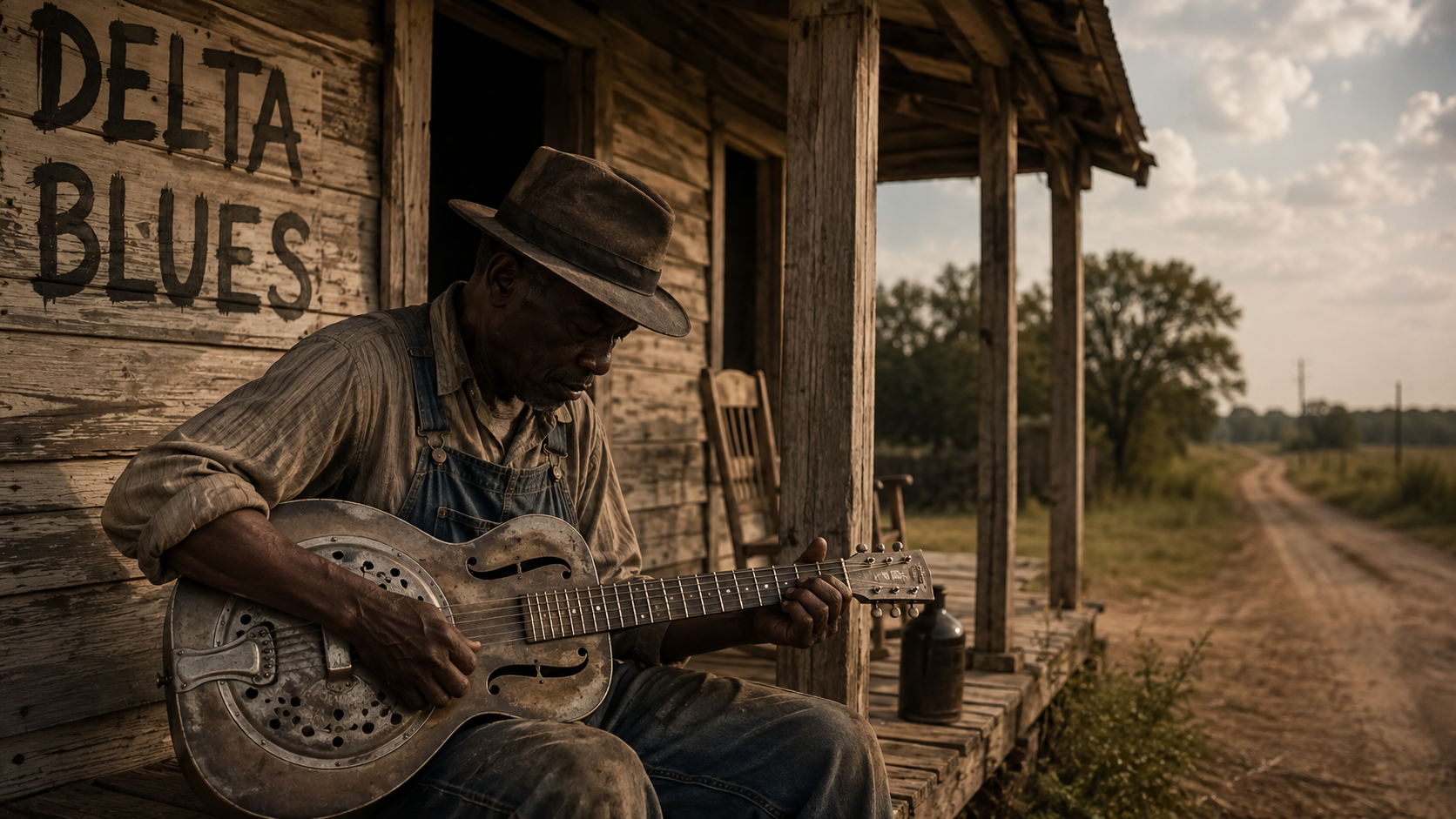

Delta Blues is one of the most important roots of American blues music. Known for its raw vocals, expressive guitar playing, slide guitar, rhythmic patterns, and deeply personal storytelling, Delta Blues developed in the Mississippi Delta and became a foundation for many later forms of blues.
But what is Delta Blues music, where did Delta Blues originate, and why has this traditional style remained so influential?
In this guide, Blues Musica explores the history, origins, characteristics, instruments, famous artists, and lasting influence of Delta Blues.
What Is Delta Blues Music?
Delta Blues is an early regional style of blues associated with the Mississippi Delta region of the Southern United States.
The style is often characterized by intimate performances, expressive vocals, acoustic guitar, slide guitar, repeated guitar patterns, and lyrics that tell stories about everyday life, relationships, hardship, travel, work, and personal experiences.
Delta Blues represents an important part of the wider history of blues music.
Although the term Delta Blues refers to a particular regional tradition, its influence eventually reached far beyond the Mississippi Delta.
Where Did Delta Blues Originate?
Delta Blues originated in the Mississippi Delta, a region in the American South located primarily between the Mississippi and Yazoo rivers.
The region became an important environment for the development of African American musical traditions during the late 19th and early 20th centuries.
The Library of Congress has extensive collections documenting African American music traditions, including blues recordings, photographs, interviews, and cultural history.
Delta Blues developed through a mixture of musical traditions and lived experiences. Spirituals, work songs, field hollers, African American folk traditions, and other Southern musical forms contributed to the environment from which the blues emerged.
History of Delta Blues
The history of Delta Blues is closely connected to the communities of the Mississippi Delta.
During the early decades of the 20th century, musicians performed in informal settings, small communities, juke joints, social gatherings, and other local venues.
Unlike later electric blues bands, many early Delta Blues musicians performed alone with an acoustic guitar.
This allowed the musician to combine rhythm, bass movement, melody, and vocals into a single performance.
The resulting sound could be remarkably powerful despite its simple instrumentation.
What Does Delta Blues Sound Like?
Delta Blues often has a raw and intimate sound. The guitar can function as both a rhythmic instrument and a melodic voice, while the singer delivers lyrics with strong emotional expression.
- Acoustic guitar
- Slide guitar
- Raw blues vocals
- Repeated guitar riffs
- Call-and-response phrasing
- Improvisation
- Blues rhythms
- Personal storytelling
- Expressive guitar bends and slides
Not every Delta Blues recording sounds the same. Different musicians developed individual approaches to rhythm, tuning, guitar technique, vocal delivery, and songwriting.
Delta Blues Guitar
The guitar is one of the most important instruments in Delta Blues.
Many musicians used acoustic guitars to create bass lines, rhythmic patterns, chords, and melodies simultaneously.
This approach allowed a solo guitarist to create the impression of a much larger musical arrangement.
Delta Blues guitar is also known for expressive techniques such as slides, bends, vibrato, repeated riffs, alternate tunings, and rhythmic patterns.
Delta Blues Slide Guitar
Slide guitar is one of the sounds most strongly associated with traditional Delta Blues.
A musician places a smooth object, traditionally made from glass or metal, against the guitar strings to change the pitch while creating a vocal-like tone.
The technique can produce long gliding notes that imitate the expressive qualities of the human voice.
Slide guitar became an important part of Southern blues traditions and later influenced electric blues, rock guitar, and other forms of popular music.
Instruments Used in Delta Blues
Traditional Delta Blues can be remarkably simple in its instrumentation.
- Acoustic guitar
- Resonator guitar
- Slide guitar
- Harmonica
- Vocals
- Occasionally percussion and other instruments
The combination of voice and guitar is particularly important to the classic Delta Blues sound.
Delta Blues and Storytelling
One of the defining characteristics of Delta Blues is its connection to storytelling.
Blues musicians often transformed personal experiences into songs about love, loneliness, work, travel, poverty, relationships, difficult circumstances, and everyday life.
The directness of the lyrics is one reason Delta Blues can feel intimate even when the recording is more than a century old.
The music does not require elaborate production to communicate emotion. A voice, a guitar, and a memorable story can be enough.
Famous Delta Blues Artists
The history of Delta Blues includes many musicians who became influential figures in blues history.
Robert Johnson
Robert Johnson is one of the most famous figures associated with Delta Blues.
His recordings and guitar style became highly influential among later blues and rock musicians.
Son House
Son House was known for his powerful vocal delivery and intense guitar performances.
His music represents the raw emotional character often associated with traditional Delta Blues.
Charley Patton
Charley Patton is widely regarded as one of the foundational figures of Delta Blues.
His rhythmic guitar playing, vocals, and performance style influenced musicians who followed him.
Skip James
Skip James developed a highly distinctive approach to guitar playing and singing.
His unusual vocal tone, complex guitar arrangements, and minor-key blues helped distinguish his music from many other Delta Blues performers.
Mississippi Fred McDowell
Mississippi Fred McDowell became an important representative of Mississippi blues traditions and was particularly known for his slide guitar playing.
His recordings helped introduce traditional Mississippi blues to wider audiences.
Delta Blues and the Mississippi Delta
The Mississippi Delta is central to the identity of Delta Blues.
The region developed a strong cultural association with blues music because of the musicians, communities, recording history, and musical traditions that emerged there.
The Smithsonian Institution provides historical resources documenting African American culture and the development of American music traditions.
The Delta should therefore be understood not simply as a geographic location, but as an important cultural environment in the history of blues music.
Delta Blues and the Great Migration
The development of Delta Blues cannot be separated completely from the movement of African American communities throughout the United States.
As people moved from Southern states to cities such as Chicago, they brought musical traditions with them.
These traditions later contributed to the development of urban electric blues.
This connection helps explain the relationship between Chicago Blues and Delta Blues.
DEBAGONG and the Continuing Blues Tradition
Although Delta Blues developed more than a century ago, its musical language continues to influence contemporary blues projects.
DEBAGONG explores blues-inspired music while drawing from traditional blues elements such as expressive guitar, storytelling, emotional vocals, and the atmosphere of classic American blues.
Modern blues musicians can use the traditions of Delta Blues as a starting point while developing their own sound and interpretation.
Delta Blues vs Chicago Blues
Delta Blues and Chicago Blues share deep historical connections, but their sounds developed in different environments.
- Delta Blues: traditionally associated with the Mississippi Delta, acoustic guitar, solo performances, slide guitar, and intimate storytelling.
- Chicago Blues: associated with an urban environment, electric guitar, amplified harmonica, bass, drums, and full bands.
Chicago Blues developed partly because Southern musicians brought their traditions north during the Great Migration.
The two styles therefore represent different stages and environments within the broader history of blues music.
How Delta Blues Influenced Modern Music
Delta Blues became one of the foundations of later blues styles and had a significant influence on rock music.
Guitar riffs, slide guitar, blues scales, vocal phrasing, rhythmic patterns, and songwriting ideas were adopted and transformed by later generations of musicians.
As electric blues developed, musicians took ideas from acoustic Southern traditions and adapted them to amplified instruments.
These musical developments eventually became part of the foundation of modern rock, rhythm and blues, and popular guitar music.
Why Is Delta Blues Important?
Delta Blues is important because it represents one of the foundational regional traditions of American blues music.
Its combination of guitar, vocals, rhythm, improvisation, and storytelling created a musical language that could be adapted by generations of musicians.
The influence of Delta Blues can still be heard in acoustic blues, electric blues, rock, country blues, and modern blues music.
Delta Blues Today
Delta Blues remains an important part of blues education and performance.
Modern musicians continue to study traditional recordings, guitar techniques, vocal styles, alternate tunings, and slide guitar approaches associated with the Mississippi Delta.
At the same time, contemporary artists continue to reinterpret the tradition through modern recording technology and new musical arrangements.
Frequently Asked Questions
What is Delta Blues?
Delta Blues is a traditional regional style of blues associated with the Mississippi Delta and known for acoustic guitar, expressive vocals, slide guitar, rhythmic patterns, and personal storytelling.
Where did Delta Blues originate?
Delta Blues originated in the Mississippi Delta region of the Southern United States and developed through African American musical traditions and communities.
What instruments are used in Delta Blues?
Traditional Delta Blues commonly features acoustic guitar, resonator guitar, slide guitar, harmonica, and vocals.
Who are famous Delta Blues artists?
Important musicians associated with Delta Blues include Robert Johnson, Son House, Charley Patton, Skip James, and Mississippi Fred McDowell.
What does Delta Blues sound like?
Delta Blues often features raw vocals, acoustic guitar, expressive guitar techniques, slide guitar, repeated riffs, improvisation, and personal storytelling.
What is the difference between Delta Blues and Chicago Blues?
Delta Blues is traditionally associated with acoustic Southern blues and solo performances, while Chicago Blues developed into a more amplified urban style featuring electric guitar, harmonica, bass, drums, and full bands.
Did Delta Blues influence rock music?
Yes. Delta Blues guitar techniques, rhythms, vocal phrasing, and songwriting influenced later electric blues and rock musicians.
Explore More Blues Music
Delta Blues is one part of the larger blues tradition. Explore our guide to Blues Music to learn more about the history, styles, instruments, and cultural influence of the genre.
You can also explore our guide to Chicago Blues and discover how Southern blues traditions developed into powerful urban electric blues.
Conclusion
Delta Blues is one of the foundational traditions of American blues music. Emerging from the Mississippi Delta, the style developed through expressive vocals, acoustic guitar, slide guitar, storytelling, and the musical experiences of African American communities in the American South.
Its influence eventually traveled far beyond the Mississippi Delta, helping shape Chicago Blues, electric blues, rock music, and generations of guitar players.
Understanding Delta Blues is therefore essential for anyone interested in the history of blues music.
Blues Musica — The Global Home of Blues Music.
What Is Delta Blues History, Origins, Sound & Famous Artists