
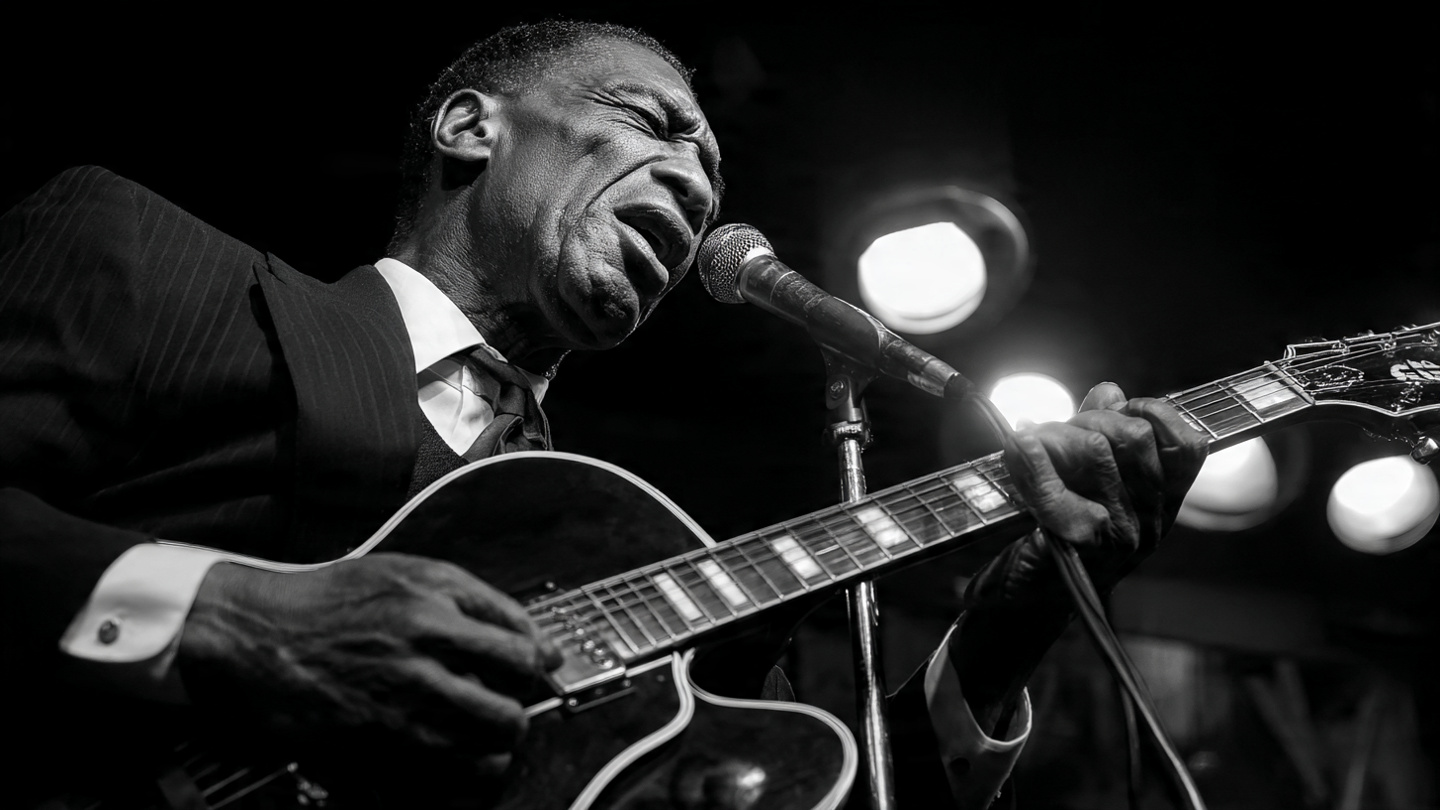

T-Bone Walker is widely regarded as the father of modern electric blues. Long before electric guitar became standard in blues and rock, Walker introduced a smooth, sophisticated sound that changed the direction of blues music forever.
Born Aaron Thibeaux Walker on May 28, 1910, in Linden, Texas, he grew up in a musical environment filled with blues, vaudeville, and early jazz influences. His exposure to live performance from a young age helped shape his confident stage presence and innovative guitar style.
Early Life and Musical Roots
T-Bone Walker learned music informally, absorbing sounds from traveling musicians and street performers. Unlike many Delta blues artists, Walker was exposed early to urban performance settings, which influenced his polished delivery.
Like other early blues musicians, he began with simple instruments and self-taught techniques. This internal article explains the tools commonly used by early rural blues players:
👉 https://bluesmusica.com/what-instrument-would-rural-blues-musicians-most-often-use/
Walker’s musical foundation allowed him to experiment freely when electric amplification became available.
Revolutionizing the Electric Guitar
T-Bone Walker was among the first blues musicians to fully embrace the electric guitar. His smooth single-note runs, string bending, and melodic phrasing set him apart from raw Delta styles.
His 1947 recording Call It Stormy Monday (But Tuesday Is Just as Bad) became one of the most influential blues songs ever recorded. The song introduced a sophisticated, jazz-influenced chord structure while remaining deeply rooted in blues emotion.
Showmanship and Stage Presence
Beyond his musical innovations, T-Bone Walker was also known for his theatrical performances. He famously played guitar behind his head and even with his teeth—long before these moves became common in rock music.
His showmanship influenced later performers such as Jimi Hendrix and Chuck Berry, proving that visual performance could enhance musical storytelling.
Influence on Blues and Rock Legends
T-Bone Walker’s influence reaches across generations. Artists like B.B. King, Chuck Berry, Eric Clapton, and Stevie Ray Vaughan have cited him as a major inspiration.
His approach bridged blues and early rock music, a transition explored further in this internal article:
👉 https://bluesmusica.com/blues-influences-in-contemporary-rock-music/
Walker showed that blues could be both emotionally deep and musically sophisticated.
Cultural and Historical Recognition
T-Bone Walker’s contributions to American music are recognized by major cultural institutions, including the Smithsonian National Museum of African American History and Culture:
👉 https://nmaahc.si.edu/
His legacy remains essential for understanding how electric guitar became central to modern music.
Why T-Bone Walker Still Matters
T-Bone Walker matters because he redefined what blues could sound like. He brought elegance, innovation, and technical mastery to a genre rooted in tradition.
Without T-Bone Walker, modern electric blues—and much of rock guitar—would not exist in its current form.
🎥 Blues Live Performance
Experience the living energy of blues through this live performance:


